From mild recession to advanced baldness — identify your exact Norwood stage, get graft counts, real 2026 costs in rupees, and donor limits. Doctor-reviewed.
From mild recession to advanced baldness — identify your exact Norwood stage, get graft counts, real 2026 costs in rupees, and donor limits. Doctor-reviewed.
Norwood 2 typically needs 500 to 1,500 grafts, most often around 800 to 1,200 for hairline refinement plus temple points. In India this costs roughly ₹40,000 to ₹1,35,000 depending on technique. However, most Norwood 2 patients are not yet surgical candidates — a mature hairline is normal, not balding.
Stages 1–2 rarely need surgery; medication is the correct first step
Stage 3 is the first stage most surgeons treat as clearly surgical
Stages 6–7 almost always need multiple sessions and cannot achieve full teenage density
Type A variants (2A–5A) affect 15–20% of men and need a different graft distribution
Donor supply, not money, is the real ceiling — plan every session around it
The Norwood scale does not measure diffuse thinning, which is a common misdiagnosis
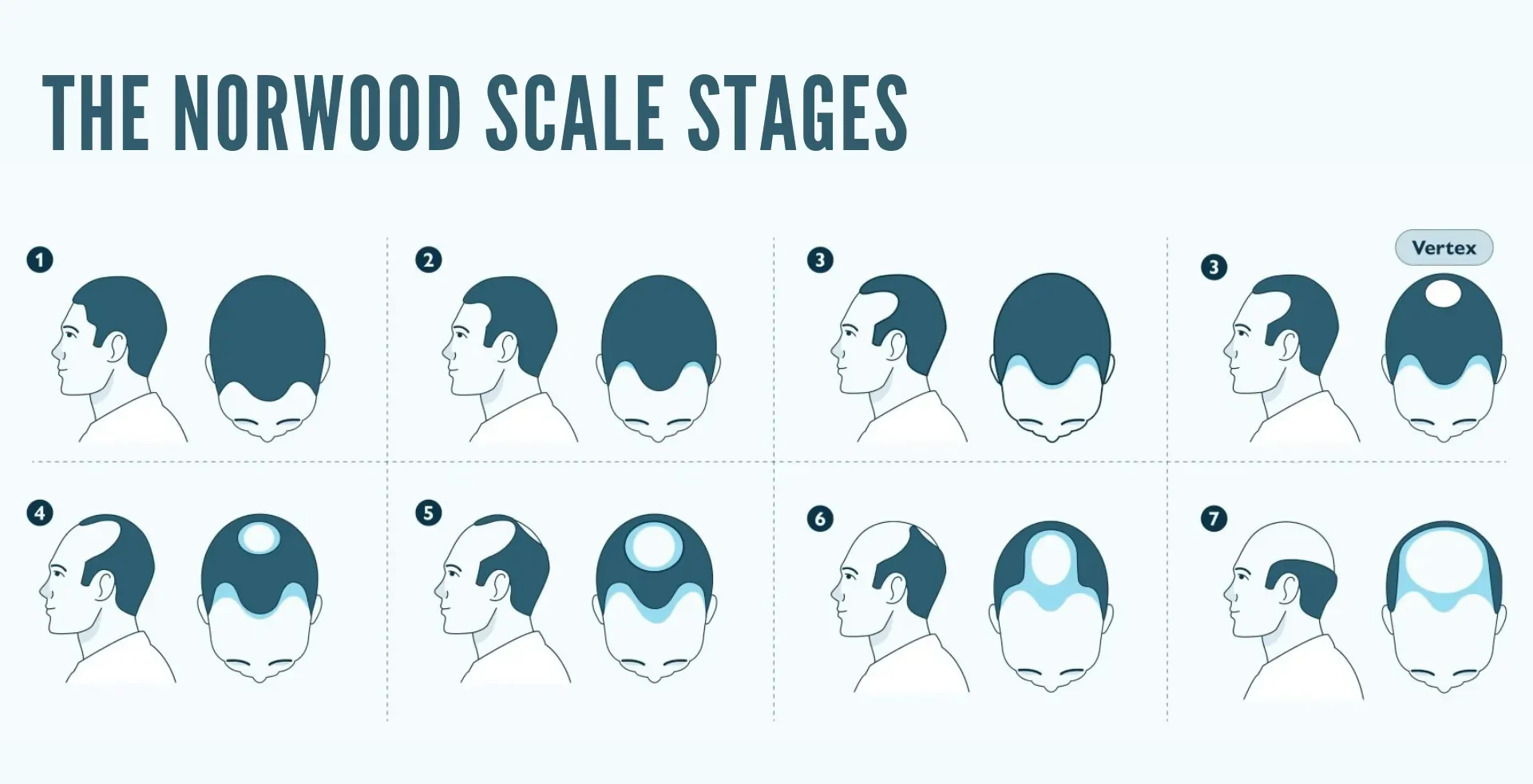
The Hamilton-Norwood scale is the standard classification system for male pattern hair loss, first described by James Hamilton in 1951 and revised by O'Tar Norwood in 1975. It grades androgenetic alopecia across seven stages, from no visible loss to near-complete loss of the top of the scalp.
Every hair transplant surgeon in India uses it for one practical reason: it converts a vague complaint into a number that predicts graft requirement, cost, session count and realistic outcome. When a clinic quotes you without first stating your Norwood stage, they are guessing.
The scale tracks two things only :
1. Temporal recession — how far the hairline has moved back at the corners.
2. Vertex thinning — whether the crown has started to bald Everything else — density, hair calibre, donor supply — is assessed separately.
Stand in front of a mirror in bright, even light. Run two checks.
Check 1 — temple depth. Find your juvenile hairline: the low, rounded line where your hair sat before puberty. Measure how far back the corners have moved.
No movement → Stage 1
Under 2 cm, symmetrical M-shape → Stage 2
Over 2 cm, deep triangular recession → Stage 3 or higher
Check 2 — the crown. Use your phone's front camera or a second mirror to look at the top-back of your head.
Fully covered → your stage is set by Check 1 alone
Visible thinning or a defined bald patch → add "Vertex" to your stage, or move up
Now combine:
Temple recession | Crown | Your stage |
None | Normal | Norwood 1 |
Under 2 cm | Normal | Norwood 2 |
Over 2 cm, deep | Normal | Norwood 3 |
Over 2 cm, deep | Thinning patch | Norwood 3 Vertex |
Severe, sparse frontal | Clear bald patch, bridge intact | Norwood 4 |
Severe | Large patch, narrow bridge | Norwood 5 |
Severe | Bridge gone — front and crown merged | Norwood 6 |
Only a horseshoe band remains | Bald | Norwood 7 |
The "bridge" is the band of hair separating your front hairline from your crown. Watching the bridge is the single most useful thing you can do — its narrowing and eventual loss is what separates stages 4, 5 and 6.
The juvenile hairline is intact. No recession, no thinning.
Grafts needed: none. Some men choose cosmetic hairline lowering (500–1,000 grafts) for a congenitally high hairline, which is a different procedure from treating hair loss.
What to do: nothing, unless you have a strong family history and want a baseline trichoscopy record for comparison later.
The corners have moved back under 2 cm, forming a shallow M. The forelock is intact and the crown is untouched.
Grafts needed: 700–1,200 (hairline 400–700, temple points 300–600) Cost in India: ₹25,000–₹1,32,000 Sessions: 1
The critical caveat: most Norwood 2 is a mature hairline, not balding. Between ages 17 and 29 nearly all men lose the juvenile hairline and settle 1–2 cm higher, permanently. That is normal development and needs no treatment. Genuine androgenetic Norwood 2 keeps progressing and shows miniaturised hairs behind the hairline on trichoscopy.
Full detail: How many grafts for Norwood 2?
Temple recession now exceeds 2 cm and is deep enough to be obvious in photographs. The hairline forms a pronounced M or U. This is where most Indian patients first book a consultation.
Grafts needed: 1,500–2,500 Cost in India : ₹53,000–₹2,75,000 Sessions: 1
Norwood 3 Vertex adds early crown thinning and pushes the requirement to 2,000–3,000 grafts (₹70,000–₹3,30,000). The distinction matters more than it sounds: crown involvement at this stage predicts faster progression, which changes hairline design and whether medication is mandatory.
Full detail: Norwood 3 hair transplant in India.
Frontal recession is severe and the crown has a distinct bald area. A visible bridge of hair still separates the two.
Grafts needed: 2,500–3,500 Cost in India: ₹88,000–₹3,85,000 Sessions: usually 1, occasionally 2
At Norwood 4 you face the first real allocation decision: the frontal third or the crown. Most surgeons prioritise the front, because the hairline frames the face and delivers far more visual impact per graft. Crowns are graft-hungry — their whorl pattern needs high density to avoid a see-through look, and treating a crown that is still expanding often wastes grafts.
Full detail: Norwood 4 — is one session enough?
The bald areas at front and crown have expanded and the separating bridge is now thin.
Grafts needed: 3,000–4,500 Cost in India: ₹1,05,000–₹4,95,000 Sessions: 1–2
Realistic expectation shifts here. Full teenage density across the whole scalp is no longer achievable. A well-planned Norwood 5 result gives a natural, age-appropriate frontal framework with lighter coverage behind — which reads as a full head of hair to everyone except a hair transplant surgeon.
The bridge is gone. The entire top of the scalp is bald, with hair remaining on the sides and back.
Grafts needed: 4,000–6,000 Cost in India: ₹1,40,000–₹6,60,000 Sessions: almost always 2, spaced 8–12 months apart
Here is the arithmetic that decides everything. A Norwood 6 bald area measures roughly 150–200 cm². Covering it at a modest 30 follicular units per cm² requires 4,500–6,000 grafts — which is most or all of an average donor supply. At natural frontal density of 40 FU/cm², you would need over 7,000, which most men simply do not have.
So Norwood 6 planning is about strategic distribution, not coverage: dense frontal third, lighter mid-scalp, crown last or not at all.
Full detail: Norwood 5 & 6 — can you still get full coverage?
Only a narrow band of hair remains around the sides and back, often thinner than at earlier stages.
Grafts needed: 5,000–7,000+ if donor supply permits Cost in India: ₹1,75,000–₹7,70,000 Sessions: 2–3, or not advisable at all
The honest position: many Norwood 7 patients are not surgical candidates. The donor band has itself thinned, so the extractable supply is often 4,000 grafts or less — not enough to cover 200+ cm² at any respectable density. Attempting it produces a thin, transparent result and permanently depletes the donor area.
Better options at this stage often include scalp micropigmentation alone, a partial frontal restoration accepting a bald crown, SMP combined with a limited transplant, or beard-graft augmentation to supplement scalp donor supply.
Full detail: Norwood 7 — what's realistically possible.
Type A variants: the pattern the standard scale misses
Roughly 15–20% of men lose hair in a Type A pattern — the entire hairline marches backward as a straight line, front to back, without forming a separate crown bald spot. These are classified 2A, 3A, 4A and 5A.
Variant | Description | Grafts |
Norwood 2A | Straight-line recession, forelock lost early | 900–1,500 |
Norwood 3A | Hairline behind the mid-point of the top | 2,000–2,800 |
Norwood 4A | Recession approaching the vertex, no crown island | 3,000–3,800 |
Norwood 5A | Loss extends past the vertex | 3,500–4,800 |
Type A matters for two reasons. First, these patients need proportionally more frontal grafts and fewer crown grafts, so a standard plan misallocates. Second, Type A tends to progress further overall, which argues for a more conservative hairline design and stronger commitment to medication.
Stage | Grafts | Sessions | Surgical priority |
Norwood 1 | 0 | — | None |
Norwood 2 | 700–1,200 | 1 | Usually defer |
Norwood 2A | 900–1,500 | 1 | Usually defer |
Norwood 3 | 1,500–2,500 | 1 | Good candidate |
Norwood 3 Vertex | 2,000–3,000 | 1 | Good candidate |
Norwood 4 | 2,500–3,500 | 1–2 | Good candidate |
Norwood 5 | 3,000–4,500 | 1–2 | Manage expectations |
Norwood 6 | 4,000–6,000 | 2 | Strategic distribution only |
Norwood 7 | 5,000–7,000+ | 2–3 | Often not advisable |
Read this table with one correction in mind: a graft is not a hair. One follicular unit graft contains 1–4 hairs, averaging about 2–2.3 hairs on Indian scalp hair. So 2,000 grafts delivers roughly 4,000–4,600 hairs. Any clinic quoting "10,000 hairs" is quoting roughly 4,500 grafts in inflated language. Always ask for the graft count.
Indian clinics price per graft, and technique drives the rate far more than the city does.
Technique | Rate per graft |
FUT (strip) | ₹25–₹40 |
Standard FUE | ₹35–₹55 |
Sapphire FUE | ₹60–₹110 |
DHI (Choi implanter pen) | ₹70–₹130 |
Applied to each stage:
Stage | Standard FUE | Sapphire FUE |
Norwood 2 | ₹25,000–₹66,000 | ₹42,000–₹1,32,000 |
Norwood 3 | ₹53,000–₹1,38,000 | ₹90,000–₹2,75,000 |
Norwood 3 Vertex | ₹70,000–₹1,65,000 | ₹1,20,000–₹3,30,000 |
Norwood 4 | ₹88,000–₹1,93,000 | ₹1,50,000–₹3,85,000 |
Norwood 5 | ₹1,05,000–₹2,48,000 | ₹1,80,000–₹4,95,000 |
Norwood 6 | ₹1,40,000–₹3,30,000 | ₹2,40,000–₹6,60,000 |
Norwood 7 | ₹1,75,000–₹3,85,000 | ₹3,00,000–₹7,70,000 |
Delhi NCR, Mumbai and Hyderabad market ranges as of 2026. Verify current pricing with any clinic directly.
Three things that change these numbers:
Volume discounts : Most clinics reduce the per-graft rate above 3,000 grafts, so Norwood 5–7 totals often land below the straight multiplication.
What's excluded : Blood work, post-operative medication, the first wash, follow-ups and PRP are frequently quoted separately. Add 20–30% if your quote omits them.
GST : Cosmetic procedures are commonly billed at 18%. Ask whether your quote is inclusive before comparing clinics.
Ryan Clinic's inclusions are set out in writing at our cost page before you commit to anything.
On very cheap quotes : rates below ₹30 per graft in a metro almost always mean technician-led surgery, where the doctor marks the hairline and leaves. Repairing a failed transplant costs more than the original procedure and consumes donor grafts you cannot replace.
This is the section most cost guides skip, and it is the one that determines your outcome.
The safe donor zone is a band across the back and sides of the scalp where follicles are genetically resistant to DHT. Only hair from this zone stays permanent after transplantation.
The numbers:
Safe donor area: roughly 120–180 cm²
Donor density: typically 60–85 follicular units per cm² (South Asian scalps often sit at the lower end of the global range, though coarser hair shafts partly compensate for coverage)
Safe lifetime extraction: about 25–30% before visible thinning appears
Realistic lifetime supply: 5,000–8,000 grafts
Set that against requirement, and the picture is stark. A Norwood 6 needing 6,000 grafts is spending nearly the whole account in one go, with nothing left if loss continues or a repair is ever needed.
Beard grafts can add 1,500–3,000 and chest hair 500–1,500 for advanced cases, though body hair has lower survival and different texture, so it is used for filler and density behind the hairline rather than for the hairline itself.
Two practical rules follow :
Never spend donor grafts on a stage you have not reached. Transplanting a crown that is still expanding wastes them.
Keep 1,000–1,500 grafts in reserve. Hair loss is progressive, and you will likely want a second procedure a decade later.
More on this: donor area capacity and density planning.
Stage | First-line approach |
1–2 | Medication and monitoring. Surgery rarely justified. |
3 | Medication for 12 months, then surgery if desired and stable |
4–5 | Surgery plus medication together. Medication protects native hair behind the graft line. |
6–7 | Surgery if donor permits, always with medication. Consider SMP combination. |
Medication is not optional at any stage where you still have native hair. A transplant replaces what you have already lost. It does nothing to stop what remains from going. Patients who transplant without addressing ongoing loss come back in five years with a transplanted hairline sitting in front of a newly bald mid-scalp — a far harder problem than the original one
The standard options are finasteride and topical minoxidil, both of which need a doctor's assessment for side-effect profile and suitability.
Three important limitations:
It does not measure diffuse thinning. Some men lose density evenly across the whole scalp without any recession, so they look like Norwood 2 while losing far more hair than a Norwood 4. In the most important variant, diffuse unpatterned alopecia (DUPA), the donor zone thins too — which makes the patient a poor surgical candidate regardless of how mild the front looks. Only trichoscopy of the donor area catches this. A clinic that stages you by eye and books surgery has skipped the one test that would have ruled you out.
It does not apply to women. Female pattern loss usually preserves the frontal hairline and thins the central parting instead. The Ludwig scale (grades I–III) is the correct classification. See our female hair loss guide.
It says nothing about hair calibre. Coarse hair covers far more scalp per graft than fine hair. Two men at identical Norwood 4 with identical graft counts can get visibly different coverage. Hair-to-skin colour contrast works the same way — low contrast reads as denser.
1. Stage yourself using the two-check method above, and photograph your hairline front, both 45° angles and top-down in consistent light.
2. not just a visual assessment — including of the donor area, to rule out DUPA.
3. Start medication if you have native hair worth protecting, after a doctor's assessment.
4. Re-photograph at 12 months. Stability is the single best predictor of a durable surgical result.
5. If you proceed, verify who operates. Confirm the doctor personally performs extraction, channel creation and implantation, and check their NMC registration.
Ryan Clinic offers a free scalp analysis with graft count and a written cost breakdown across our Delhi, Mumbai and Hyderabad branches. You can see outcomes by stage in our results gallery.
Frequently Asked Questions
What Norwood stage am I?
Check two things: how far your temples have receded from your juvenile hairline, and whether your crown is thinning. Under 2 cm with a normal crown is Norwood 2. Over 2 cm with a normal crown is Norwood 3. A bald crown with a hair bridge still intact is Norwood 4; no bridge is Norwood 6.
How many grafts do I need for my Norwood stage?
Approximately 700–1,200 for Norwood 2, 1,500–2,500 for Norwood 3, 2,500–3,500 for Norwood 4, 3,000–4,500 for Norwood 5 and 4,000–6,000 for Norwood 6. Your exact count depends on donor density, hair calibre and target density.
What is the cost of a hair transplant by Norwood stage in India?
Standard FUE ranges from about ₹25,000 at Norwood 2 to ₹3,30,000 at Norwood 6. Sapphire FUE ranges from ₹42,000 to ₹6,60,000 across the same stages. Confirm whether GST, medication and follow-ups are included.
At which Norwood stage should I get a hair transplant?
Norwood 3 is the earliest stage most surgeons consider clearly surgical. Stages 1 and 2 are usually better treated with medication and monitoring, since loss is still active and donor grafts spent early cannot be recovered.
Can Norwood 6 or 7 be fully covered?
Not at natural density. A Norwood 6 bald area of 150–200 cm² would need over 7,000 grafts at full frontal density, which exceeds most donor supplies. A well-planned result gives a dense frontal framework with lighter coverage behind, typically across two sessions.
How fast does the Norwood scale progress?
There is no fixed rate. Some men stay at Norwood 3 for decades; others move from 3 to 5 within five years. Family history, age of onset and whether you take medication are the strongest predictors. Onset before 25 generally indicates faster progression.
Does the Norwood scale apply to women?
No. Female pattern loss usually preserves the hairline and thins the central parting, so the Ludwig scale (grades I–III) is used instead. Women with hyperandrogenic conditions occasionally show male-pattern loss and are staged on Norwood.
Can medication move me back a Norwood stage?
Sometimes, partially. Finasteride and minoxidil can reverse recent miniaturisation and regrow hair that has thinned but not yet died. They cannot regrow follicles lost years ago. The earlier your stage, the more they can recover.
How many grafts can be done in one session?
Most clinics safely place 2,500–3,500 grafts in a single day. Beyond that, graft out-of-body time rises and survival drops, so higher counts are split across two sessions 8–12 months apart
Norwood O.T. Male pattern baldness: classification and incidence. Southern Medical Journal, 1975.
Hamilton J.B. Patterned loss of hair in man: types and incidence. Annals of the New York Academy of Sciences, 1951.
Ludwig E. Classification of the types of androgenetic alopecia occurring in the female sex. British Journal of Dermatology, 1977.
International Society of Hair Restoration Surgery (ISHRS) — Practice Census and graft planning guidance.
Indian Association of Dermatologists, Venereologists and Leprologists (IADVL) — androgenetic alopecia treatment guidelines.
Unger W., Shapiro R. Hair Transplantation, 5th edition — donor supply and safe donor zone estimation.
About the author Dr. Pranendra Singh is a hair restoration surgeon at Ryan Clinic, Delhi, specialising in Sapphire FUE. Read full profile →
Medical disclaimer: This article is for general information and does not replace a personal medical consultation. Graft counts, costs and outcomes vary between individuals. Please consult a qualified hair transplant surgeon to assess your suitability.
Book Your Free Consult Now!