An honest look at donor limits, partial restoration, SMP and every real option — no false promises of full coverage at the final stage of hair loss.
An honest look at donor limits, partial restoration, SMP and every real option — no false promises of full coverage at the final stage of hair loss.
Norwood 7 needs 6,000 to 9,000 grafts to cover, but the donor area at this stage typically holds only 3,000 to 5,000 — and often less. Most Norwood 7 patients are not candidates for full restoration. What works instead is a partial frontal restoration, scalp micropigmentation, or the two combined. Costs range from ₹25,000 for SMP alone to ₹3,85,000 for a frontal transplant.
Key points
Norwood 7 leaves only a narrow horseshoe of hair around the sides and back
The donor band at this stage is itself narrower and often thinning — this is the real constraint
Grafts taken from the upper margin of the horseshoe may fall out later; safe donor is smaller than it looks
A frontal framework of 2,500–3,500 grafts is realistic; full coverage is not
SMP alone with a shaved head is often the most predictable and cost-effective result
Choosing no treatment is a legitimate option, not a failure
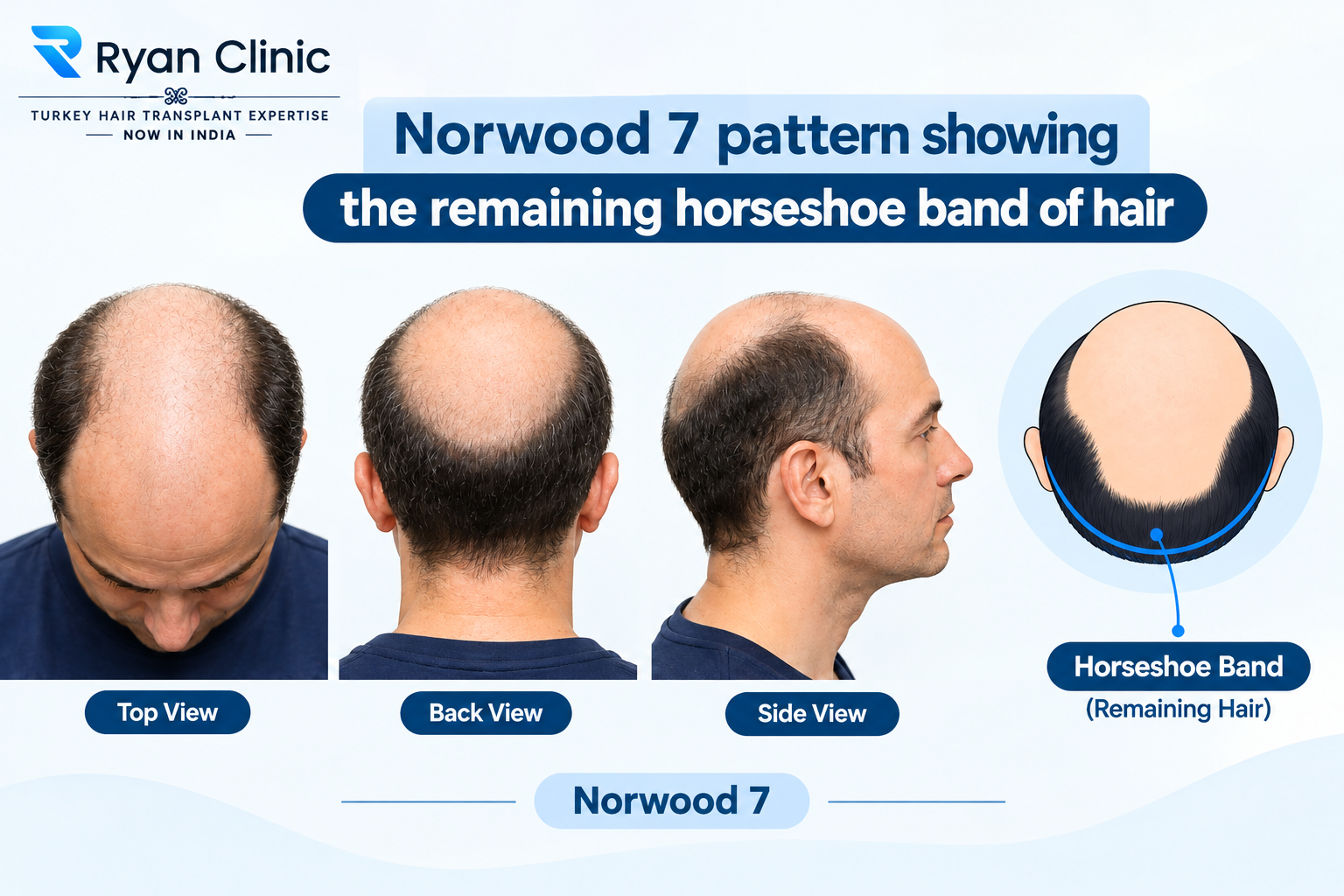
Norwood 7 is the final stage of the Hamilton-Norwood scale. The entire top of the scalp — front, mid-scalp and crown — has lost hair, leaving only a band running around the sides and back of the head in a horseshoe shape.
Two features distinguish it from Norwood 6, and both matter more than the visible baldness on top:
The remaining band is narrower. It sits lower on the head than at earlier stages, having receded from above.
The band is often thinner. Hair within the horseshoe frequently shows reduced density compared to a Norwood 4 or 5 donor area.
Bald surface area at Norwood 7 typically runs 200 to 300 cm² — roughly one and a half times a Norwood 6.
For the full staging system, see our Norwood scale guide for India. If your bald zones on top are large but the band is still broad and dense, you may be Norwood 6 — see that guide, where the arithmetic is more favourable.
What Norwood 7 would need:
Target density | Area | Grafts required |
20 FU/cm² (thin, see-through) | 250 cm² | 5,000 |
30 FU/cm² (light but acceptable) | 250 cm² | 7,500 |
40 FU/cm² (natural frontal density) | 250 cm² | 10,000 |
What a Norwood 7 donor typically holds:
At Norwood 4 or 5, a safe donor zone of 120–180 cm² at 60–85 follicular units per cm² yields 5,000 to 8,000 lifetime grafts. At Norwood 7 that shrinks on both variables — the band is smaller and frequently less dense — so realistic extractable supply is commonly 3,000 to 5,000 grafts, and sometimes under 3,000.
Set those two tables side by side and the position is clear: for most men at Norwood 7, there is not enough donor hair to cover the bald area at any density that would look convincing. Spreading 4,000 grafts across 250 cm² produces 16 FU/cm² — visible scalp everywhere, and a permanently spent donor area.
This is not a limitation of technique, technology or budget. Sapphire blades, Choi pens and robotic extraction all move existing hair from one place to another. None of them creates new follicles.
There is a second, more technical issue at Norwood 7 that catches patients out.
The safe donor zone shrinks as the pattern advances. Only hair from the genetically DHT-resistant band stays permanent after transplantation. At Norwood 7, the upper boundary of that band has moved downward — sometimes well below where hair is still visibly growing.
That means the top portion of your remaining horseshoe may be hair that is on its way out. Harvest from it and you transplant follicles that will miniaturise and fall out in the recipient area within a few years, exactly as they would have on the donor site. The patient sees good growth at 12 months and thinning by year four, and assumes the surgery failed.
A competent assessment therefore does two things:
Trichoscopy of the donor band itself : measuring hair shaft diameter variation. Variation above roughly 20% indicates the zone is not stable and should not be harvested.
Conservative boundary marking : taking only from the mid and lower band, well clear of the advancing edge.
If a clinic assesses you visually and quotes 6,000 grafts at Norwood 7 without examining your donor under magnification, that quote is not based on anything.
Option | What it does | Grafts | Typical cost |
SMP alone, shaved head | Pigment mimics stubble across the whole scalp | 0 | ₹25,000–₹90,000 |
Partial frontal restoration | Rebuilds a hairline and frontal third; crown stays bald | 2,500–3,500 | ₹87,500–₹3,85,000 |
Transplant + SMP | Frontal grafts plus pigment behind, reducing contrast | 2,500–3,500 | ₹1,15,000–₹4,75,000 |
Beard/body augmentation | Supplements scalp donor for greater coverage | +2,000–4,000 | Adds ₹70,000–₹4,00,000 |
Hair system | Non-surgical prosthetic | 0 | ₹15,000–₹60,000/year, ongoing |
No treatment | Shave and keep it | 0 | ₹0 |
The most common surgical plan at Norwood 7. Around 2,500 to 3,500 grafts build a conservative hairline, temple points and frontal third at 30 to 35 FU/cm², with the mid-scalp and crown left untreated.
What it achieves : from the front and in conversation, you read as a man with a receding hairline rather than a bald man. The face is framed again, which is where most of the perceived age difference lives.
What it does not achieve : the crown and mid-scalp remain bald and are fully visible from above and behind, and in overhead light. Anyone standing behind you sees an unchanged head.
Whether that trade is worth ₹1,50,000+ is a personal judgement. Some men find the frontal change transformative; others find the visible boundary between restored front and bald crown more conspicuous than uniform baldness was. Both reactions are common, and an honest surgeon will tell you so before taking your money.
Usually the best cosmetic outcome available at this stage.
Scalp shows through sparse hair because pale skin reflects light between the shafts. SMP deposits pigment that darkens the scalp, cutting that contrast. Applied behind a frontal transplant, it makes 30 FU/cm² read closer to 40, and it softens the boundary between treated and untreated zones rather than leaving a hard line.
Practically: frontal grafts for texture and a real hairline, SMP across the mid-scalp and crown for density illusion. The combination costs more than either alone but consistently outperforms both.
For men with insufficient donor supply, this is frequently the best available result — not a consolation prize.
SMP on a closely shaved head produces a convincing, even stubble appearance across the whole scalp. It is predictable, requires no donor hair, costs a fraction of surgery, and has no graft survival risk. Typically 2 to 3 sessions spaced a few weeks apart, with a touch-up every 4 to 6 years as pigment fades.
The limitation is that it only works shaved or very short. It is a colour treatment, not hair — it has no texture and cannot be grown out.
See our SMP vs hair transplant comparison.
Beard grafts can add 1,500 to 3,000 and chest hair another 500 to 1,500. At Norwood 7 this can be the difference between an unworkable plan and a viable one.
The caveats are real: body and beard hair have different texture, growth cycle and lower survival rates than scalp hair. They are placed behind the hairline to build density, never in the front row. Extraction adds hours of surgical time and cost.
Worth stating plainly, because most clinic websites will not: a shaved head is a perfectly good outcome. It costs nothing, carries no surgical risk, spends no donor hair, and looks deliberate rather than transitional. A large number of men at Norwood 7 arrive at this and are entirely content with it.
There is no medical requirement to treat androgenetic alopecia. It is a cosmetic decision, and declining it is as valid as proceeding.
An honest surgeon will decline these cases :
Extractable donor below roughly 3,000 grafts : The result would be thin everywhere and the donor permanently spent.
Diffuse unpatterned alopecia (DUPA) : If the donor band itself is miniaturising, transplanted hair will fall out too. This is the leading cause of transplants that fail despite flawless technique, and only donor trichoscopy detects it.
Norwood 7 before age 40 : Reaching the final stage that early indicates aggressive progression, and the horseshoe may continue to recede — taking your transplanted hair's donor origin with it.
Expectations of full coverage : No graft count, technique or price achieves it at this stage.
Being told no by a good clinic is a better outcome than being told yes by a bad one. A declined case costs you a consultation; a poorly planned Norwood 7 surgery costs ₹2,00,000+ and your remaining donor hair.
Approach | Grafts | Standard FUE | Sapphire FUE |
Partial frontal | 2,500–3,500 | ₹87,500–₹1,92,500 | ₹1,50,000–₹3,85,000 |
Extended, with beard grafts | 4,500–6,000 | ₹1,57,500–₹3,30,000 | ₹2,70,000–₹6,60,000 |
SMP alone | — | ₹25,000–₹90,000 | — |
SMP touch-up (every 4–6 years) | — | ₹8,000–₹25,000 | — |
Delhi NCR, Mumbai and Hyderabad market ranges as of 2026. Verify current pricing with any clinic directly.
Two warnings specific to this stage. First, be sceptical of large graft quotes. If a clinic proposes 6,000 grafts at Norwood 7, ask them to show you the donor calculation — the band area, the measured density, and the extraction percentage. The numbers should be on paper. Second, FUT becomes tempting at these volumes because it yields more grafts per session at lower cost, but the linear donor scar rules out the shaved look permanently, which is precisely the fallback most Norwood 7 patients need to keep open.
Our cost breakdown states Ryan Clinic's inclusions in writing before you commit to anything.
Ryan Clinic offers a free scalp analysis including donor trichoscopy at our Delhi, Mumbai and Hyderabad branches. Where a case is not suitable for surgery, we say so.
Partially. A frontal restoration of 2,500 to 3,500 grafts can rebuild a hairline and frontal third, but full coverage is not achievable — a Norwood 7 scalp of 200 to 300 cm² would need 6,000 to 9,000 grafts, while the donor band at this stage typically holds only 3,000 to 5,000.
Possibly. The deciding factor is not how bald you are on top but how much stable donor hair remains. Below roughly 3,000 extractable grafts, or if trichoscopy shows thinning in the donor band itself, surgery will not produce a good result and scalp micropigmentation is the better option.
Between 6,000 and 9,000 at a light-to-moderate density of 25 to 35 follicular units per cm², and around 10,000 at natural frontal density. Very few donor areas hold that much, and almost none at Norwood 7.
For most men, either scalp micropigmentation on a shaved head, or a partial frontal restoration combined with SMP behind it. The combination gives the most natural result; SMP alone is the most predictable and least expensive.
Typically ₹25,000 to ₹90,000 for full-scalp coverage across 2 to 3 sessions, with touch-ups every 4 to 6 years at ₹8,000 to ₹25,000. It requires no donor hair and carries no graft survival risk.
Because it is a large sale. Ask to see the donor calculation — band area, measured density and safe extraction percentage — in writing. If the arithmetic isn't shown, the number isn't grounded in your anatomy.
It can add 1,500 to 3,000 grafts and sometimes makes a marginal case workable. Beard hair is coarse and useful for density behind the hairline, but has different texture and lower survival than scalp hair, so it is never used in the front row.
Some men find the restored front transformative; others find the boundary between treated and untreated zones more noticeable than uniform baldness was. Adding SMP across the crown softens that transition considerably. Ask to see top-down photographs of comparable cases before deciding.
Book Your Free Consult Now!