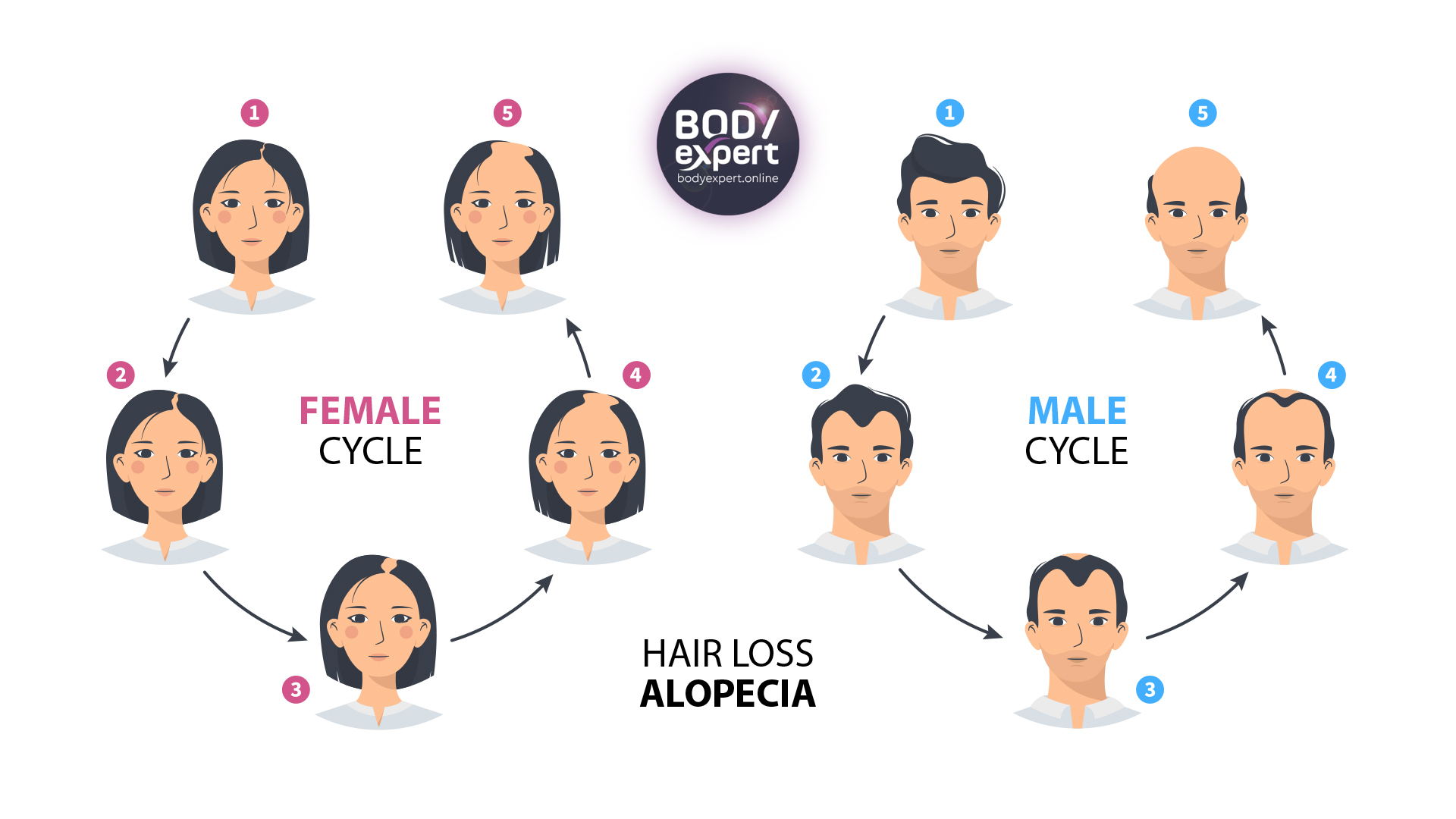
Norwood 4 needs 2,500–3,500 grafts — right at the edge of a safe single session. One session fully restores the front; the crown usually needs a second, 8–12 months later. Covers graft allocation, 2026 India costs by technique, and donor-supply planning.
Norwood 4 needs 2,500–3,500 grafts — right at the edge of a safe single session. One session fully restores the front; the crown usually needs a second, 8–12 months later. Covers graft allocation, 2026 India costs by technique, and donor-supply planning.
Norwood 4 needs 2,500 to 3,500 grafts, which sits right at the safe limit for a single session. One session is enough to fully restore the front. Covering the front and the crown to natural density usually requires a second session 8 to 12 months later. Cost in India runs ₹88,000 to ₹3,85,000 depending on technique
Key points
The defining feature of Norwood 4 is the bridge — the band of hair still separating front from crown
Safe single-session limit is 2,500–3,500 grafts; beyond that, graft survival drops
Front first is the standard plan. Crowns consume grafts disproportionately for less visual return.
Norwood 4 spends roughly 40–50% of your lifetime donor supply — reserve planning matters here
Medication protects the bridge; losing it moves you to Norwood 5 or 6
Norwood 4 is the stage where hair loss becomes two separate problems rather than one. Frontal recession is severe and the crown has developed a clearly defined bald area — but a bridge of hair still connects the sides across the mid-scalp, keeping the two bald zones apart.
That bridge is the whole story of this stage. As long as it holds, you are Norwood 4. When it thins to a narrow strip you are Norwood 5, and when it disappears entirely and the two bald areas merge, you are Norwood 6. Watching the bridge is the single most useful thing you can do to track your own progression.
Typical measurements at this stage:
Frontal bald zone: roughly 50–70 cm²
Crown bald zone: roughly 30–50 cm²
Combined: 80–120 cm²
At a natural-looking 30 follicular units per cm², covering all of that requires 2,400 to 3,600 grafts — which is exactly where the numbers below come from.
Norwood 4A is the variant without a crown island: the entire hairline marches backward as a straight line, front to back, with no separate bald patch at the vertex. It needs more frontal grafts and no crown work, typically 3,000 to 3,800.
For the full staging system, see our Norwood scale guide for India.
The honest answer has two parts.
Yes, for the front. A frontal restoration at Norwood 4 needs roughly 2,000 to 2,500 grafts across the hairline, temple points and frontal third. That fits comfortably in one day, and it delivers the large majority of the visual improvement — because the front frames your face and is what people see when they look at you.
Usually no, for front and crown together at full density. Covering both zones properly needs 3,000 to 3,500+ grafts, which sits at or past the ceiling of what can be safely placed in a single day.
Why the ceiling exists. Most surgeons place 2,500 to 3,500 grafts in one session, and the limit is not stamina — it is biology:
Out-of-body time. Grafts survive best when they spend the shortest possible time outside the scalp. A 4,000-graft session stretches to 10–12 hours, and the last grafts placed have been waiting far longer than the first.
Donor extraction limits. Only about 20–25% of the safe donor zone can be harvested in one sitting without visible thinning or compromised healing.
Recipient site vascularity. Densely packed channels across a large area compete for blood supply. Spreading the work reduces that competition.
Precision decay. Angle and direction accuracy fall off across a very long surgical day, and those two variables determine whether the result looks natural.
So what does a realistic Norwood 4 plan look like?
Plan | Session 1 | Session 2 | When |
Front only | 2,000–2,500 grafts, hairline + temples + frontal third | — | Single procedure |
Front, then crown | 2,000–2,500 grafts, front | 1,000–1,500 grafts, crown | 8–12 months later |
Full coverage attempted in one day | 3,000–3,500 grafts, spread thinly | — | Possible, but density suffers everywhere |
The third option is the one to be careful about. Spreading 3,200 grafts across 100+ cm² gives you roughly 30 FU/cm² everywhere — technically full coverage, but thin enough to look see-through in bright light across the whole scalp. Most surgeons prefer a dense front and an untreated crown over a uniformly transparent result.
If a clinic promises full Norwood 4 coverage at natural density in a single sitting, ask two questions: how many grafts, and what density in each zone. The arithmetic will usually answer itself.
Front or crown first? The allocation decision
This is the defining choice at Norwood 4, and the standard answer is front first, for four reasons:
Visual return per graft. The frontal third frames the face. Restoring it changes how old you look more than any other zone. The crown is visible mainly from above and behind, and mainly to other people.
Crowns are graft-hungry. The crown grows in a whorl — a spiral pattern radiating from a central point. Recreating that requires careful angle work and higher density; below about 35 FU/cm² the scalp shows through the spiral. A 40 cm² crown at proper density is 1,400 to 1,600 grafts for a zone most people never see.
The crown is still expanding. At Norwood 4 the vertex bald spot is usually growing outward. Transplant its current edge and you can find, five years later, a ring of native loss around your transplanted crown — a visible halo that needs fixing.
Donor economics. Grafts are finite. Spending them on the zone with the highest return first is simply better allocation.
When crown work is reasonable at Norwood 4: you are over 40 with a stable pattern, on medication, with good donor supply, and the crown genuinely bothers you more than the front. That's a legitimate patient preference — but it should be a considered choice, not a default.
Technique | Rate/graft | 2,500 grafts | 3,000 grafts | 3,500 grafts |
FUT (strip) | ₹25–₹40 | ₹62,500–₹1,00,000 | ₹75,000–₹1,20,000 | ₹87,500–₹1,40,000 |
Standard FUE | ₹35–₹55 | ₹87,500–₹1,37,500 | ₹1,05,000–₹1,65,000 | ₹1,22,500–₹1,92,500 |
Sapphire FUE | ₹60–₹110 | ₹1,50,000–₹2,75,000 | ₹1,80,000–₹3,30,000 | ₹2,10,000–₹3,85,000 |
DHI (Choi pen) | ₹70–₹130 | ₹1,75,000–₹3,25,000 | ₹2,10,000–₹3,90,000 | ₹2,45,000–₹4,55,000 |
Delhi NCR, Mumbai and Hyderabad market ranges as of 2026. Verify current pricing with any clinic directly.
Two things specific to this graft range:
Volume discounts usually kick in. Most clinics reduce the per-graft rate above 3,000 grafts, so real Norwood 4 totals often land below straight multiplication. Ask for the rate at your graft count, not the headline rate.
Two-session pricing. If you are planning front-then-crown, ask upfront whether the second session is priced at the same rate or discounted. Some clinics offer a package; others charge full rate again, which changes the total materially.
What quotes routinely exclude: GST (cosmetic procedures are commonly billed at 18% — ask whether yours is inclusive), pre-surgical blood work, post-operative medication, the first wash, follow-ups, and PRP where used. Add 20 to 30% if these are missing. Our cost breakdown states Ryan Clinic's inclusions in writing.
On sub-₹30 quotes at this volume: a 3,000-graft procedure at ₹25 per graft is ₹75,000, which is not enough to cover a full surgical day of a qualified doctor's time. At that price the doctor marks the hairline and technicians do the work. At Norwood 4 — where you are committing nearly half your lifetime donor supply — that is a poor place to economise.
Your safe donor zone holds roughly 5,000 to 8,000 extractable grafts across your entire life. A Norwood 4 procedure of 3,000 grafts spends 40 to 50% of that in one day.
That matters because Norwood 4 is rarely the end of the road. If your pattern progresses to Norwood 5 or 6 over the next fifteen years — which is common — you will want grafts available for the mid-scalp behind your new hairline.
Two rules follow:
Do not attempt maximum coverage now :Take a dense, well-designed front and leave reserve.
Keep 1,500 grafts back: That is roughly what a future mid-scalp reinforcement costs.
Beard grafts can add 1,500 to 3,000 for later sessions and chest hair another 500 to 1,500, though body hair has lower survival and different texture — it is used for density behind the hairline, not for the hairline itself. See our donor capacity guide.
Protecting the bridge
The bridge is what keeps you at Norwood 4 instead of Norwood 6, and it is native hair — meaning it is DHT-sensitive and will keep thinning if untreated.
This is the strongest argument for medication at any stage. Transplant a dense hairline at Norwood 4, lose the bridge over the following decade, and you end up with transplanted hair at the front, a bald mid-scalp behind it, and a transplanted or bald crown behind that — a striped result that is expensive and difficult to fix.
Finasteride and topical minoxidil are the standard options, both requiring a doctor's assessment for suitability and side-effect profile. Many surgeons ask Norwood 4 patients to be stable on medication for 6 to 12 months before operating, so the surgical plan is built on a known trajectory.
What results can you realistically expect?
For a well-planned 2,500-graft frontal restoration at Norwood 4:
Frontal coverage: full, with natural density and a soft irregular hairline
Crown: untreated unless a second session is planned — be clear about this before surgery
Detectability: low from the front and in conversation; the untreated crown remains visible from above
Surgery duration: 6 to 9 hours under local anaesthesia, day procedure
Back to desk work: 5 to 7 days
Final result: 12 to 15 months
Expectation management is the difference between a satisfied and dissatisfied Norwood 4 patient. Full teenage density across the entire scalp is not the outcome. A natural, age-appropriate frontal framework that makes you look ten years younger from the front — with a crown that is either treated later or accepted — is.
Judging before-after photos at this stage: insist that the clinic states graft count, Norwood stage, months elapsed and, crucially, whether the crown was treated. A Norwood 4 "after" photographed only from the front tells you nothing about what happened behind. Ask for the top-down view. Our results gallery includes both angles.
Timepoint | What happens |
Days 1–3 | Forehead swelling, redness at recipient sites, scabs form |
Days 5–7 | Scabs soften; most patients return to desk work |
Days 10–14 | Scabs cleared; transplanted hairs begin to shed |
Weeks 3–6 | Shock shedding — normal, and it can also affect native hair around the grafts |
Weeks 6–12 | The flat phase. Nothing visible happens. |
Months 3–4 | First new growth, fine and light |
Months 6–9 | Noticeable density |
Months 12–15 | Final result; crown areas often lag the front by 2–3 months |
Shock loss of native hair is more common at Norwood 4 than at earlier stages, because grafts are placed among existing miniaturised hairs. It recovers, but it can be alarming at week four. Full aftercare detail is in our first 10 days guide.
Spreading grafts too thin across front and crown to claim full coverage in one session.
Treating the crown first, in a zone that is still expanding.
Designing a low, aggressive hairline appropriate to Norwood 2 — at Norwood 4 the pattern is established and progressive, so conservative placement is essential.
Spending all donor reserve with no allowance for future progression.
Skipping medication, which risks losing the bridge and undoing the plan.
Accepting a "one sitting, full coverage" promise without asking for the density figures per zone.
Check your bridge. Photograph the top of your head and note how wide the connecting band is. Repeat every six months.
Get trichoscopy, including of the donor area, to measure available supply and rule out diffuse unpatterned loss.
Decide your priority — front, crown, or a staged plan — before consultations, so you can compare quotes on the same basis.
Ask every clinic for a zone-wise plan: grafts per zone and target density per zone, in writing.
Confirm who operates. Extraction, channel creation and implantation should all be performed by the doctor, and their NMC registration should be verifiable.
Ryan Clinic offers a free scalp analysis with zone-wise graft counts and a written cost breakdown at our Delhi, Mumbai and Hyderabad branches.
Norwood 4 typically needs 2,500 to 3,500 grafts — roughly 2,000 to 2,500 for the frontal third, hairline and temple points, plus 1,000 to 1,500 if the crown is treated. Norwood 4A needs 3,000 to 3,800 because loss extends backward without a separate crown patch.
The front can, comfortably. Covering both the front and the crown at natural density usually needs 3,000 to 3,500+ grafts, which is at or beyond the safe single-session ceiling. Most surgeons restore the front first and treat the crown 8 to 12 months later if wanted.
Between ₹88,000 and ₹3,85,000 depending on technique and graft count. Standard FUE runs ₹35–₹55 per graft and Sapphire FUE ₹60–₹110. Volume discounts often apply above 3,000 grafts, so ask for the rate at your specific count.
The front, in almost all cases. It frames the face and delivers far more visual improvement per graft. Crowns need higher density to look natural, are visible mainly from above, and are usually still expanding at this stage.
Most clinics safely place 2,500 to 3,500 grafts in a single day. Beyond that, graft out-of-body time increases, donor extraction approaches unsafe limits, and survival rates fall. Higher totals are split across sessions 8 to 12 months apart.
Eight to twelve months. That allows the donor area to heal fully, lets you see the first session's result before committing more grafts, and gives the recipient scalp time to re-establish blood supply.
Yes. A frontal restoration does not change the crown, so it stays visible from above and behind. Many patients accept this; others plan a second session. Either way, be clear which you are getting before surgery.
Not all, but a large share. A 3,000-graft procedure spends roughly 40 to 50% of a typical 5,000 to 8,000 lifetime supply. Keeping around 1,500 grafts in reserve for future progression is standard planning.
Sources
Norwood O.T. Male pattern baldness: classification and incidence. Southern Medical Journal, 1975.
Hamilton J.B. Patterned loss of hair in man: types and incidence. Annals of the New York Academy of Sciences, 1951.
International Society of Hair Restoration Surgery (ISHRS) — Practice Census and session planning guidance.
Indian Association of Dermatologists, Venereologists and Leprologists (IADVL) — androgenetic alopecia treatment guidelines.
Unger W., Shapiro R. Hair Transplantation, 5th edition — donor supply, session limits and graft survival.
Beehner M. Studies of graft survival and out-of-body time in follicular unit transplantation. Hair Transplant Forum International.
About the author Dr. Pranendra Singh is a hair restoration surgeon at Ryan Clinic, Delhi, specialising in Sapphire FUE. Read full profile →
Medical disclaimer: This article is for general information and does not replace a personal medical consultation. Graft counts, costs and outcomes vary between individuals. Please consult a qualified hair transplant surgeon to assess your suitability.
Book Your Free Consult Now!