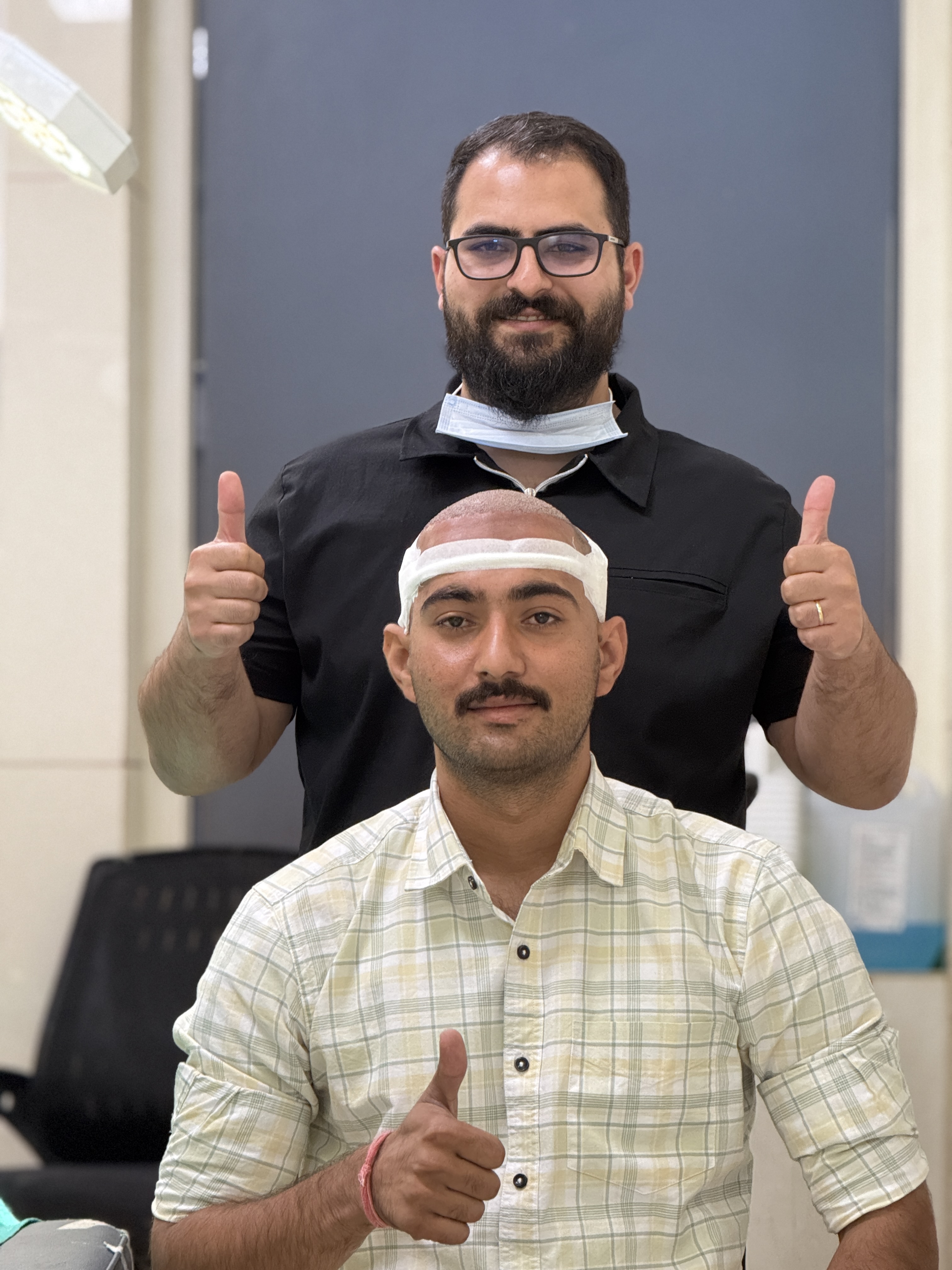
Protect your newly transplanted grafts with the right aftercare. Discover essential tips for washing, sleeping, exercise, scalp care, and recovery during the crucial first 10 days after a hair transplant.
Protect your newly transplanted grafts with the right aftercare. Discover essential tips for washing, sleeping, exercise, scalp care, and recovery during the crucial first 10 days after a hair transplant.
Undergoing a hair transplant marks a significant milestone in the quest to achieve greater hair thickness and restore your natural hairline. However, this procedure is only part of the whole process. The early days, especially the first 10 days after the transplant, comprise an important stage because the newly grafted follicles are settling into their new homes and the scalp starts the recovery process.
During this time, carefully following your cosmetic surgeon's directions on aftercare is of utmost importance. Things such as scratching or touching your scalp, washing it improperly, extensive exercising, stressing your head with heat or unsuitable headgear might interfere with your recovery.
The objective of this tutorial is to help you understand what happens during the first ten days after your hair transplantation, regardless of the technique used (FUE or any other procedure), which will facilitate the recovery process.
Hair transplantation entails relocating healthy hair roots from a donor site to regions experiencing hair loss. After the hair is transplanted, there needs to be some time for the roots to acclimatize and initiate the healing process.
The first days are critical because:
- The scalp may be sensitive and swollen.
- Small injuries are healing in the site of the grafts.
- Crusts may form.
- The transplanted roots need to be properly cared for.
- Excessive rubbing is to be avoided.
- Proper hygiene should be maintained.
- Patients should adhere to the prescribed treatment.
It is important to understand that newly transplanted roots do not produce hairline immediately. Hair growth takes time and some hair loss may be experienced in the recovery time.
Therefore, the first 10 days after hair transplantation should be treated as a process of protection and healing instead of a time when people expect to see their hair growing dramatically.
The recovery of patients may vary depending on the extent of grafting, methods employed, physical healing abilities of the patient, and surgeon directives. Although it might vary from patient to patient, the timeline presented below shows a general idea.
Major focus during the first day is protecting your scalp.
You could see:
- Slight redness
- Painful sensations
- Slight swelling
- Minor bleeding, or discharge
- Sensitivity near transplanted and donor areas
Your center will usually give detailed directions about sleeping, washing, treatment, hair care, etc.
Don't touch your graft unless needed, and consult your surgeon on how to wash your scalp, since instructions could differ.
You might be advised to sleep with your head above the heart level, thus decreasing swelling in your forehead.
A few patients notice swelling arising in the early stages of healing. Normal fluid may have flowed to the lower parts of the face because the swelling appears around the eyes and forehead.
In this case, it does not indicate that something is wrong, but it is wise to consult the doctor as the swelling increases or when there are other symptoms to worry about.
In this phase:
- Do not scratch your head.
- Do not touch your scabs.
- Be sure to take medication as directed.
- Keep the area covered.
- Clean it as advised by your doctor.
- Refrain from strenuous activities until your doctor permits you.
This phase is not what you expected since it is normal for the area to be inflamed and crusty.
Small scabs may show up on the site of the transplant procedure. This is all part of the recovery process.
At this time of recovery, some behaviors must be followed:
Do not remove the scabs by force. Rubbing can worsen the sensitivity of the area. Normally, the doctors recommend a sort of washing ritual, which helps to soften the scabs so that they will gradually come off.
Patients should avoid looking at the newly transplanted hair area.
Small scabs may show up on the site of the transplant procedure. This is all part of the recovery process.
At this time of recovery, some behaviors must be followed:
Do not remove the scabs by force. Rubbing can worsen the sensitivity of the area. Normally, the doctors recommend a sort of washing ritual, which helps to soften the scabs so that they will gradually come off.
Patients should avoid looking at the newly transplanted hair area.
By the end of the first week, a number of patients may have noticed the lessening of their discomfort. Nonetheless, the scalp is still sensitive.
You may begin following your doctor’s recommendations about your shampooing practices.
You also need to comply with the following requirements:
- Use hair products approved by your doctor.
- Use gentle washing techniques.
- Avoid scratching.
- Keep out of the sun.
- Stay away from things that can lead to excessive perspiration.
- Follow the doctor’s instructions regarding medications
During the second week, much of the crusting will have fallen off. The scalp may start to look normal, though some people may still have some redness.
At this time, a lot of people feel comfortable going back to their everyday life, but it will vary from case to case and depend on how much time has passed after the procedure as well as how fast a person heals.
Your surgeon will probably assess your progress at this time as well as give you further instructions.
Keep in mind that the process of hair growing takes a long time. The first ten days are mainly aimed at protecting the transplanted area from any influence and ensuring proper healing of the scalp.
The most important focusing point of aftercare is following the recommendations of specialists.
There are several good practices that may vary between different professionals with respect to washing hair, taking medicine, sleeping, exercising and scalp care. Hence, the general information found on the internet cannot replace the particular recommendations given by one’s surgeon.
It is necessary to keep the scalp clean, but washing it too much can cause irritation of the skin that is healing. Your doctor may instruct you to:
- Use a prescribed or recommended product without pressing it on the skin.
- Keep it for the recommended amount of time.
- Rinse off the scalp with warm water.
- Avoid the usage of high-pressure water on the grafts.
- Dry the scalp by patting it instead of rubbing it vigorously
Itching is normally present while healing is taking place. Unfortunately, scratching may aggravate the scalp and cause harm to the healing tissue.
If you cannot manage the itching, contact your physician’s office instead of scratching your scalp.
In the early phase of recuperation, doctors commonly advise adopting a technique that lessens strain on the affected anatomical region. It is advisable to sleep in an elevated position to prevent swelling after the procedure. There may be a requirement to sleep in unique positions due to the nature of the surgical operations.
Doing sports leads to enhanced sweating and circulation. Post-surgery, your doctor might suggest no physical training for a while.
Walking is fine for some patients, but exercise that involves lifting heavy weights, running, or high-impact training should be avoided.
Make sure to follow your physician's instructions.
Giving your scalp long exposure to sunlight can irritate it.
It is advisable to avoid sunlight altogether during the while few months following the surgery. Please consult with your doctor regarding when it will be okay for you to start wearing hats or anything else.
The use of cigarettes can affect the process of circulation and healing the wound, while alcohol can interfere with medications and contribute to dehydration as well as blood loss on a lower level.
Your healthcare provider can ask you to refrain from both of these substances.
Your doctor can prescribe some forms of therapy like antibiotics, pain relievers, anti-inflammatory drugs, etc.
Follow strictly the prescriptions given by
The early period of recovery can require some patience. Patients should avoid the following items:
Don’t scratch
Even if your scalp feels itchy, refrain from scratching it or you will irritate the area.
Don’t pick scabs
Let the scabs come off as per your clinic’s directions.
Don’t wash your hair too harshly
Try not to be too harsh when cleaning your scalp.
Don’t perform strenuous exercise
Follow your surgeon’s recommendations about returning to your workouts.
Don’t apply too much heat
Stay away from saunas, steam baths, and very hot surroundings in the early period of recovery.
Don’t expose your scalp to extreme sunlight
Prevent the affected scalp from being outside for long hours.
Don’t use cosmetics that have not been approved
Avoid putting oils, styling products, dyes, and other items unless specifically told by your clinic not to.
One frequent belief is that hair that has been transplanted should begin to grow right after the surgery. In fact, transplanted hair undergoes a natural change before it can start growing.
It is common from time to time to lose some transplanted hair. This is known as shock loss, or postoperative loss. Even if the hair is gone, the hair follicle usually remains in the scalp.
In several months' time, the hair can start growing back gradually. The precise outcome can be different as it depends on many variables including:
- The quality of hair donor
- The severity of hair loss
- The number of grafts performed
- The procedure used for hair transplant
- Properties of hair
- The process of healing in the client
- The existing pattern of hair loss
- The use of hair loss management methods in the future
By following the instructions, you can have a better understanding of what period would be reasonable for you.
The FUE Hair Transplant in Delhi is one of the important themes in discussions related to the minimally invasive hair restoration.
The procedure is based on the harvesting of individual follicular units in the donor area and their placement in recipient areas.
Despite its minimal invasiveness, it is a surgical procedure requiring due attention to recovery.
People seeking the procedure should not take it for granted that smaller extraction points allow resuming their activities right away.
Your recovery can be successful depending on how well the instructions of the medical staff are followed.
Women are also affected by hair loss; and thus, the patients who seek Female Hair Transplant in Delhi may have different cases and reasons for their hair loss as compared to men.
Female hair transplant may include:
- Hairline
- Frontal scalp
- Parting
- Areas with diffuse thinning
Treatment should be personalized according to the hair loss pattern, density of donor area, medical history, and expectations of the patient.
After the procedure, the patient should observe the same principles: to protect the newly transplanted area and follow the recommendations of their doctor during the initial healing.
Those who are interested in getting an eyebrow transplant might be curious if aftercare is similar to that of scalp transplants. The same fundamental principle applies to both forms of surgery: transplanted hair follicles ought to be kept safe while the area in question heals.
Since the area around eyebrows is much smaller and more sensitive, patients should pay additional attention to the following matters:
- Frequent touching of the treated area
- Application of makeup
- Washing the face
- Sleeping position
- Exposure to sunlight
- Accidental rubbing of the eyebrows
All patients who undergo eyebrow transplantation should obtain his or her own surgeon’s advice regarding the care of the area.
Those who are interested in getting an eyebrow transplant might be curious if aftercare is similar to that of scalp transplants. The same fundamental principle applies to both forms of surgery: transplanted hair follicles ought to be kept safe while the area in question heals.
Since the area around eyebrows is much smaller and more sensitive, patients should pay additional attention to the following matters:
- Frequent touching of the treated area
- Application of makeup
- Washing the face
- Sleeping position
- Exposure to sunlight
- Accidental rubbing of the eyebrows
All patients who undergo eyebrow transplantation should obtain his or her own surgeon’s advice regarding the care of the area.
The procedure of beard transplant in Delhi works on the principles of hair transplanting which is basically transferring the hair roots from one area of the body to another area for the desired density.
Patients need to be very careful during the initial healing period of the transplant since the face is exposed and sensitive.
They need to prevent touching, rubbing, shaving, or using unauthorized cosmetic products on the affected area.
Any advice regarding the time to get back to normal grooming habits will be provided by your physician.
Selecting a Hairline Transplant Clinic in Delhi goes beyond just locating a facility that conducts transplants.
The design of the hairline is crucial to attaining a natural outcome.
An effective treatment strategy takes into account:
- Chronological age
- Measurements of the face
- Shape of the natural hairline
- Hair that can be found around the donor site
- Thickness of the hair
- Rate of deterioration of hair
- What the patient expected to achieve
Getting a hairline that is either excessively low or flat may eventually cause issues because it will look unnatural.
The expert surgeon should talk about the reasons regarding their choice of hairline design beforehand.
The treatment of PRP in Delhi is among the treatments for hair loss that patients will read about during their work on aftercare following hair transplant surgery.
PRP treatment, or Platelet-Rich Plasma treatment, utilizes a patient’s own platelet-rich plasma as a part of the treatment for hair loss.
PRP treatment may be a good fit for some patients and may not work for others, depending on their specific situation as well as the recommendation of their doctor.
Therefore, patients should consult their doctor about whether PRP should be used after a hair transplant or not, and answer some basic questions:
- What is PRP?
- When and how much PRP is needed?
- How many sessions of PRP treatment may be necessary?
- Is PRP effective for my specific case?
Even a successful procedure can lead to difficult recovery due to inadequate aftercare.
Error 1: Excessive touching
Some patients constantly check their hairline by touching the grafts. This isn't helpful and is also not recommended.
Error 2: Picking off the crusts
Crusts should not be peeled off.
Error 3: Resuming high-intensity exercise too early
It is up to the surgeon to decide when a person can return to strenuous workouts.
Error 4: Using different remedies found online
Not all types of oils, creams, supplements, or hair products are suitable after the surgery.
Error 5: Comparing recovery with someone else's experience
The healing process is different in each case.
Error 6: Wanting to see results too soon
The hair growth process requires time; significant results appear after a certain period.
Error 7: Ignoring the worrying signs
If one has worrying symptoms, they should contact the doctor instead of trying self-diagnosis.
Most individuals have discomfort, swelling, redness, and crusting after transplantation, but if there are symptoms to worry about, one must call their clinic immediately. Symptoms that require immediate attention are:
- Severe or increasing pain
- Significant bleeding
- Increasing swelling
Signs of infection may also warrant a clinic visit, as well as any rapid spike in other symptoms including pus or discharge, fever, and redness.
The initial healing stages are essential since the scalp is undergoing healing, and the areas where transplants occurred require special care. However, hair restoration is a long process than lasts for months.
You should refrain from touching, rubbing, or scratching the transplanted areas since this should only be done after a few days after the surgery took place.
The time to wash the hair and techniques will be different depending on the clinic and the procedure used. You should follow your physician's guidelines.
Strenuous exercise is commonly restricted during the initial recovery period. Ask your surgeon when you can safely resume your normal workout routine.
For a few days after an operation, there may be some swelling in the area of the forehead. However, if the swelling increased in size and is unusual, the patient should consult with their doctors
Indeed, there may be some hair loss after the procedure takes place. The visible hair on the head may fall out, while the hair follicle stays intact. Your doctor is better qualified to explain what exactly is going to happen in your case.
Book Your Free Consult Now!