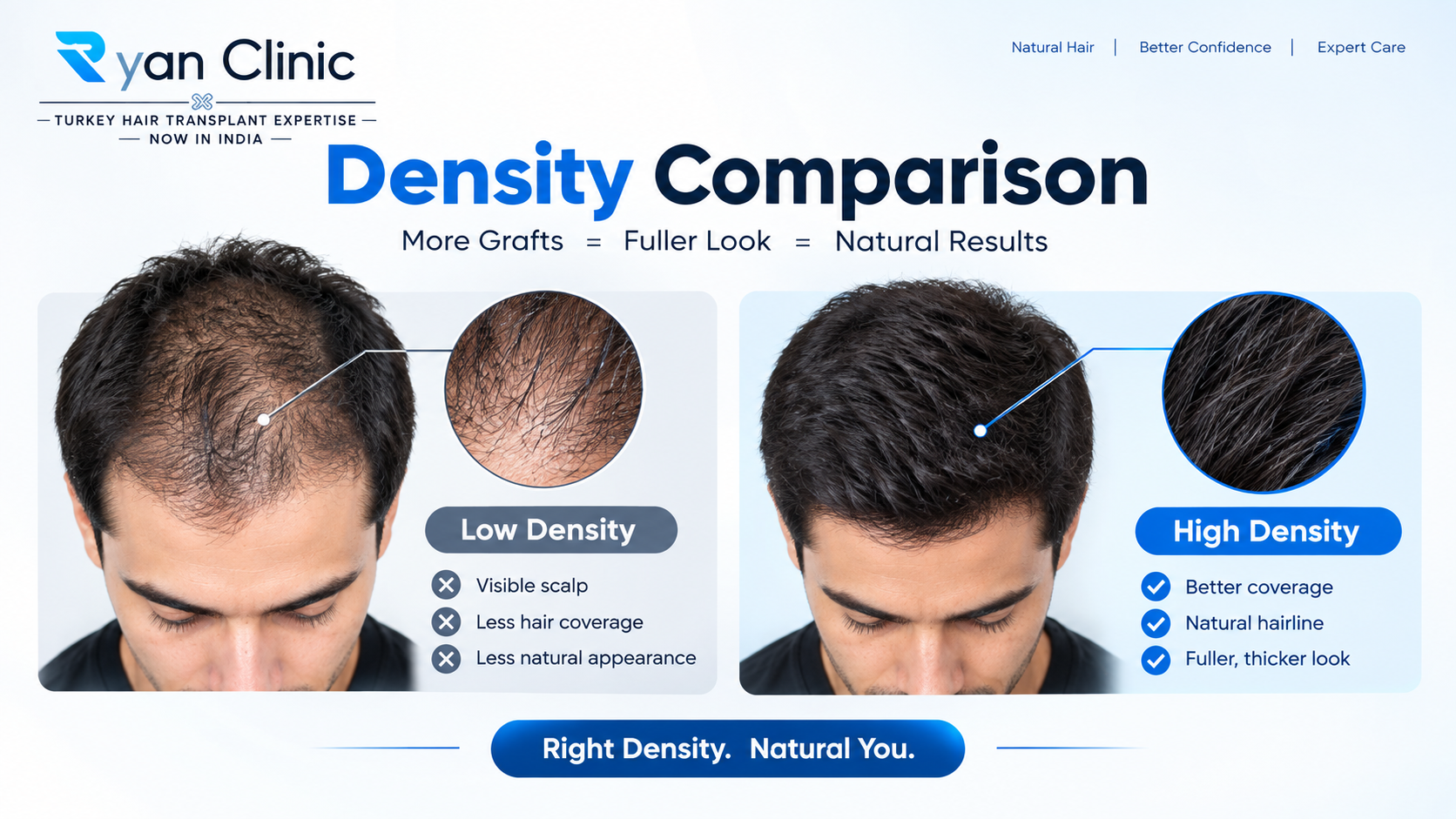
Native scalp holds 80–100 grafts per cm², but roughly half of that looks full. See what density each zone actually needs — and the simple math to check any clinic's quote yourself.
Native scalp holds 80–100 grafts per cm², but roughly half of that looks full. See what density each zone actually needs — and the simple math to check any clinic's quote yourself.
A full native scalp holds 80 to 100 follicular units per cm². Transplants target 35 to 45 in the frontal third, 25 to 35 in the mid-scalp and 20 to 30 at the crown. That's under half of native density — but roughly 50% of native reads as "full" to the eye. Packing above 50 reduces graft survival without a proportionate gain in appearance.
Key points :
Density is measured in follicular units per cm², not hairs — one unit holds 1 to 4 hairs
Below 30 FU/cm², scalp shows through in bright overhead light
Above 50, blood supply to the recipient area becomes the limiting factor and survival falls
The hairline's front row is deliberately sparser, using single-hair grafts for a soft edge
Coarse hair covers two to three times more scalp per graft than fine hair
You can audit any quote yourself: grafts ÷ area = density
Two different numbers get called density, and confusing them is how patients get misled.
Follicular unit density is the number of grafts per cm². A follicular unit is a natural cluster containing 1 to 4 hairs. Hair density is the number of individual hairs per cm².
On Indian scalp hair, a follicular unit averages about 2 to 2.3 hairs. So a scalp at 90 FU/cm² carries roughly 200 hairs per cm².
Surgeons plan in follicular units. Marketing often quotes hairs, because the number is twice as large. When a clinic advertises "up to 100 units of density" or "9,000 hairs implanted", ask them to restate it as follicular units per cm² — that's the number that determines what you'll see in the mirror.
Native density by population varies meaningfully:
Hair type | Typical native density |
Caucasian | 80–100 FU/cm² |
South Asian / East Asian | 60–85 FU/cm² |
African | 50–70 FU/cm² |
South Asian scalps commonly sit in the 60–85 range — below the global average in unit count, but with coarser individual shafts that compensate substantially for coverage.
Why half of native density looks full
This is the concept that makes hair transplantation viable at all.
Scalp becomes visible when light reflects off skin between hair shafts. You don't need to replace every follicle to stop that — you need enough shafts to interrupt the reflection. In practice, roughly 40 to 50% of native density reads as a full head of hair at conversational distance and in photographs.
That's why a transplant placed at 40 FU/cm² — under half of a native 90 — produces results that look complete. And it's why chasing native density is neither possible nor necessary: your donor supply couldn't fund it, and the visual return above 45 or so is marginal.
Density | Appearance | Where it's used |
15–20 FU/cm² | Visibly thin; scalp shows clearly | Large-area coverage at Norwood 6–7 when donor is limited |
20–25 FU/cm² | Light coverage; visible in overhead light | Crown, or mid-scalp in advanced cases |
25–30 FU/cm² | Acceptable; reads as full at a distance, thin in bright light | Mid-scalp; crown in favourable cases |
30–35 FU/cm² | Good; convincing in most conditions | Mid-scalp, or frontal in coarse/curly hair |
35–45 FU/cm² | Natural; the standard frontal target | Frontal third and hairline zone |
45–55 FU/cm² | Dense packing; diminishing visual return | Small refinement areas only |
55+ FU/cm² | Survival risk outweighs benefit | Rarely justified |
The practical threshold is 30. Below it, most patients see scalp through the result under office lighting or sunlight — which is exactly when they'll be looking.
It seems intuitive that more grafts per cm² means a better result. Past a point, it doesn't, for three reasons.
Blood supply is the binding constraint. Each transplanted graft needs the recipient area to supply it with blood within the first few days. Recipient sites packed very tightly compete for the same vascular bed. Above roughly 50 FU/cm², a measurable proportion of grafts fail to establish supply and are lost — so you pay for grafts, permanently spend donor sites, and don't get the hair.
Tissue trauma rises. Cutting a large number of channels in a small area of scalp increases swelling and disrupts the existing microvasculature, which compounds the first problem.
The visual return flattens. Going from 40 to 50 FU/cm² costs 25% more grafts for a difference most people cannot see. At Norwood 4 or above, those grafts are far better spent extending coverage backward than thickening an area that already looks full.
The economics make the same point. Density × area = grafts = cost. Raising your frontal density from 35 to 45 across a 60 cm² area adds 600 grafts — ₹36,000 to ₹66,000 on Sapphire FUE rates, and 600 grafts permanently removed from a finite donor supply.
Ask what a clinic proposing "maximum density" is trading away to fund it.
A good surgical plan does not use one density across the scalp. It varies deliberately.
Zone | Density | Graft type | Reasoning |
Transition zone (front 0.5–1 cm) | 20–30 FU/cm² | Single-hair grafts only, irregular | Mimics the soft, broken natural hairline edge |
Defined hairline (next 1–2 cm) | 35–45 FU/cm² | 1–2 hair grafts | Creates visual density behind the soft edge |
Frontal third | 35–45 FU/cm² | 2–3 hair grafts | Frames the face; highest priority zone |
Mid-scalp | 25–35 FU/cm² | 2–3 hair grafts | Blends front to back |
Crown / vertex | 20–30 FU/cm² | 2–3 hair grafts, whorl pattern | Lowest priority; graft-hungry |
Temple points | 25–35 FU/cm² | Single-hair grafts, acute angle | Fine hair at a very flat angle |
The counterintuitive part is the front. The very first row is deliberately sparser and irregular, built from single-hair grafts. A natural hairline is not a line — it's a soft, broken transition. Packing multi-hair grafts densely into the front row produces the hard, pluggy edge that makes a transplant obvious from across a room.
So when a clinic quotes you "45 FU/cm² density", ask where. If the answer is "everywhere including the front row", the design is wrong regardless of the number
Two men can receive identical graft counts at identical densities and get visibly different coverage. The variable is hair characteristics.
Factor | Effect on coverage |
Shaft calibre | The biggest single variable. Coarse hair (above 80 microns) covers two to three times the scalp of fine hair (below 60 microns) at the same density. |
Hair-to-skin contrast | Dark hair on fair skin shows scalp readily. Lower contrast reads as denser at identical density. |
Curl and wave | Curly hair lifts off the scalp and covers substantially more area than straight hair. |
Hairs per follicular unit | A scalp averaging 2.8 hairs per unit delivers far more coverage than one averaging 1.8 at the same graft count. |
Length and styling | Slightly longer hair styled across the scalp dramatically improves apparent density. |
Many Indian patients have a genuine advantage here — coarse, dark, often wavy hair. A man with thick wavy hair at 30 FU/cm² can look denser than a man with fine straight hair at 40.
This is why any clinic quoting a graft number before examining your hair calibre under magnification is estimating rather than planning. Trichoscopy measures shaft diameter and hairs per unit, and both should feed into your graft count.
The arithmetic is simple, and doing it will tell you more than any consultation script.
Density = grafts ÷ area (in cm²)
Measuring your bald area at home: a standard credit card is about 46 cm². Hold it against the area you want restored and count how many would cover it. Two card-lengths across your frontal zone is roughly 92 cm².
Worked example : A clinic quotes 2,000 grafts for your frontal third. You estimate that area at 60 cm².
2,000 ÷ 60 = 33 FU/cm²
That's at the low end for a frontal zone. Acceptable if your hair is coarse and wavy; thin if it's fine and high-contrast. Either way, you now have a specific question to ask rather than a vague concern.
Reference table:
Area | At 30 FU/cm² | At 40 FU/cm² | At 50 FU/cm² |
50 cm² | 1,500 grafts | 2,000 | 2,500 |
75 cm² | 2,250 | 3,000 | 3,750 |
100 cm² | 3,000 | 4,000 | 5,000 |
150 cm² | 4,500 | 6,000 | 7,500 |
Warning signs in a quote:
A graft number with no stated area or density
One density figure applied across the whole scalp
Density promised above 55 FU/cm²
"Maximum density" language with no discussion of what's being traded
Density quoted in hairs rather than follicular units
No trichoscopy of your hair calibre before the number was produced
What a proper plan looks like in writing: area per zone, target density per zone, graft count per zone, and total. Ryan Clinic provides this at the free scalp analysis across our Delhi, Mumbai and Hyderabad branches.
The higher your stage, the more density becomes a rationing decision.
Stage | Approach |
Area is small and donor is intact. Full 40–45 FU/cm² across the front is affordable. | |
Density holds at the front; the crown gets 20–25 or is deferred. | |
Strategic distribution: 35–40 front, 25–30 mid-scalp, 20–25 or nothing at the crown. | |
Frontal framework at 30–35, with SMP behind to reduce contrast. |
Spreading grafts evenly at advanced stages is the classic error. A uniform 28 FU/cm² across a Norwood 6 scalp is technically full coverage and looks transparent everywhere. A dense front with a lighter back looks considerably better with the same graft count.
Frequently Asked Questions
A full native scalp carries 80 to 100 follicular units per cm², which is roughly 200 hairs. South Asian scalps commonly sit at 60 to 85 units, with coarser individual shafts that compensate for the lower count.
The frontal third and hairline target 35 to 45 follicular units per cm², the mid-scalp 25 to 35, and the crown 20 to 30. The very front transition zone is deliberately sparser at 20 to 30, using single-hair grafts for a soft, natural edge.
It's the practical minimum for acceptable coverage. At 30 FU/cm² the result looks full at conversational distance but scalp may show in bright overhead light. It works better for coarse, wavy or low-contrast hair than for fine, straight, high-contrast hair.
No. Above roughly 50 follicular units per cm², recipient sites compete for blood supply and a measurable proportion of grafts fail to survive. The visual gain from 40 to 50 is small, while the graft cost is 25% higher and permanently spent.
Divide the graft count by the area in cm². A standard credit card is about 46 cm², which makes a useful measuring reference. For example, 2,000 grafts across a 60 cm² frontal zone gives 33 follicular units per cm².
Because a natural hairline is a soft, irregular transition rather than a line. The front 0.5 to 1 cm uses single-hair grafts at lower density, with density building behind it. Packing multi-hair grafts into the front row creates the hard, pluggy edge that makes transplants obvious.
Substantially. Coarse hair above 80 microns covers two to three times more scalp than fine hair below 60 microns at the same density. Curl, hair-to-skin contrast and hairs per follicular unit also change the graft count needed for the same visual result.
It can be placed, but survival falls sharply at those densities because the recipient area cannot supply enough blood. The result is grafts paid for, donor sites permanently spent, and hair that never grows. Densities above 55 are rarely justified.
Sources :
Unger W., Shapiro R. Hair Transplantation, 5th edition — recipient density, dense packing and graft survival.
Beehner M. A comparison of hair growth at varying densities in follicular unit transplantation. Hair Transplant Forum International.
Mayer M., Perez-Meza D. Graft survival at different densities in hair restoration surgery. Dermatologic Surgery.
Jimenez F., Ruifernández J.M. Distribution of human hair in follicular units: a mathematical model. Dermatologic Surgery.
International Society of Hair Restoration Surgery (ISHRS) — Practice Census and density planning guidance.
Indian Association of Dermatologists, Venereologists and Leprologists (IADVL) — androgenetic alopecia treatment guidelines.
About the author Dr. Pranendra Singh is a hair restoration surgeon at Ryan Clinic, Delhi, specialising in Sapphire FUE. Read full profile →
Medical disclaimer: This article is for general information and does not replace a personal medical consultation. Density targets, graft counts and outcomes vary between individuals. Please consult a qualified hair transplant surgeon to assess your suitability.
Book Your Free Consult Now!