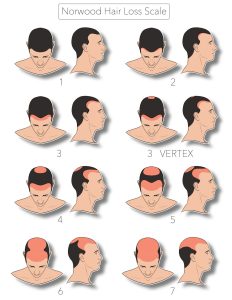
Norwood 3 needs 1,500–2,500 grafts, ₹53,000–₹2,75,000 in India. Get zone-wise counts, real before-after results & expert hairline design tips.
Norwood 3 needs 1,500–2,500 grafts, ₹53,000–₹2,75,000 in India. Get zone-wise counts, real before-after results & expert hairline design tips.
Norwood 3 typically needs 1,500 to 2,500 grafts, costing ₹53,000 to ₹2,75,000 in India depending on technique. It is the earliest stage most surgeons treat as clearly surgical, and it delivers the best result-per-graft ratio of any stage because the donor area is still intact and one session is usually enough.
Key points
Norwood 3 means temple recession beyond 2 cm — the first stage Norwood himself classified as balding
Zone-wise: hairline 800–1,200 grafts, temple points 400–800, mid-scalp blending 300–500
Norwood 3 Vertex adds crown thinning and pushes the count to 2,000–3,000
One session of 5 to 8 hours is almost always sufficient
Medication is not optional — it protects the native hair sitting behind your new hairline
Final result at 12 to 15 months; the 3-month shedding phase is normal, not failure
Norwood 3 is the third stage on the Hamilton-Norwood scale and the point at which male pattern hair loss becomes unmistakable. The defining feature is temple recession deeper than 2 cm behind the original juvenile hairline, creating a pronounced M or U shape at the front.
O'Tar Norwood, who revised the scale in 1975, drew the line here deliberately: stages 1 and 2 fall within the range of normal adult hairline maturation, while stage 3 represents the minimum degree of loss he considered genuinely balding.
Three variants matter clinically:
Variant | What it looks like | Grafts |
Norwood 3 | Deep symmetrical temple recession, forelock intact, crown normal | 1,500–2,500 |
Norwood 3 Vertex | Same frontal recession plus visible crown thinning | 2,000–3,000 |
Norwood 3A | Whole hairline recedes as a straight line; forelock lost early | 2,000–2,800 |
The Vertex distinction is the one to get right. Crown involvement at this stage signals faster overall progression, which changes three things: hairline design becomes more conservative, medication moves from recommended to essentially mandatory, and the surgeon plans donor spending around a likely Norwood 5 or 6 endpoint rather than a stable Norwood 3.
For the full staging system, see our Norwood scale guide for India.
The difference decides whether surgery makes sense now or in three years, so it is worth measuring rather than guessing.
Norwood 2 | Norwood 3 | |
Temple recession | Under 2 cm | Over 2 cm |
Shape | Shallow M | Deep M or U |
Visible in photos | Only from certain angles | Obvious from the front |
Forelock | Fully intact | Intact but narrowing |
Surgical consensus | Usually defer | Generally a good candidate |
Typical grafts | 700–1,200 | 1,500–2,500 |
If you measure under 2 cm, read our Norwood 2 guide instead — that stage is frequently a normal mature hairline rather than active loss, and surgery is often the wrong answer.
Graft requirement breaks down by zone rather than as a single number:
Zone | Grafts | Purpose |
Frontal hairline | 800–1,200 | Rebuilding the front edge and frontal third |
Temple points (both sides) | 400–800 | 200–400 per side; the biggest single factor in looking younger |
Mid-scalp blending | 300–500 | Only where density behind the hairline has dropped |
Standard Norwood 3 total | 1,500–2,500 | One session |
Norwood 3 Vertex | 2,000–3,000 | Add 500 or more for crown |
Norwood 3A | 2,000–2,800 | More frontal, less crown |
What actually moves your number within that range:
Donor density. Higher density means more available grafts and often a higher target density.
Hair calibre. Coarse hair covers far more scalp per graft than fine hair. Two men at identical Norwood 3 can need counts 500 grafts apart for the same visual result.
Hair-to-skin contrast. Dark hair on fair skin needs more grafts to avoid a see-through look than dark hair on darker skin.
Curl. Wavy and curly hair creates coverage illusion and can reduce requirement.
How low you want the hairline. Every centimetre lower costs hundreds of grafts and commits donor supply permanently.
Remember that a graft is not a hair. One follicular unit contains 1 to 4 hairs, averaging about 2 to 2.3 on Indian scalp hair — so 2,000 grafts delivers roughly 4,000 to 4,600 hairs. A clinic quoting you "9,000 hairs" is quoting about 4,000 grafts in inflated language. Always ask for the graft count.
Density targets for a natural Norwood 3 result: 35 to 45 follicular units per cm² across the frontal third, tapering to 25 to 35 through the mid-scalp. Below 30 FU/cm² the hairline looks transparent in bright light. Above 50, blood supply struggles and survival drops. Ask any clinic what density they plan, not just the graft total — see our density guide.
Norwood 3 hair transplant cost in India (2026)
Indian clinics price per graft. Technique drives the rate far more than city does.
Technique | Rate/graft | 1,500 grafts | 2,000 grafts | 2,500 grafts |
FUT (strip) | ₹25–₹40 | ₹37,500–₹60,000 | ₹50,000–₹80,000 | ₹62,500–₹1,00,000 |
Standard FUE | ₹35–₹55 | ₹52,500–₹82,500 | ₹70,000–₹1,10,000 | ₹87,500–₹1,37,500 |
Sapphire FUE | ₹60–₹110 | ₹90,000–₹1,65,000 | ₹1,20,000–₹2,20,000 | ₹1,50,000–₹2,75,000 |
DHI (Choi pen) | ₹70–₹130 | ₹1,05,000–₹1,95,000 | ₹1,40,000–₹2,60,000 | ₹1,75,000–₹3,25,000 |
Norwood 3 Vertex (2,000–3,000 grafts) runs ₹70,000–₹1,65,000 on standard FUE and ₹1,20,000–₹3,30,000 on Sapphire FUE.
Delhi NCR, Mumbai and Hyderabad market ranges as of 2026. Verify current pricing with any clinic directly.
FUT is a poor choice at Norwood 3. It leaves a permanent linear donor scar to treat a graft requirement that FUE handles comfortably. The saving is real, but so is the scar, and it limits short haircuts for life.
What quotes routinely leave out:
GST (cosmetic procedures are commonly billed at 18% — ask whether your figure is inclusive)
Pre-surgical blood work
Post-operative medication and the first wash
Follow-up consultations
PRP sessions, where part of the protocol
Add 20 to 30% to any headline number if these are excluded. Our full cost breakdown states Ryan Clinic's inclusions in writing before you commit.
On sub-₹30 quotes: in a metro, rates that low almost always mean technician-led surgery, where the doctor marks the hairline and leaves the room. Repairing a poor result costs more than the original procedure — and it consumes donor grafts you cannot replace.
Norwood 3 has the strongest cost-to-benefit profile of any stage, for four reasons:
Donor supply is untouched. You still have your full 5,000 to 8,000 lifetime grafts, so spending 2,000 leaves real reserve for later. At Norwood 6 the same 2,000 is a fragment of what's needed.
One session is enough. Under 2,500 grafts fits comfortably in a single day at safe out-of-body times. No 8-to-12-month wait for a second surgery.
Maximum visual return per graft. The frontal third frames the face. Restoring it changes how old you look more than any other zone — and it is exactly the area Norwood 3 affects.
There is native hair to blend into. The forelock and mid-scalp are still present, so the transplant integrates rather than sitting alone. Well-executed Norwood 3 results are among the hardest to detect.
The trade-off is that expectations are correspondingly higher. At Norwood 5 any coverage is an improvement; at Norwood 3 your result sits next to your own untouched hair, so angle, direction and density have to be exact. This is where doctor-led work separates from technician-led work.
More Norwood 3 results are ruined by design than by surgical technique. Three rules:
Do not restore the juvenile hairline: The low, straight, rounded hairline you had at 14 is not coming back, and rebuilding it at 30 looks wrong at 45 — by which time the hair behind it may have receded, leaving a transplanted strip stranded at the front. Surgeons place the mid-frontal point roughly 7 to 8 cm above the glabella (the ridge between the eyebrows) for exactly this reason.
The hairline must be irregular: A natural hairline is a soft, broken transition zone, not a line. It needs single-hair grafts in the front row, two-hair grafts behind them, and deliberate micro-irregularity. A straight, even hairline built from multi-hair grafts is the classic signature of a technician-led job and is visible from across a room.
Temple points are not optional. Skipping them saves 400 to 800 grafts and undermines the whole result — a restored frontal hairline with unrestored temples reads as obviously surgical. They also carry disproportionate weight in how young the face looks.
On the vertex at Norwood 3V: most surgeons prioritise the front and leave the crown for later or entirely. Crowns need high density to avoid a see-through whorl, and treating one that is still expanding wastes grafts. Front first is the standard, defensible plan.
Norwood 3 before and after: what a good result looks like
Realistic outcomes for a well-planned 2,000-graft Norwood 3 procedure:
Coverage: full frontal restoration with no visible density gradient into native hair
Detectability: effectively none once grown, at conversational distance or in photographs
Sessions: one, in the large majority of cases
Surgery duration: 5 to 8 hours under local anaesthesia, day procedure, no admission
Back to desk work: 5 to 7 days
Final result: 12 to 15 months
How to read anyone's before-after photos — including ours. Genuine comparisons match on every variable except the hair:
Same angle, same distance, same lens
Same lighting, ideally overhead and diffuse
Both photos dry, or both wet — never one of each (wet hair looks thinner)
Same hair length and styling
Time elapsed stated explicitly, and at least 12 months
Graft count and Norwood stage disclosed
A "before" shot in harsh top-down light with wet, flattened hair next to an "after" in soft frontal light with dry, styled hair can show dramatic improvement with no surgery at all. If a clinic won't state the graft count and timeframe under a photo, treat it as marketing rather than evidence. Our results gallery lists both.
Recovery and growth timeline
Timepoint | What happens |
Days 1–3 | Swelling across the forehead, redness at recipient sites, scabs form |
Days 5–7 | Scabs soften; most patients return to desk work |
Days 10–14 | Scabs cleared; transplanted hairs begin to shed |
Weeks 3–6 | Shock shedding — transplanted hairs fall out. Normal and expected. |
Weeks 6–12 | The "ugly duckling" phase. Nothing visible is happening. Most patients panic here. |
Months 3–4 | First new growth: fine, sparse, lighter in colour |
Months 6–9 | Noticeable density; hair thickens and darkens |
Months 12–15 | Final result |
Shedding at week 3 is not failure. The transplanted follicle survives beneath the skin and re-enters its growth cycle; only the hair shaft is lost. Detailed aftercare is in our first 10 days guide.
A transplant replaces hair you have already lost. It does nothing to stop the hair you still have from going.
At Norwood 3 you retain a full forelock and mid-scalp. Those follicles are DHT-sensitive and will continue to miniaturise if untreated. Transplant a dense hairline at 30 without addressing ongoing loss, and by 38 you can have a transplanted front sitting ahead of a newly thinned mid-scalp — a harder and more expensive problem than the one you started with.
The standard options are finasteride and topical minoxidil, both requiring a doctor's assessment for suitability and side-effect profile. Many surgeons ask patients to be stable on medication for 6 to 12 months before operating, precisely so the surgical plan is built on a known trajectory rather than a guess.
Hairline placed too low. Looks impressive at 12 months, wrong at 45, and permanently spends donor grafts.
Skipping temple points to save money, producing an obviously surgical frontal line.
Multi-hair grafts in the front row, creating a hard, pluggy edge.
No medication, guaranteeing progression behind the graft line.
Treating the crown first at Norwood 3V, spending grafts on an expanding zone.
Choosing on price alone. The gap between a ₹28/graft and a ₹75/graft procedure is usually who holds the instrument.
Not photographing your baseline. Without dated before photos in consistent light, you cannot properly assess your own result.
What to do next
Measure your recession from the juvenile hairline and confirm you are past 2 cm.
Photograph your hairline — front, both 45° angles, top-down, dry, in even light. Date them.
Get trichoscopy, including of the donor area, to check density and rule out diffuse unpatterned loss.
Discuss medication and, ideally, establish stability before booking surgery.
Verify who operates. Confirm the doctor personally performs extraction, channel creation and implantation, and check their NMC registration.
Ryan Clinic offers a free scalp analysis with graft count and a written cost breakdown at our Delhi, Mumbai and Hyderabad branches.
Norwood 3 typically needs 1,500 to 2,500 grafts — around 800 to 1,200 for the hairline, 400 to 800 for temple points and 300 to 500 for mid-scalp blending. Norwood 3 Vertex requires 2,000 to 3,000 because of crown involvement.
Between ₹53,000 and ₹2,75,000, depending on technique and graft count. Standard FUE runs ₹35–₹55 per graft, Sapphire FUE ₹60–₹110 and DHI ₹70–₹130. Confirm whether GST, medication and follow-ups are included.
Yes, in almost all cases. Most clinics safely place 2,500 to 3,500 grafts in a single day, so a Norwood 3 requirement of 1,500 to 2,500 fits comfortably. Surgery takes 5 to 8 hours under local anaesthesia as a day procedure.
No. Norwood 3 is the earliest stage most surgeons consider clearly surgical, because recession is definite rather than developmental. Age matters more than stage — under about 25, surgeons often advise medication first while the pattern is still unpredictable.
Transplanted hairs shed at 3 to 6 weeks, new growth begins at 3 to 4 months, noticeable density arrives at 6 to 9 months, and the final result appears at 12 to 15 months.
It should, provided the hairline is irregular rather than straight, single-hair grafts are used in the front row, temple points are restored, and density reaches 35 to 45 follicular units per cm². Design failures, not surgical ones, cause most unnatural results.
Most surgeons strongly recommend it. Transplanted grafts are permanent, but the native forelock and mid-scalp behind them remain DHT-sensitive and will keep thinning. Medication protects that hair; surgery does not.
Usually not first. Surgeons generally prioritise the frontal third because it frames the face and delivers more visual impact per graft. A crown that is still expanding can consume grafts without producing a lasting result.
heck that both photos match on angle, distance, lighting, hair length and wet-or-dry state, and that the graft count, Norwood stage and time elapsed are stated. Photos without those details are marketing, not evidence.
Sources
Norwood O.T. Male pattern baldness: classification and incidence. Southern Medical Journal, 1975.
Hamilton J.B. Patterned loss of hair in man: types and incidence. Annals of the New York Academy of Sciences, 1951.
International Society of Hair Restoration Surgery (ISHRS) — Practice Census and graft planning guidance.
Indian Association of Dermatologists, Venereologists and Leprologists (IADVL) — androgenetic alopecia treatment guidelines.
Shapiro R. Principles and techniques used to create a natural hairline in surgical hair restoration. Facial Plastic Surgery Clinics of North America.
Unger W., Shapiro R. Hair Transplantation, 5th edition — hairline design and density planning.
About the author Dr. Pranendra Singh is a hair restoration surgeon at Ryan Clinic, Delhi, specialising in Sapphire FUE. Read full profile →
Medical disclaimer: This article is for general information and does not replace a personal medical consultation. Graft counts, costs and outcomes vary between individuals. Please consult a qualified hair transplant surgeon to assess your suitability.
Book Your Free Consult Now!