See the real graft count (700–1,200), 2026 pricing in rupees, and the trichoscopy test that tells you if it's a mature hairline or actual hair loss — before you book anything.
See the real graft count (700–1,200), 2026 pricing in rupees, and the trichoscopy test that tells you if it's a mature hairline or actual hair loss — before you book anything.
Norwood 2 typically needs 500 to 1,500 grafts, most often around 800 to 1,200 for hairline refinement plus temple points. In India this costs roughly ₹40,000 to ₹1,35,000 depending on technique. However, most Norwood 2 patients are not yet surgical candidates — a mature hairline is normal, not balding.
Key points
Norwood 2 recession is usually under 2 cm behind the juvenile hairline, in a symmetrical M-shape
Graft counts by zone: hairline 400–700, temple points 300–600, Norwood 2A up to 1,200
Indian cost ranges from about ₹40 per graft for standard FUE to ₹110+ for Sapphire FUE and DHI
Most men under 27 with Norwood 2 should start medication and reassess after 12–24 months
Transplanting too early risks donor depletion and an unnatural result as loss progresses behind the graft line
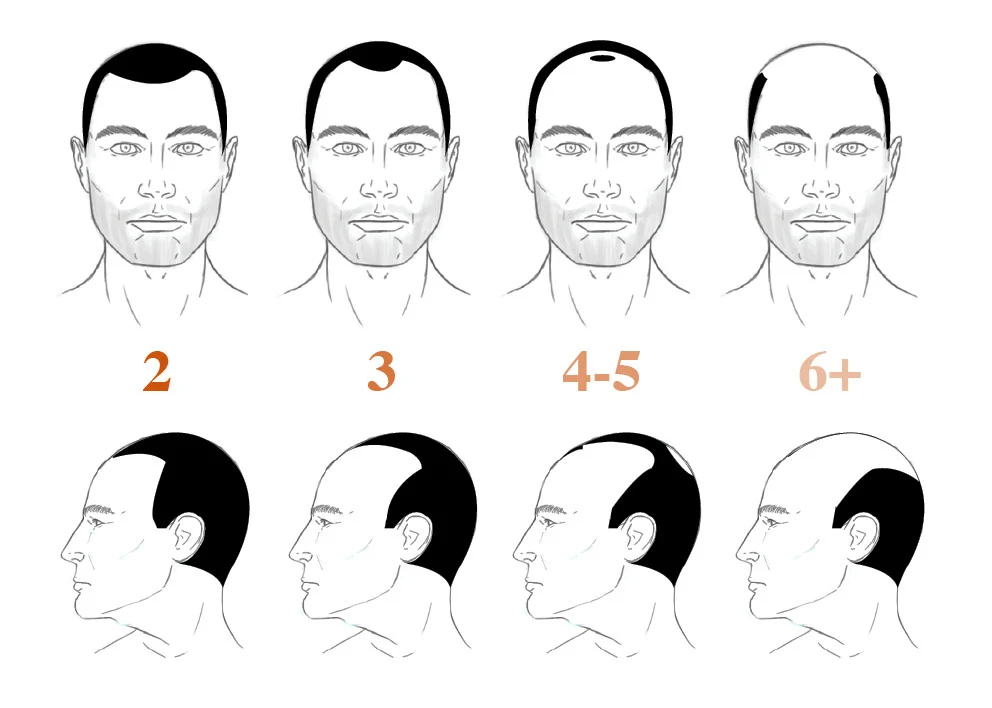
Norwood 2 is the second stage on the Hamilton-Norwood scale, the standard classification surgeons use for male pattern hair loss. At this stage the hairline has moved back symmetrically at both temples, forming a shallow M or triangular shape, while the central forelock stays intact and the crown is untouched.
The defining measurement is depth. In Norwood 2, recession at the temples is generally under 2 cm behind the original juvenile hairline — the low, straight, rounded hairline most boys have before puberty. Beyond that depth, you are moving into Norwood 3, which is the first stage most surgeons treat as clearly surgical.
Two variants matter:
Norwood 2A — the whole front hairline moves back as a straight line rather than receding at the corners. The forelock is lost early. This variant needs more grafts than standard Norwood 2.
Norwood 2 Vertex — mild temple recession plus early thinning at the crown. This signals faster progression and changes the plan significantly.
This is the most important question on this page, and it is the one that gets skipped most often.
A mature hairline is a normal developmental change, not balding. Between roughly ages 17 and 29, most men lose the low juvenile hairline and settle into an adult one that sits about 1 to 2 cm higher, with slightly squared-off corners. It stops there. It is not progressive and it does not need treatment.
Androgenetic alopecia at Norwood 2 looks similar at a glance but behaves differently. Here is how a surgeon tells them apart:
Signal | Mature hairline | Early androgenetic alopecia |
Progression | Stops and stays stable for years | Continues moving back every 12–24 months |
Miniaturisation | Absent behind the hairline | Present — thin, short, wispy hairs mixed with normal ones |
Density behind hairline | Unchanged | Measurably reduced on trichoscopy |
Crown | Normal | May show early diffuse thinning |
Shed rate | Normal | Elevated, often noticed on the pillow or in the shower |
Family history | Not predictive | Strong maternal or paternal pattern |
The practical test is trichoscopy — a magnified scalp examination that measures hair shaft diameter variation. Variation above roughly 20% behind the hairline indicates active miniaturisation and genuine pattern loss. Two photographs taken 12 months apart under the same lighting are the second-best test and cost nothing.
If you have a mature hairline with no miniaturisation, you do not have hair loss and you do not need a hair transplant. A clinic that recommends surgery anyway is one you should walk away from.
For genuine Norwood 2 androgenetic loss, graft counts break down by zone:
Zone | Grafts needed | Notes |
Frontal hairline refinement | 400–700 | Lowering and softening the front edge |
Temple points (both sides) | 300–600 | 150–300 per side; heavily affects how young you look |
Mid-scalp blending | 0–300 | Only if density behind the hairline has dropped |
Standard Norwood 2 total | 700–1,200 | Most common range |
Norwood 2A total | 900–1,500 | Straight-line recession covers more surface area |
Norwood 2 Vertex | 1,000–1,600 | Add 300–500 for early crown work |
A graft is not a hair. One graft is a follicular unit containing 1 to 4 hairs. Indian scalp hair averages roughly 2 to 2.3 hairs per graft, so 1,000 grafts delivers approximately 2,000 to 2,300 hairs. Any clinic quoting you in "hairs" rather than grafts is inflating the number — always ask for the graft count.
Density matters as much as count. The frontal third is normally packed at 35 to 45 follicular units per cm² for a natural result. Below 30 FU/cm² the hairline looks see-through in bright light. Above 50 FU/cm², graft survival starts to drop because the blood supply cannot support the packing. Ask any clinic what density they plan, not just how many grafts.
For how graft counts scale at later stages, see our guides to Norwood 3 and the full Norwood scale.
Usually not yet. Here is the honest breakdown.
Reasons to wait
Your loss is still active. Transplanted hair is permanent, but the native hair behind it is not. Place a dense hairline at 23 and lose the mid-scalp at 30, and you are left with an island of transplanted hair floating in front of a bald patch. Fixing that costs more than the first surgery.
Donor supply is finite. You have roughly 6,000 to 8,000 lifetime extractable grafts. Spending 1,200 on cosmetic refinement at Norwood 2 leaves less for Norwood 5 later.
Medication works best early. At Norwood 2 the follicles are miniaturised, not dead. This is the stage where finasteride and topical minoxidil have the highest chance of holding or partly reversing the loss — an outcome surgery cannot deliver.
Age. Most surgeons apply a soft floor around 25 to 27 for elective hairline work, because the final pattern is not yet predictable before then.
Reasons surgery is reasonable at Norwood 2
You are 28 or older and your hairline has been stable for at least two years
You have been on medical therapy for 12+ months and loss is arrested
The concern is temple points specifically — these rarely regrow with medication
You have a congenitally high hairline rather than progressive loss
The recession is from scarring, trauma or traction rather than androgenetic causes
At Ryan Clinic, a meaningful share of Norwood 2 consultations end with a recommendation to start medication and return in a year rather than book surgery. If your consultation does not include that conversation as a possibility, get a second opinion. More on this in our clinic selection checklist.
Indian clinics price per graft. The technique drives the rate far more than the city does.
Technique | Per graft | 800 grafts | 1,200 grafts | 1,500 grafts |
FUT (strip) | ₹25–₹40 | ₹20,000–₹32,000 | ₹30,000–₹48,000 | ₹37,500–₹60,000 |
Standard FUE | ₹35–₹55 | ₹28,000–₹44,000 | ₹42,000–₹66,000 | ₹52,500–₹82,500 |
Sapphire FUE | ₹60–₹110 | ₹48,000–₹88,000 | ₹72,000–₹1,32,000 | ₹90,000–₹1,65,000 |
DHI (Choi pen) | ₹70–₹130 | ₹56,000–₹1,04,000 | ₹84,000–₹1,56,000 | ₹1,05,000–₹1,95,000 |
Ranges reflect Delhi NCR, Mumbai and Hyderabad market rates as of 2026. Verify current pricing directly with any clinic.
FUT is rarely appropriate at Norwood 2 : It leaves a linear donor scar to treat a cosmetic-grade recession — a poor trade at this stage.
What the quote should include, and often does not:
GST (cosmetic procedures are commonly billed at 18% — confirm whether your quote is inclusive)
Pre-surgical blood work
Post-operative medication and the first wash
Follow-up consultations
PRP sessions, if part of the protocol
Add roughly 20 to 30% to any headline figure if these are excluded. Our full cost breakdown sets out Ryan Clinic's inclusions in writing before you commit.
A note on very cheap quotes : Rates below ₹30 per graft in a metro almost always mean technician-led surgery, where the doctor marks the hairline and leaves. Graft survival in technician-led work runs far below doctor-led figures, and a failed 1,000-graft procedure costs more to repair than it cost to perform.
Norwood 2 has the best outcome profile of any stage, because the surface area is small and there is native hair to blend into.
Coverage: full, with no visible density gradient, in the large majority of well-planned cases
Sessions: one is almost always sufficient
Surgery time: 4 to 6 hours for 800 to 1,200 grafts
Back to desk work: 5 to 7 days
Detectability: effectively zero once grown, because the transplant blends into existing hair rather than standing alone
The trade-off is that expectations are higher. At Norwood 5, any coverage is an improvement. At Norwood 2, the result sits next to your own untouched hair, so hairline design, graft angle and density have to be exact. This is precisely where doctor-led work separates from technician-led work.
Norwood 2 recovery and growth timeline
Timepoint | What happens |
Days 1–3 | Swelling and redness at the recipient site |
Days 5–7 | Scabs soften; most patients return to desk work |
Day 10–14 | Scabs cleared; transplanted hairs begin to shed |
Weeks 3–6 | Shock shedding — normal and expected, not failure |
Months 3–4 | First new growth appears, fine and sparse |
Months 6–9 | Noticeable density; hair thickens and darkens |
Months 12–15 | Final result at Norwood 2, usually earlier than at higher stages |
Detailed aftercare is covered in our first 10 days guide.
Photograph your hairline — front, both 45° angles, top-down, in the same light. Repeat in 6 and 12 months.
Get a trichoscopy assessment - not just a visual look. Ask for the miniaturisation percentage.
Discuss medical therapy first - Finasteride and minoxidil carry real side-effect considerations that need a doctor's input, but they are the correct first line at this stage.
Reassess at 12 months - If stable and you still want temple points or hairline refinement, surgery becomes a reasonable elective choice.
If you do proceed, verify the surgeon - Confirm the doctor performs extraction, channel creation and implantation personally — and check their NMC registration
Frequently Asked Questions
Most Norwood 2 cases need 700 to 1,200 grafts. Norwood 2A can require up to 1,500 because straight-line recession covers more area. The exact count depends on temple depth, desired density and your donor supply.
Roughly ₹40,000 to ₹1,35,000 for 800 to 1,200 grafts, depending on technique. Standard FUE runs ₹35–₹55 per graft, Sapphire FUE ₹60–₹110, and DHI ₹70–₹130. Confirm whether GST and follow-ups are included.
Both look similar. A mature hairline sits 1–2 cm higher than the juvenile one and then stays stable, with no miniaturisation behind it. Androgenetic Norwood 2 keeps progressing and shows thin, wispy miniaturised hairs on trichoscopy.
Can I get a hair transplant at Norwood 2 if I am 22?
Most surgeons will advise against it. Before about 25 to 27 the final loss pattern is unpredictable, and placing a dense hairline early can leave transplanted hair isolated in front of later loss. Medication first is the standard recommendation.
It can partly reverse recent miniaturisation and, more importantly, arrest progression in a majority of men who take it consistently. It is most effective at early stages like Norwood 2. It requires a doctor's assessment because of its side-effect profile.
Not when well planned. Because grafts blend into surrounding native hair rather than sitting in a bald field, Norwood 2 results are among the hardest to detect — provided hairline design, angle and density are correct.
Typically 4 to 6 hours for 800 to 1,200 grafts, under local anaesthesia, as a day procedure with no hospital admission.
Not necessarily. At these graft volumes, partial-shave and no-shave options are often feasible, though they take longer and usually cost more per graft.
Sources
Norwood O.T. Male pattern baldness: classification and incidence. Southern Medical Journal, 1975.
Hamilton J.B. Patterned loss of hair in man: types and incidence. Annals of the New York Academy of Sciences, 1951.
International Society of Hair Restoration Surgery (ISHRS) — practice census and graft-count guidance.
Indian Association of Dermatologists, Venereologists and Leprologists (IADVL) — androgenetic alopecia treatment guidelines.
Rassman W.R. et al. Hair densitometry and miniaturisation assessment. Dermatologic Surgery.
About the author Dr. Pranendra Singh is a hair restoration surgeon at Ryan Clinic, Delhi, specialising in Sapphire FUE. Read full profile →
Medical disclaimer: This article is for general information and does not replace a personal medical consultation. Graft counts, costs and outcomes vary between individuals. Please consult a qualified hair transplant surgeon to assess your suitability.
Book Your Free Consult Now!