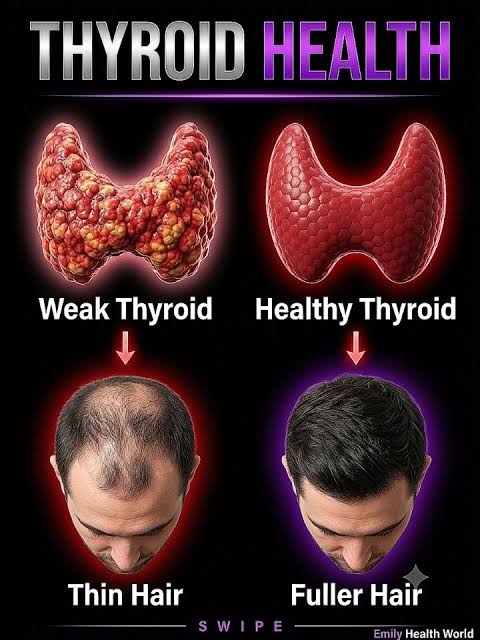
Usually, yes — without surgery. See how thyroid-driven shedding differs from pattern baldness, why hair often falls more right after starting treatment, and when a transplant actually becomes the right call.
Usually, yes — without surgery. See how thyroid-driven shedding differs from pattern baldness, why hair often falls more right after starting treatment, and when a transplant actually becomes the right call.
For most people, treatment — not a transplant. Thyroid hair loss is diffuse rather than patterned, and it is usually reversible: regrowth typically begins 3–6 months after TSH normalises, with fuller recovery by 12 months. A transplant is only appropriate if genuine pattern baldness exists underneath, and only once thyroid levels have been stable for at least six months.
Key points :
Thyroid hair loss thins hair all over the scalp; pattern baldness recedes at the temples and crown
Both an underactive and an overactive thyroid cause it, through the same mechanism — follicles pushed early into the resting phase
Shedding usually appears 2–3 months after the thyroid disturbance, which is why the cause is often missed
Regrowth follows correction of TSH, not surgery. Transplanting diffusely thinning hair wastes grafts
Shedding often increases in the first 2–3 months of levothyroxine. This is expected and temporary — it is not a reason to stop
Surgery becomes reasonable once TSH is stable for 6 months on an unchanged dose and patterned loss is confirmed
Yes, and both directions do it.
Thyroid hormone is one of the signals that controls the hair growth cycle. When levels fall too low (hypothyroidism) or rise too high (hyperthyroidism), a large share of follicles leave the growing phase early and enter the resting phase together. Two to three months later they shed as a group. This is called telogen effluvium, and it is why the hair fall seems to arrive out of nowhere long after you started feeling tired or anxious.
The two conditions look slightly different:
Hypothyroidism — hair becomes dry, coarse and brittle; thinning is diffuse; the skin is dry and the scalp may be too. A classic and often-missed sign is thinning of the outer third of the eyebrows.
Hyperthyroidism — hair becomes unusually fine and soft; thinning is diffuse; often accompanied by weight loss, heat intolerance and palpitations.
In India, hypothyroidism is by far the more common of the two, and it is substantially more common in women.
This is the question that decides everything, and you can get most of the way there by looking in a mirror.
Thyroid hair loss | Pattern baldness (androgenetic) | |
|---|---|---|
Pattern | Diffuse — thinner everywhere, including the back and sides | Specific zones: temples, hairline, crown |
Donor area | Also affected | Preserved — this is the defining feature |
Onset | Fairly sudden, over weeks | Gradual, over years |
Shedding | Large volumes on the pillow, in the shower, in the comb | Slow thinning; less dramatic daily shedding |
Hair quality | Texture changes — coarse and dry, or unusually fine | Hairs miniaturise: thinner and shorter, texture normal |
Other signs | Fatigue, weight change, cold or heat intolerance, dry skin, eyebrow thinning | None |
Reversible? | Usually, with treatment | No — progressive without medication |
Right treatment | Correct the thyroid | Medication, and surgery if appropriate |
The single most useful question: is the back and sides of your head also thinner? Pattern baldness spares the donor zone almost entirely. Thyroid-driven shedding does not. If your barber has commented that the back is thinner too, that is not male pattern baldness alone.
The complication is that the two can coexist — and frequently do. A man of 38 can have both an underactive thyroid and inherited pattern baldness. In that case the diffuse component recovers with treatment and the patterned component does not, which is precisely why the thyroid must be corrected first. Otherwise nobody, surgeon included, can see what is actually there.
Usually, yes. The rough timeline:
Stage | What happens | When |
|---|---|---|
Treatment starts | TSH begins moving toward normal | Week 0 |
Possible increased shedding | A new wave of telogen hairs releases | Weeks 4–12 |
TSH stabilises in range | Dose settled by your physician | Month 2–4 |
Regrowth begins | New short hairs visible at the hairline and parting | Month 3–6 |
Noticeable density returns | Regrown hair reaches usable length | Month 6–9 |
Full recovery | As good as it is going to get | Month 12–18 |
Hair grows about a centimetre a month. That is the constraint, and no treatment shortens it. Anyone offering you faster regrowth is selling something.
Recovery is usually good but not always complete — particularly if the thyroid was uncontrolled for years, or if pattern baldness was progressing quietly underneath the whole time.
Usually, yes. The rough timeline:
Stage | What happens | When |
|---|---|---|
Treatment starts | TSH begins moving toward normal | Week 0 |
Possible increased shedding | A new wave of telogen hairs releases | Weeks 4–12 |
TSH stabilises in range | Dose settled by your physician | Month 2–4 |
Regrowth begins | New short hairs visible at the hairline and parting | Month 3–6 |
Noticeable density returns | Regrown hair reaches usable length | Month 6–9 |
Full recovery | As good as it is going to get | Month 12–18 |
Hair grows about a centimetre a month. That is the constraint, and no treatment shortens it. Anyone offering you faster regrowth is selling something.
Recovery is usually good but not always complete — particularly if the thyroid was uncontrolled for years, or if pattern baldness was progressing quietly underneath the whole time.
This catches out an enormous number of patients, and it makes some of them stop their tablets.
Starting levothyroxine resets the hair cycle. As the body returns to normal thyroid function, another cohort of follicles shifts phase together — and sheds. So shedding often increases for the first two to three months of treatment before it improves. It is a sign the cycle is restarting, not a sign the drug is harming you.
Do not stop or reduce your thyroid medication because your hair is falling. Tell your physician, who will check whether the dose is right. Stopping treatment guarantees the hair loss continues, and brings back everything else the thyroid was causing.
This also applies to anti-thyroid drugs used for hyperthyroidism, and to hair shedding after radioactive iodine or thyroid surgery.
When is a hair transplant actually the right answer?
A transplant moves hair. It does not treat thyroid disease, and it does nothing for diffuse shedding — transplanting into a scalp that is shedding everywhere spends permanent, finite grafts on a problem that was going to resolve on its own.
Surgery becomes reasonable when all of these are true:
Thyroid function has been stable for at least six months on an unchanged dose — TSH in range, confirmed on repeat testing
The loss is clearly patterned, with a preserved donor area that a surgeon has examined and measured
Diffuse shedding has settled — you are no longer losing hair by the handful
Other reversible causes have been excluded — iron deficiency, vitamin D and B12 deficiency, recent illness, crash dieting, medication effects
You have given regrowth enough time — at least 12 months from TSH normalising, so that what recovers has recovered
Donor density is adequate to cover the pattern without over-harvesting
If all six hold, thyroid disease is not an obstacle to a Sapphire FUE transplant. Well-controlled hypothyroid patients undergo hair restoration surgery routinely and heal normally.
TSH, free T4, and free T3 — the core panel
Anti-TPO antibodies — identifies autoimmune (Hashimoto’s) thyroid disease, which matters for the reason below
Ferritin — iron deficiency is extremely common in Indian women and causes its own diffuse shedding. A ferritin in the teens will undo any surgical result
Vitamin D and vitamin B12 — frequently low alongside thyroid disease
Complete blood count
Where relevant in women: a hormonal panel for PCOS, which causes a different and treatable pattern
A surgeon who books you for a transplant without seeing a current TSH is not diagnosing, only scheduling. Every plan at Ryan Clinic starts with the doctors establishing what kind of hair loss you actually have.
The autoimmune caution: Hashimoto’s and alopecia areata
Autoimmune thyroid disease travels in company. Patients with Hashimoto’s thyroiditis have a higher rate of other autoimmune conditions, including alopecia areata — hair loss in sharply defined round or oval patches, sometimes with a distinctive pitting of the nails.
This matters because alopecia areata is not treated with surgery. It is an immune attack on the follicle, the follicle usually survives, and hair frequently returns with medical treatment. Transplanting into an active patch can trigger loss of the transplanted hair as well — spending permanent grafts to feed the same immune process.
If your hair loss is in distinct patches rather than a general thinning or a receding pattern, you need a dermatologist, not a surgeon.
For a well-controlled thyroid patient, very little. What the surgical team needs to know:
Your current TSH and your dose, and that the dose has not changed recently
Take levothyroxine as usual on the morning of surgery — it is taken on an empty stomach, well before food, and a hair transplant does not require fasting, so this is straightforward. Do not skip it
Uncontrolled hypothyroidism slows wound healing and can affect heart rate and drug sensitivity. This is one of the reasons for the six-month stability rule
Uncontrolled hyperthyroidism is a genuine contraindication to elective surgery — the combination of surgical stress and adrenaline-containing local anaesthetic is one to avoid entirely until thyroid levels are controlled
If you are also diabetic or hypertensive, both are assessed alongside; thyroid, diabetes and blood pressure frequently appear together
Thyroid patients at Ryan Clinic
Ryan Clinic assesses thyroid-related hair loss as a diagnostic question before a surgical one. If your loss is diffuse and your thyroid is untreated or recently treated, you will be told to come back — not booked.
[CONFIRM AND ADD: whether you require a current TSH report from every patient; your stability window before operating (6 months, or your figure); whether you test or require ferritin, vitamin D and B12; whether you have a dermatologist on the team or a referral pathway for medical hair loss; your policy on patients presenting with patchy loss.]
Free scalp analyses are available at our Delhi, Mumbai and Hyderabad centres, and full pricing is on our hair transplant cost page.
Book a free scalp analysis — bring your most recent thyroid report, and we will tell you honestly whether you need surgery at all.
Usually, yes. Once TSH returns to normal and stays there, regrowth typically begins at 3–6 months and continues for 12–18 months. Recovery may be incomplete if the thyroid was uncontrolled for years or if pattern baldness is also present.
Yes, provided thyroid levels have been stable for at least six months on an unchanged dose, the hair loss is clearly patterned with a preserved donor area, and diffuse shedding has settled. Well-controlled thyroid patients heal normally after surgery.
Thyroid hair loss is diffuse — thinner everywhere including the back and sides — and comes on over weeks with heavy shedding. Pattern baldness is gradual, affects the temples and crown, and spares the donor area at the back of the head.
Because levothyroxine resets the hair cycle, releasing another group of resting hairs. Increased shedding in the first two to three months of treatment is expected and temporary. Do not stop your medication — tell your physician, who will check the dose.
TSH within your laboratory’s normal range, stable on repeat testing over at least six months with no dose change. The exact target is set by your treating physician; surgeons look for stability over time rather than a single reading.
It can. Thinning of the outer third of the eyebrows is a recognised sign of hypothyroidism, and it is often the clue that separates thyroid-related hair loss from pattern baldness. It usually improves once thyroid levels are corrected.
Biotin does not treat thyroid hair loss, and high-dose biotin can interfere with thyroid blood tests and produce misleading results. Tell any lab that you take it, and stop it before testing if your physician advises.
Not directly, but autoimmune thyroid disease such as Hashimoto’s occurs more often alongside alopecia areata. Hair loss in sharply defined round patches needs dermatological assessment, not surgery — transplanting into an active patch can fail.
For more on planning a hair transplant, browse our more guides.
Sources :
Indian Thyroid Society / Indian Journal of Endocrinology and Metabolism — thyroid dysfunction prevalence and management in India.
Indian Journal of Dermatology / International Journal of Trichology — thyroid hormone and the hair follicle cycle; telogen effluvium in thyroid disease.
American Thyroid Association — patient guidance on hypothyroidism, hyperthyroidism and treatment effects.
International Society of Hair Restoration Surgery (ISHRS) — candidacy assessment and contraindications to hair restoration surgery.
Published literature on biotin interference with thyroid immunoassays.
About the author Dr. Pranendra Singh is a hair restoration surgeon at Ryan Clinic, Delhi, specialising in Sapphire FUE. Read full profile →
Medical disclaimer: This article is general information and does not replace medical advice. Thyroid diagnosis, dosing and monitoring are decided by your treating physician. Never stop, start or change thyroid medication on the basis of this article — including if your hair shedding increases after starting treatment.
Book Your Free Consult Now!