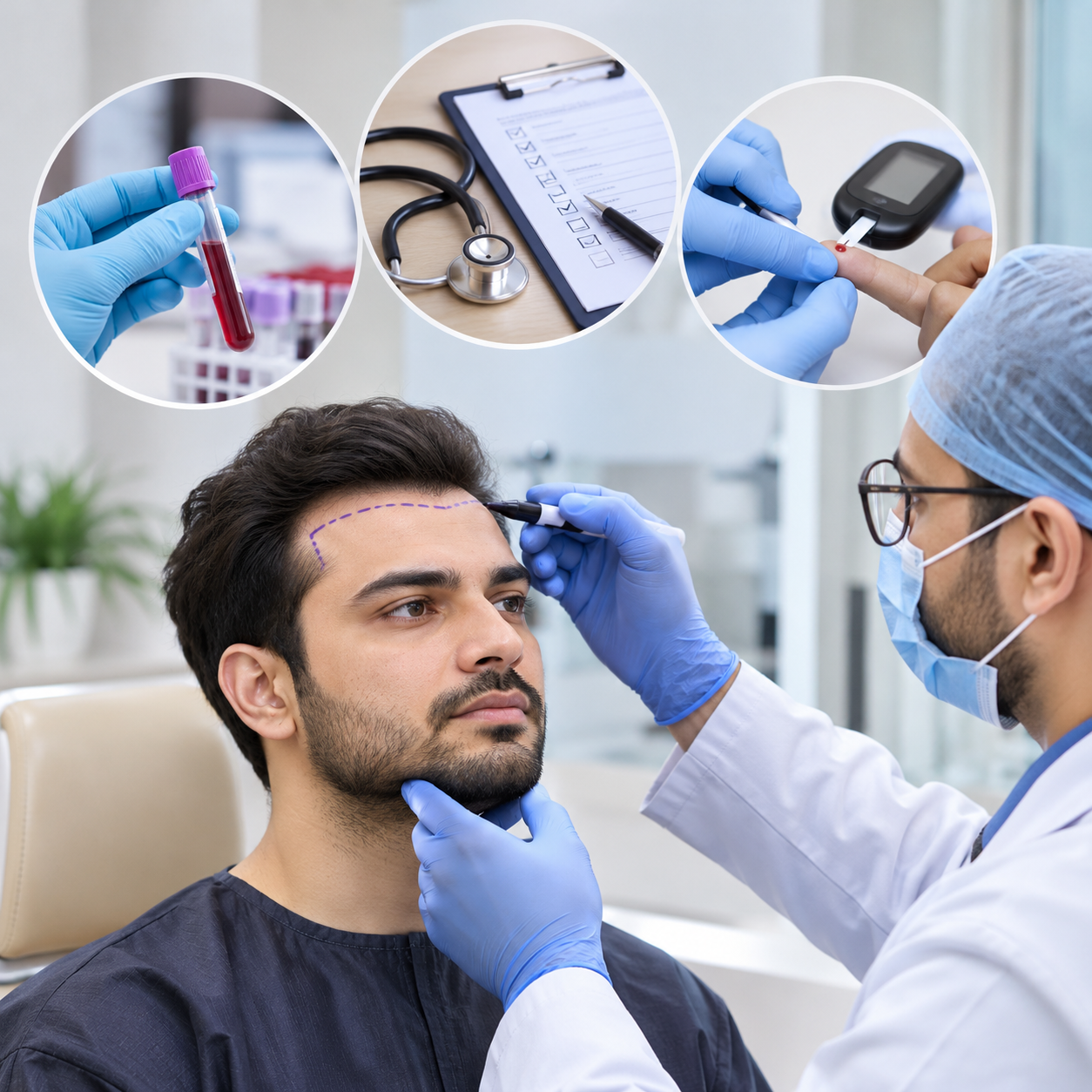
Planning a hair transplant? Learn about important pre-surgery blood tests, scalp examinations, and health assessments that help doctors evaluate your suitability and plan a safer procedure.
Planning a hair transplant? Learn about important pre-surgery blood tests, scalp examinations, and health assessments that help doctors evaluate your suitability and plan a safer procedure.
Thinking about getting a hair transplant? You might already be researching the best technique, comparing clinic prices, or imagining how your new hairline could look. But there's something equally important that deserves your attention before surgery: your health.
A hair transplant isn't just about moving hair from one part of your scalp to another. It's a medical procedure, and your doctor needs to make sure you're a suitable candidate before going ahead.
That's where medical tests before hair transplant surgery come in.
These tests help your doctor understand your general health, identify possible risks, and plan your treatment more carefully. The good news? Not everyone needs a long list of investigations. The tests recommended for you will depend on your health, medical history, and the procedure you're considering.
Let's understand what these tests are, why they matter, and how you can prepare for your hair transplant with greater confidence.
Imagine booking your hair transplant only to discover that an underlying health condition could affect your recovery. That's exactly the kind of situation a proper medical assessment aims to prevent.
Hair transplantation is usually performed under local anaesthesia, but it still involves minor surgical incisions. Your doctor needs to consider factors such as bleeding, healing, infections, and any medications you're currently taking.
Pre-surgery assessments can help doctors understand whether your body is ready for the procedure.
They may also identify health concerns that should be managed before surgery.
Remember, medical testing isn't about finding reasons to reject you for surgery. It's about helping your doctor make a safer, more informed treatment decision.
One of the tests your doctor may recommend is a Complete Blood Count, or CBC.
This test provides a basic picture of your blood health by measuring several important components.
For example, haemoglobin helps carry oxygen throughout your body. If your haemoglobin is significantly low, your doctor may want to investigate possible anaemia before surgery.
White blood cells are involved in your immune system, while platelets help your blood clot when you have a cut or injury.
Why does this matter for hair transplantation?
During the procedure, small openings are made in the scalp. Your doctor needs to consider whether any blood-related condition could affect bleeding or recovery.
A CBC alone cannot determine whether you're fit for surgery, but it can provide useful information when clinically indicated.
If so, your doctor may recommend checking your blood glucose before a hair transplant.
Do you have diabetes, or have you ever been told your blood sugar is higher than normal?
Two commonly used tests are fasting blood sugar and HbA1c.
Fasting blood sugar measures your glucose level after a specified period without food. HbA1c provides an estimate of your average blood sugar over the previous two to three months.
When diabetes is poorly controlled, wounds may take longer to heal, and the risk of infection can increase.
But having diabetes doesn't automatically mean you cannot get a hair transplant.
Many factors matter, including how well your condition is managed and your overall health. Your doctor will evaluate these before deciding whether surgery is appropriate.
That's why doctors sometimes recommend clotting tests before surgery.
These may include PT, INR, and aPTT.
The tests help assess specific parts of the blood-clotting process.
If you've experienced unusual bleeding in the past, have a known clotting disorder, or take anticoagulant medication, your doctor may need additional information before planning your procedure.
However, these tests aren't routinely necessary for every healthy patient.
One important thing to remember: never stop aspirin or prescribed blood thinners on your own. Always discuss medication changes with your treating doctor and the doctor who prescribed them.
Some hair transplant clinics include screening for certain blood-borne infections in their pre-surgery protocols.
These may include hepatitis B, hepatitis C, and HIV.
You might wonder why these tests are discussed before a hair transplant.
The purpose is to identify health conditions that may need additional medical attention or affect procedural planning.
Testing should always follow applicable medical guidelines and requirements for consent and confidentiality.
A positive test result does not automatically rule out hair transplantation. Your medical team should assess your health and treatment options individually.
Your liver performs several important jobs, including processing many medications.
If you have a history of liver disease, unusual symptoms, or certain medical conditions, your doctor may recommend liver function tests.
These tests measure markers such as ALT, AST, bilirubin, and albumin.
The results may help your doctor understand whether a liver condition could influence medication choices or surgical planning.
Not every hair transplant patient needs liver function testing. Your doctor will decide based on your individual medical history.
Your kidneys help filter waste products from your blood and maintain the body's fluid balance.
For people with kidney disease, diabetes, high blood pressure, or other relevant health conditions, kidney function tests may be useful.
These tests commonly include serum creatinine and an estimated glomerular filtration rate, or eGFR.
If the results suggest a kidney-related concern, your doctor may recommend further evaluation before an elective procedure.
Again, the goal isn't to perform every possible test. It's to identify the investigations that are actually useful for your situation.
Here's something many people don't realize: not every type of hair loss needs a hair transplant.
Sometimes, thinning hair is linked to an underlying medical condition.
Thyroid disorders are one example.
Both an underactive and an overactive thyroid can affect the hair growth cycle, sometimes causing noticeable thinning.
If your doctor suspects a thyroid-related problem, they may recommend a thyroid-stimulating hormone (TSH) test.
Why is this important?
Because treating the underlying cause of hair loss may be more appropriate than immediately considering surgery.
This is especially relevant if you're experiencing widespread thinning rather than a typical pattern of hair loss.
Blood tests are useful, but they don't tell your doctor everything about your hair.
Before recommending transplantation, your doctor also needs to examine your scalp and donor area.
The donor area is usually the part of the scalp from which hair follicles will be extracted.
During your consultation, your doctor may look at your hair density, thickness, scalp health, hair loss pattern, and available donor follicles.
They may also use a magnifying examination technique called trichoscopy to look more closely at your scalp and hair.
This assessment helps determine whether you have enough suitable donor hair and whether transplantation is an appropriate option.
When choosing a Hair transplantation clinic, pay attention to how carefully the medical team evaluates your scalp rather than focusing only on the number of grafts offered.
An FUE Hair Transplant, or Follicular Unit Extraction, involves removing individual follicular units from a donor area and placing them into areas affected by hair loss.
Before surgery, your doctor should review your medical history, current medications, allergies, donor area, and hair loss pattern.
You should also have an opportunity to discuss what the procedure involves and what kind of results may realistically be possible.
The number of grafts required depends on several factors, including the size of the treatment area, donor hair availability, and your hair characteristics.
Choosing FUE doesn't remove the need for proper medical evaluation.
Hair loss can be especially confusing for women because it doesn't always follow the same pattern seen in men.
Some women notice a widening parting. Others experience a receding hairline, thinning around the temples, or reduced overall hair density.
Before recommending a Female Hair Transplant, a doctor needs to understand what's causing the hair loss.
Possible causes include female pattern hair loss, thyroid disorders, iron deficiency, traction alopecia, and inflammatory scalp conditions.
Depending on your symptoms, your doctor may suggest tests such as CBC, ferritin, thyroid function, or selected hormonal investigations.
Not every woman needs these tests.
More importantly, not every woman experiencing hair loss is a suitable candidate for transplantation.
Some conditions respond better to medical treatment, while others require further investigation before surgery can be considered.
If you have patchy facial hair or limited beard growth, you may have considered a Beard Transplant.
But before planning the procedure, your doctor needs to assess both your facial skin and donor hair.
They may check for scars, inflammation, skin conditions, and the availability of suitable donor follicles.
Beard transplantation also requires careful planning of hair direction and angle.
That's because facial hair grows differently from scalp hair, and the placement of transplanted follicles influences the final appearance.
As with scalp transplantation, medical investigations are selected according to your health and the doctor's assessment.
A receding hairline can change the way your face looks, which is why many people consider a Hairline Transplant.
However, designing a hairline isn't simply about placing it as low as possible.
Your doctor should consider your facial proportions, age, donor hair availability, and whether your existing hair loss is likely to progress.
This is particularly important for younger patients.
A hairline that looks suitable today should also be planned with possible future thinning in mind.
During your consultation, discuss your expectations openly and ask how the proposed design fits your long-term hair restoration plan.
Eyebrows play an important role in facial appearance, and losing eyebrow hair can be frustrating.
If you've been searching online for Eyebrow transplant near me, it's worth understanding the medical assessment involved before choosing a clinic.
Eyebrow thinning can happen for several reasons, including over-plucking, injuries, scarring, thyroid disorders, and certain forms of alopecia.
Before an Eyebrow transplant, your doctor should identify the likely cause of hair loss and examine the skin in the eyebrow area.
The procedure also requires careful attention to the angle and direction of the transplanted hairs.
Because eyebrow hair follows a distinctive growth pattern, treatment planning is especially important.
You may have heard that PRP treatment can be used alongside hair transplantation.
PRP stands for Platelet-Rich Plasma. It involves preparing a platelet-rich component from a person's blood and injecting it into a selected treatment area.
Some clinics offer PRP before or after hair transplant surgery.
But is it compulsory?
No. PRP isn't a universal requirement for hair transplantation.
Research into its benefits as an additional treatment is ongoing, and results vary across studies.
If your doctor recommends PRP, ask why it's being suggested for your particular case, what benefits are expected, and what the limitations and costs are.
It should not be presented as a guarantee of graft survival or hair growth.
Getting an abnormal blood test result can be worrying, especially when you've already planned your surgery.
But an abnormal result doesn't always mean you must give up on getting a hair transplant.
For example, if your blood sugar is poorly controlled, your doctor may recommend improving its management before surgery.
If you have significant anaemia, additional investigations or treatment may be needed.
And if you have an active scalp infection, the procedure may need to be postponed until the condition has been addressed.
Since hair transplantation is generally an elective procedure, it's better to resolve important health concerns before moving forward.
Your treating doctor should explain what the results mean and whether additional care is needed.
Preparing for surgery doesn't have to feel complicated.
Start by being open with your doctor about your health. Mention any ongoing illnesses, allergies, previous surgeries, and medications or supplements you take.
If you smoke or drink alcohol, discuss this too, because your doctor may provide specific preparation instructions.
Follow the clinic's guidance about hair washing, food, medication, and your appointment schedule.
And don't hesitate to ask questions.
You should understand what will happen during surgery, who will perform the procedure, what the possible risks are, and what recovery may involve.
A well-informed decision is always better than rushing into treatment.
You may need certain blood tests depending on your medical history and the clinic's protocol. Your doctor will decide which investigations are appropriate.
Some doctors recommend CBC testing to assess haemoglobin, white blood cells, and platelets. Whether you need it depends on your individual health.
Yes, some people with diabetes may be suitable candidates. However, blood sugar control and overall health should be assessed before surgery.
They can be. Women experiencing hair loss may need additional investigations to identify possible thyroid, nutritional, or hormonal causes.
Testing requirements depend on medical protocols, applicable regulations, and individual circumstances. Consent and confidentiality are important.
Yes. Thyroid disorders can contribute to hair loss, so your doctor may recommend evaluating or managing the condition before considering surgery.
No. PRP is not compulsory for every FUE patient. Your doctor can explain whether it may be appropriate for your situation.
Your clinic will provide a testing schedule based on the procedure, your medical history, and the investigations required.
Your doctor may recommend further tests, medical treatment, or postponing surgery until the issue has been evaluated.
A proper medical consultation is essential before hair transplantation. It helps determine whether the procedure is suitable and what precautions are necessary.
When you're thinking about a hair transplant, it's natural to focus on how your hair might look afterward. But before discussing density, hairline design, or the number of grafts, there's something more important to consider: whether the treatment is right for you.
Medical tests, scalp examinations, and a detailed consultation help your doctor understand your health and plan the procedure responsibly.
Whether you're exploring FUE Hair Transplant, Female Hair Transplant, Beard Transplant, Hairline Transplant, or Eyebrow Transplant, your journey should begin with the right information and realistic expectations.
Ryan Turkey Hair Transplant Expertise Now In India, located in New Delhi, offers consultations for people exploring hair restoration options. During a consultation, patients can discuss their hair loss concerns, donor hair suitability, medical history, and available treatment approaches.
Because everyone's hair loss pattern and medical needs are different, a personalized assessment is an important first step.
Book Your Free Consult Now!