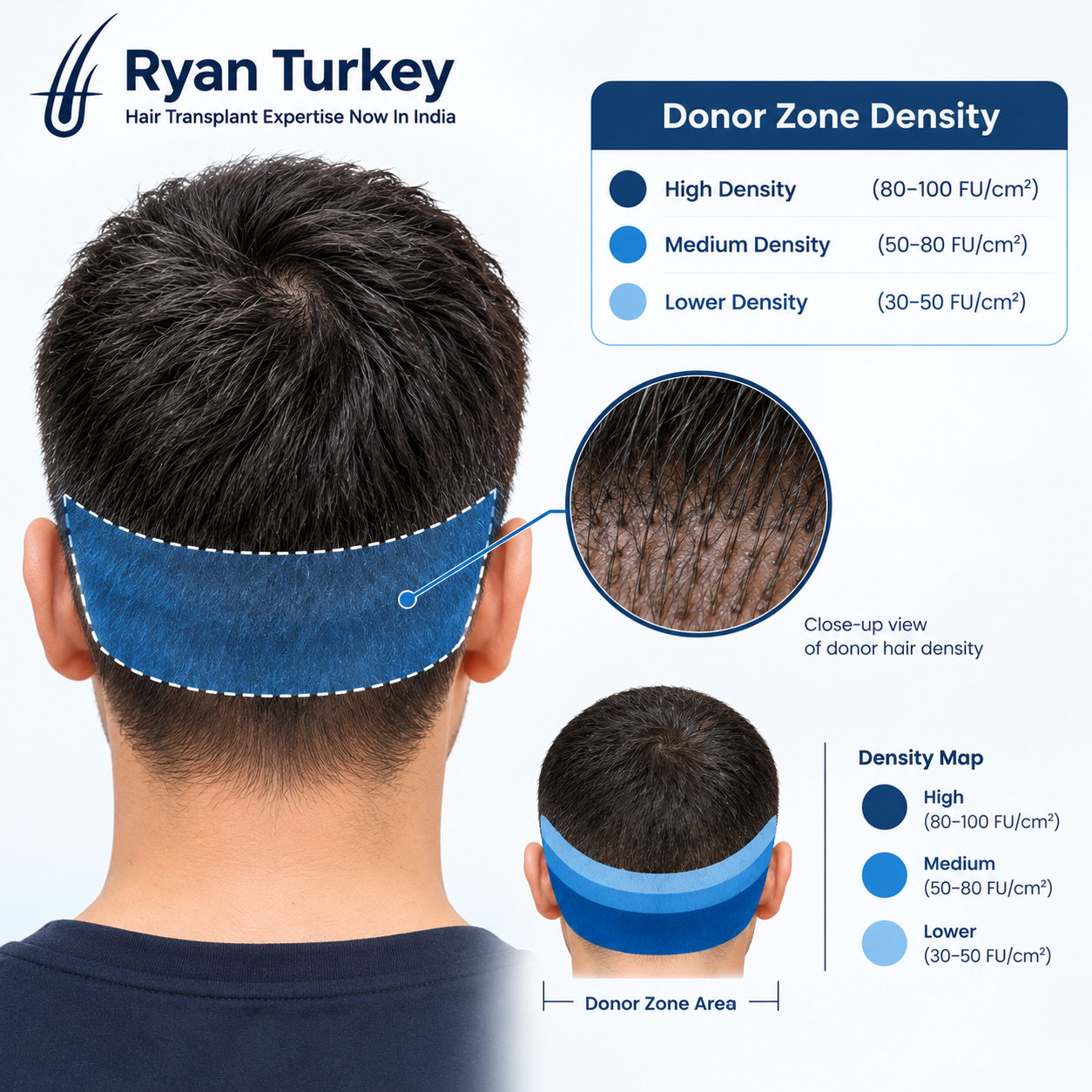
Your graft count is limited by the back of your head, not the bald part. Learn what donor density actually measures, where the "5,000–7,000 grafts for life" number comes from, and the six real options when your donor supply is tight.
Your graft count is limited by the back of your head, not the bald part. Learn what donor density actually measures, where the "5,000–7,000 grafts for life" number comes from, and the six real options when your donor supply is tight.
Your graft count is limited by the back of your head, not the bald part. Donor density averages around 60–80 follicular units per cm² in Indian patients; below about 55 is considered low. Low density does not automatically rule out surgery — it changes what is realistic. The options are prioritising the frontal third, a lower planned density, beard grafts, scalp micropigmentation, medication, or accepting that surgery is not the right answer.
Key points :
Density is measured in follicular units per cm², not in “how thick it looks”
Roughly 40–50% of donor follicular units can be harvested across a lifetime before thinning shows — the source of the familiar 5,000–7,000 figure
Density is only one of four things that matter; hair calibre, hairs per graft and hair-skin contrast matter just as much
Miniaturisation in the donor zone is the finding that changes everything, because it can mean DUPA
Beard grafts can add hair for some patients, but they are single-hair, coarser, and wrong for a hairline
Over-harvesting is invisible on the day and visible two years later — it only shows when the hair is cut short.
The donor area is the band of hair at the back and sides of your head that is genetically resistant to the hormone driving pattern baldness. It is the only hair you have that stays. Everything a transplant does comes out of it.
Surgeons measure it as follicular units per square centimetre — how many natural hair groupings sit in each cm² of scalp. Because each Indian follicular unit usually contains about two hairs, the hair count per cm² is roughly double the follicular unit count.
Donor density (FU/cm²) | Assessment | What it usually means |
|---|---|---|
Above 80 | Excellent | Generous donor supply; most plans achievable |
65–80 | Average for Indian patients | Standard planning applies |
55–65 | Below average | Achievable, with careful prioritisation |
45–55 | Low | Significant constraints; conservative plan only |
Below 45 | Very low | Surgery often not advisable; other options first |
These bands are a guide, not a verdict. A patient at 58 FU/cm² with thick, wavy, dark hair on a dark scalp can end up with better coverage than a patient at 72 with fine, straight hair on pale skin.
It is not a marketing figure. It is arithmetic, and it is worth seeing:
Step | Typical value |
|---|---|
Safe donor area in an adult scalp | roughly 190–210 cm² |
Average density | 60–80 FU/cm² |
Total follicular units in the safe zone | roughly 12,000–15,000 |
Proportion safely harvestable over a lifetime | about 40–50% |
Lifetime graft budget | roughly 5,000–7,000 |
Harvest beyond about half and the donor zone starts to look thin — not as bald patches, but as a general see-through quality when the hair is short. That change is permanent.
Run the same arithmetic at 45 FU/cm² and the lifetime budget falls to roughly 3,500–4,500 grafts. That is the whole reason this page exists: the same Norwood 5 pattern that one patient can cover comfortably, another cannot cover at all.
Four things together determine how much coverage your donor hair can produce.
Density — follicular units per cm². The headline number.
Hair calibre — the thickness of each indiviHow it should be measureddual hair, measured in microns. This matters enormously. Coarse hair (roughly 70 microns and above) covers far more scalp per graft than fine hair (below about 60 microns). A coarse-haired patient with mediocre density often beats a fine-haired patient with good density.
Hairs per follicular unit — a donor zone averaging 2.3 hairs per graft delivers meaningfully more hair than one averaging 1.8, at identical graft counts.
Contrast between hair and scalp — dark hair on pale skin shows every gap; dark hair on darker skin, or grey hair on pale skin, reads as fuller at the same density. This is why some patients look well covered at 30 FU/cm² and others do not.
A surgeon assessing you is weighing all four. Which is why a graft number quoted over WhatsApp from a photograph is a guess — none of the four can be judged that way.
Properly, this takes a few minutes and a magnifying device:
Densitometry or trichoscopy — a magnified view of a marked area of scalp, counting follicular units within a known field
Several sites, not one. The occipital zone at the back, and both parietal areas above the ears. Density varies across the donor region, and the sides are usually the weaker point
Hairs per follicular unit recorded, not only unit count
Calibre assessed
Miniaturisation looked for specifically — see below
The whole thing documented, so it can be compared in two years
If a clinic quotes you a graft count without doing this, they have not measured your donor area — they have looked at the bald part and read off a price list. At any age, but especially under 30, that examination is the most important five minutes of the consultation. Every plan at Ryan Clinic starts with the doctors taking these measurements.
When a surgeon examines your donor area under magnification, they are looking for hairs that are thinner, shorter and more variable in calibre than they should be. Some variation is normal. Significant miniaturisation — commonly taken as more than about 20% of donor hairs showing it — raises the possibility of diffuse unpatterned alopecia (DUPA).
DUPA means the donor area is not stable. The hair a surgeon would harvest is itself going to be lost. Transplanting it produces grafts that fail over the following years, and leaves a donor zone that is both thinner and damaged.
This is the single situation where “low donor density” is not a constraint to work around but a reason not to operate at all. It is also, unfortunately, the situation most likely to be missed by a clinic that does not examine the back of your head.
The highest-value decision available. The front frames the face and delivers the largest perceived change per graft. A restored front with a thin crown reads as a full head of hair in almost every situation; the reverse reads as nothing. With 3,000 usable grafts and a Norwood 5 pattern, spending all of them on the front is usually the right call.
Leave the crown. At advanced stages it can absorb 2,500 grafts and still look modest.
Standard planning implants at around 40 FU/cm². With limited donor hair, a surgeon may plan 25–35 FU/cm² over a larger area instead — less dense, but covering more. Whether that works depends heavily on your hair calibre and contrast, which is why the four factors above matter.
A higher, softer hairline costs substantially fewer grafts than a low one and, past your thirties, usually looks more natural anyway. Cost by graft count is on our hair transplant cost page.
Beard hair can be harvested and implanted into the scalp. For the right patient it genuinely expands the budget, typically by 1,000–2,500 grafts where beard growth is dense.
What you should know before anyone sells it to you:
Beard grafts are usually single-hair units, so 1,000 beard grafts deliver roughly 1,000 hairs — against about 2,000 from 1,000 scalp grafts
The texture is different. Beard hair is coarser, often curlier, and can look wiry against scalp hair
It is not for the hairline. Its place is the mid-scalp and crown, where it can be blended behind scalp hair
Yield is generally lower than scalp grafts
Extraction leaves marks on the face if done badly — small, but on a visible area
Not everyone is a candidate. Sparse beard growth means no meaningful gain
Used properly — as filler behind a scalp-hair front — it is a legitimate way to stretch a limited donor. Used as a headline offer to make a big graft number possible, it is a warning sign.
SMP is cosmetic tattooing that mimics the appearance of closely shaved follicles. It costs no donor hair at all, and it does two useful things: it creates the illusion of density behind a transplanted front, and it can stand alone for someone who is not a surgical candidate.
It does not grow, it needs occasional refreshing, and it looks best with short hair. For patients with genuinely low donor density, the combination of a modest transplant at the front plus SMP behind it frequently produces a better result than surgery alone could.
Every native hair you keep is a graft you do not have to spend. For a patient with limited donor supply, protecting existing hair is not a secondary consideration; it is the main one. Finasteride and minoxidil are the two treatments with real evidence behind them, and both are decisions to make with a doctor.
If you have low donor density and you are not on medication, that is the first conversation, before any surgical planning.
It has to be on the list, because for some people it is the right answer. A very low donor density, significant miniaturisation, or an extensive pattern that cannot be meaningfully covered are all reasons to stop. Hair systems, a closely cropped or shaved style, and SMP are real options, not consolation prizes — and none of them spends hair you cannot get back.
Over-harvesting the donor area is the most common permanent injury in this field, and its defining feature is that you cannot see it when it happens.
At one month, your hair has grown back over the extraction sites and the donor looks fine. At six months, with normal hair length, it still looks fine. Then you get a short haircut for the first time in two years — a number two, a summer trim — and the back of your head is visibly see-through, with a moth-eaten quality along the lower margin.
That is why the honest constraint is a lifetime harvest limit rather than a per-session one, and why a clinic offering to take 4,000 grafts from a donor area that should safely yield 4,000 in total is making a decision you will discover much later. It cannot be undone: SMP can camouflage it, beard grafts can sometimes soften it, but the follicles are gone.
Before surgery, ask to see a photograph of a previous patient’s donor area at short hair length, at least a year post-op. Almost nobody asks. It is the single most revealing request you can make.
Donor density too low to produce a result worth the surgery
Significant donor miniaturisation suggesting DUPA
A previously over-harvested donor with little safe reserve left
Expectations — usually full coverage of an advanced pattern — that the available donor hair cannot meet
Patient unwilling to consider prioritising the front over full coverage
None of these is about willingness to operate. It is about whether the hair exists. Where it does not, we will say so and go through the alternatives above.
Ryan Clinic measures donor density under magnification at multiple sites before any graft count is quoted, and documents it so it can be compared later. Where donor supply is limited, you will be given a prioritised plan in writing — what can be covered, what cannot, and what it costs in grafts.
[CONFIRM AND ADD: whether you perform densitometry on every patient and at how many sites; the device used; whether you record hairs per follicular unit and calibre; your safe lifetime harvest percentage; your maximum single-session harvest; whether you perform beard or body hair transplantation and in which cases; whether you offer SMP in-house or refer; whether you provide donor photographs at short hair length on request.]
Free scalp analyses are available at our Delhi, Mumbai and Hyderabad centres.
Book a free scalp analysis — the donor measurement is the part of the appointment that actually determines your options.
Around 60–80 follicular units per cm² is typical for Indian patients. Above 80 is excellent, 45–55 is low, and below 45 usually means surgery is not advisable. Because most Indian follicular units hold two hairs, the hair count per cm² is roughly double.
Only by measurement. A surgeon examines several donor sites under magnification, counting follicular units per cm², recording hairs per unit and hair calibre, and checking for miniaturisation. A graft count quoted from a photograph is not an assessment.
Roughly 5,000–7,000 for an average donor — about 40–50% of the follicular units in a safe donor area of 190–210 cm². At low density, the lifetime figure can fall to around 3,500–4,500. Harvesting beyond the safe limit thins the donor permanently.
Yes, in suitable patients, typically adding 1,000–2,500 grafts. Beard grafts are usually single-hair and coarser than scalp hair, so they are used in the mid-scalp and crown rather than the hairline, and yield is generally lower than scalp grafts.
It becomes permanently thin, which usually only becomes visible when the hair is cut short — often a year or two after surgery. The follicles cannot be replaced. Scalp micropigmentation or beard grafts can camouflage it, but not restore it.
Generally no. In diffuse unpatterned alopecia the donor area is itself thinning, so harvested grafts are eventually lost and the donor is left visibly damaged. It is identified by finding significant miniaturisation in the donor zone under magnification.
Prioritise the frontal third, plan a lower implantation density with a higher hairline, consider beard grafts as filler, use scalp micropigmentation for the appearance of density, and protect the hair you still have with medication. For some patients, not operating is the right choice.
It matters as much. Coarse hair covers considerably more scalp per graft than fine hair, so a patient with average density and thick hair can achieve better coverage than one with high density and fine hair. Hairs per graft and hair-to-skin contrast also count.
For more on planning a hair transplant, browse our more guides.
Sources :
International Society of Hair Restoration Surgery (ISHRS) — donor area assessment, safe donor zone definition and harvesting limits.
Indian Journal of Dermatology / International Journal of Trichology — donor density, hair calibre and follicular unit composition in Indian patients.
Published literature on diffuse unpatterned alopecia and donor area miniaturisation.
Published literature on body and beard hair transplantation: graft characteristics, yield and indications.
Published literature on safe donor area and lifetime harvestable graft estimates in androgenetic alopecia.
About the author Dr. Pranendra Singh is a hair restoration surgeon at Ryan Clinic, Delhi, specialising in Sapphire FUE. Read full profile →
Medical disclaimer: This article is general information and does not replace medical advice. Donor density, safe harvest limits and surgical candidacy can only be determined by a qualified surgeon after an in-person examination of the donor area under magnification.
Book Your Free Consult Now!