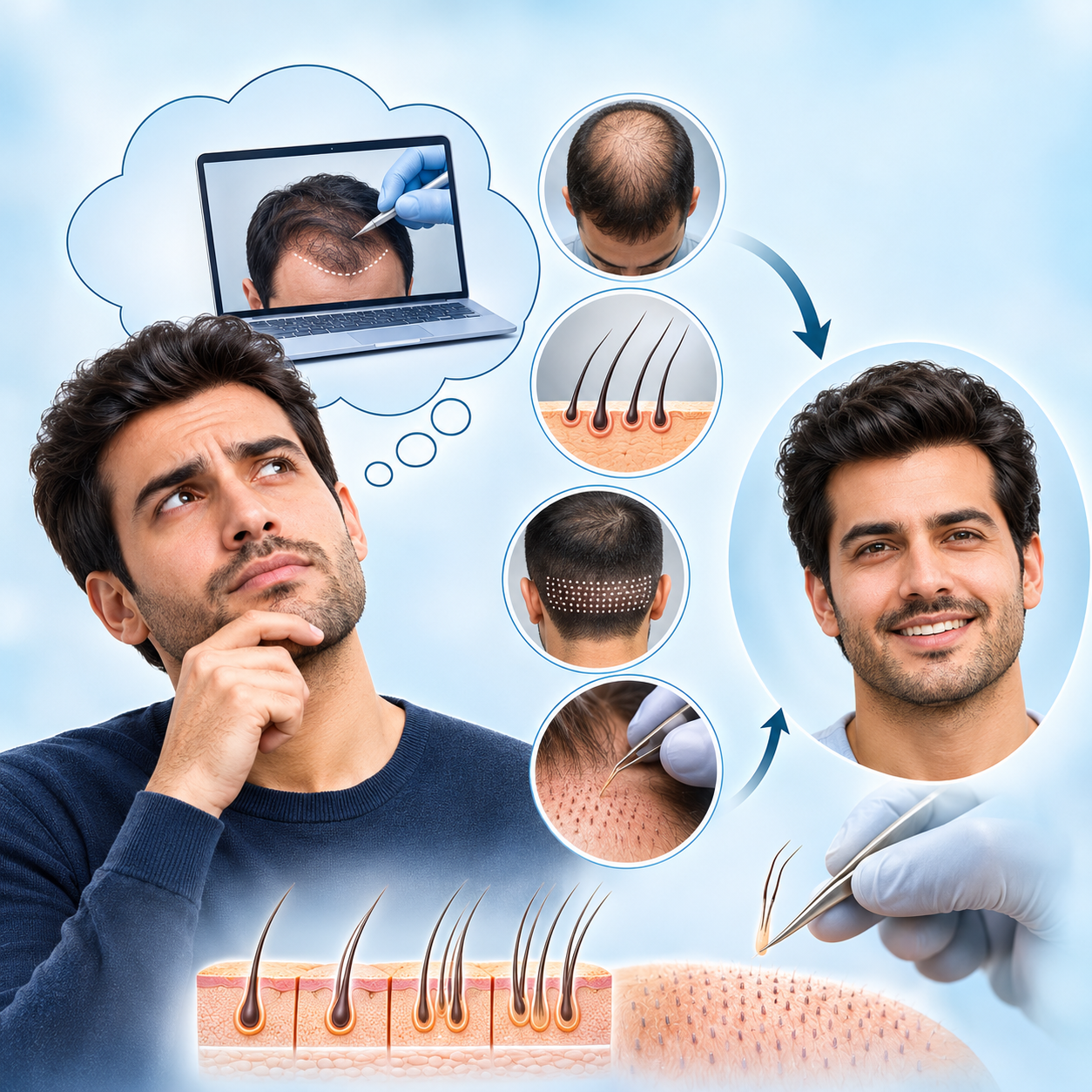
Not sure whether you need 1,500, 2,500, or 4,000 hair grafts? Learn why online hair transplant graft estimates vary and how hair loss patterns, donor hair density, hair thickness, and hairline design influence your treatment plan.
Not sure whether you need 1,500, 2,500, or 4,000 hair grafts? Learn why online hair transplant graft estimates vary and how hair loss patterns, donor hair density, hair thickness, and hairline design influence your treatment plan.
Hair loss can affect your appearance, confidence, and the way you style your hair. When considering a Hair Transplant, one of the first questions people ask is, “How many hair grafts will I need to restore my hairline or cover my bald areas?”
Many people search online for graft calculators, compare before-and-after photographs, or watch hair transplant videos to estimate their requirements. However, online estimates often provide different numbers for similar hair loss patterns.
For example, one online calculator might suggest 2,000 grafts, while another recommends 3,000 grafts for what appears to be the same level of baldness.
Why does this happen?
The answer lies in individual hair characteristics, scalp conditions, donor hair availability, and treatment goals. Hair transplantation is not simply about placing a specific number of grafts. It requires careful medical assessment, appropriate graft distribution, and realistic planning.
This guide explains how hair graft requirements are calculated, why online estimates differ, and what patients should understand before choosing a hair transplantation clinic.
A hair graft is a small unit of tissue containing one or more hair follicles. In natural hair growth, follicles commonly grow in groups called follicular units.
Each follicular unit may contain:
One hair
Two hairs
Three hairs
Four or occasionally more hairs
During a hair transplant, these follicular units are harvested from a suitable donor area, usually the back or sides of the scalp, and transplanted into areas experiencing hair thinning or baldness.
One graft does not necessarily mean one hair.
For example, 2,000 grafts containing an average of two hairs each would represent approximately 4,000 individual hairs.
However, the actual number of hairs per graft varies between patients and donor areas.
This distinction is important because two patients receiving the same number of grafts may achieve different visual coverage.
Online graft calculators generally use simplified information, such as the size of the bald area or the patient's estimated hair loss stage.
Although these tools can provide a rough starting point, they cannot fully evaluate the biological and aesthetic factors involved in hair restoration.
Here are the major reasons online estimates may differ.
Not everyone experiences hair loss in the same way.
Some people develop a receding frontal hairline, while others experience thinning around the crown or across the entire upper scalp.
A patient requiring only frontal hairline restoration may need fewer grafts than someone with extensive frontal and crown hair loss.
Even when two patients have similar bald areas, the distribution of existing hair can significantly influence their treatment requirements.
Hair shaft thickness plays an important role in determining the appearance of fullness.
Thicker hair generally provides greater visual coverage than very fine hair.
For example, a patient with coarse hair may achieve satisfactory coverage with fewer grafts than someone with fine hair, depending on other factors.
Therefore, graft planning should consider hair characteristics rather than relying only on the surface area of baldness.
Some patients have completely bald areas, while others retain a significant amount of thin or miniaturized hair.
A completely bald area may require more transplanted follicles to create visible coverage.
However, placing grafts between existing hairs requires careful planning to reduce the risk of damaging surrounding follicles.
Doctors must also consider whether the existing hair is likely to continue thinning.
The donor area is one of the most important factors in hair transplant planning.
Most scalp hair transplants use follicles from the back and sides of the head because these areas are often relatively resistant to androgen-related hair loss.
However, the number of safely harvestable grafts varies between individuals.
Excessive harvesting can cause visible thinning, uneven density, or scarring in the donor region.
A responsible treatment plan must preserve donor hair for potential future needs.
Hairline design directly influences the number of grafts required.
A lower hairline may require additional grafts because it increases the area needing coverage.
Similarly, a densely packed frontal hairline may require more grafts than a conservative design.
An appropriate hairline should consider facial proportions, age, existing hair, and the possibility of future hair loss.
The objective is not necessarily to create the lowest possible hairline, but to achieve a natural-looking and sustainable result.
The following table provides broad educational estimates for different hair restoration areas.
Hair Loss Area | Approximate Graft Range |
Minor hairline recession | 500–1,200 grafts |
Frontal hairline restoration | 1,000–2,000 grafts |
Frontal area with moderate thinning | 1,500–2,500 grafts |
Crown restoration | 1,000–2,500 grafts |
Extensive frontal and crown coverage | 3,000–4,500+ grafts |
Important: These figures are illustrative, not clinical recommendations. Actual graft requirements can fall outside these ranges depending on the size of the treatment area, donor capacity, hair characteristics, and achievable density.
A larger graft count does not automatically produce a better result.
A qualified hair transplant surgeon evaluates several factors before recommending the number of grafts.
The surgeon assesses the scalp area requiring transplantation, commonly measured in square centimetres.
For example, if the recipient area measures 50 cm² and the planned density is 35 grafts per cm²:
50 × 35 = 1,750 grafts
This is a simplified calculation. It does not account for existing hair, variations in graft distribution, or surgical limitations.
The surgeon examines donor density, hair calibre, scalp characteristics, and the estimated number of grafts that can be harvested safely.
Hair loss can continue after transplantation, particularly in patients with androgenetic alopecia.
A long-term treatment strategy may involve preserving donor grafts and discussing appropriate medical treatment for existing hair.
The surgeon determines how available grafts should be distributed.
Single-hair follicular units are often preferred along the leading edge of the hairline to create a softer appearance, while suitable multi-hair units may be used farther behind for additional visual density.
Follicular Unit Extraction, commonly known as FUE, is a technique used to harvest individual follicular units from the donor area.
Patients exploring FUE Hair Transplant in Delhi often ask whether this method allows doctors to transplant more grafts than other techniques.
The extraction method alone does not determine how many grafts a patient needs.
The appropriate graft count depends on donor availability, recipient area size, hair characteristics, surgical planning, and patient safety.
FUE involves small extraction wounds and generally leaves numerous tiny scars rather than a single linear donor scar. It is not completely scar-free.
A carefully performed FUE procedure aims to preserve follicular integrity and achieve appropriate coverage without unnecessarily depleting the donor area.
requires particular attention to aesthetic detail.
The frontal hairline is highly visible and strongly influences facial appearance.
Successful planning involves considering:
Natural hair direction and growth angles
Appropriate hairline height and shape
Gradual transitions between different densities
Suitable placement of single-hair grafts
Long-term changes in surrounding hair
For example, two patients may each receive 1,800 grafts, but their results may look different because of hair thickness, graft distribution, and hairline design.
This is why hairline restoration should focus on appropriate placement rather than simply increasing the graft count.
People researching a Hair transplant in Delhi may encounter different graft estimates from websites, online consultations, and individual clinics.
These differences do not necessarily indicate that one estimate is incorrect.
Different recommendations may reflect variations in treatment goals, density planning, donor management, and the areas selected for restoration.
However, patients should ask their surgeon to explain how the recommended graft count was calculated.
A thorough consultation should include a scalp examination, discussion of the underlying cause of hair loss, donor assessment, and realistic expectations.
Patients considering an FUE Hair Transplant in Delhi should also discuss the surgeon's qualifications, procedural approach, possible complications, and postoperative care.
Patients searching for a Hair Transplant in Mumbai should avoid comparing treatment plans solely on the number of grafts offered.
A proposal for 3,500 grafts is not automatically superior to a recommendation for 2,500 grafts.
The suitability of either plan depends on the patient's scalp condition, donor reserves, hair loss pattern, and desired coverage.
It is also important to understand whether the quoted graft count refers to follicular units rather than individual hairs.
Before undergoing surgery, patients should request a clear explanation of the proposed treatment area, estimated graft distribution, limitations, and expected recovery process.
Yes. Beard Transplant in Delhi involves different aesthetic considerations from scalp hair transplantation.
Beard restoration may address patchy facial hair, naturally sparse beard growth, or selected areas of facial hair loss.
Graft requirements depend on the area being treated, the desired beard shape, existing facial hair, and donor suitability.
The surgeon must carefully consider the direction and angle of implanted hairs to achieve a natural appearance.
Because facial hair has different characteristics from scalp hair, donor hair selection and realistic expectations are especially important.
A professional assessment is necessary before determining the appropriate number of grafts.
Not necessarily.
Increasing the number of grafts without proper planning can create unnecessary risks.
Excessive harvesting may reduce donor density, while overly aggressive recipient-site placement can affect healing or compromise graft survival.
Other important factors include surgical technique, graft handling, recipient-site preparation, vascular supply, and postoperative care.
Hair transplantation should aim for an appropriate balance between coverage, natural appearance, and long-term donor preservation.
Before choosing a hair transplantation clinic, consider the following questions:
Has a qualified doctor examined my scalp and donor area?
What is the medical cause of my hair loss?
How was my recommended graft count calculated?
Which areas will receive the transplanted grafts?
Is the proposed density realistic for my hair characteristics?
How much donor hair should be preserved for the future?
What are the potential risks, limitations, and expected results?
Who will perform the key surgical steps?
Clear answers can help patients make informed decisions and avoid unrealistic expectations.
The number varies according to the treatment area, hair loss severity, existing density, donor availability, and desired coverage. A surgeon must assess these factors to provide an individualized estimate.
Online calculators can offer approximate figures, but they cannot reliably assess donor quality, hair thickness, scalp health, or future hair loss. They should not replace an in-person medical evaluation.
For some patients, 2,000 grafts may provide suitable frontal coverage. Others may require fewer or more grafts depending on the size of the area and treatment goals.
If each graft contains an average of two hairs, 3,000 grafts would contain approximately 6,000 hairs. The actual total depends on the number of hairs within each follicular unit.
It may be possible for selected patients, but suitability depends on donor capacity, surgical planning, the patient's medical condition, and procedural safety. Not every patient is an appropriate candidate for a large session.
No. Visual density depends on hair calibre, graft survival, hair distribution, natural hair characteristics, and recipient-site planning. More grafts do not guarantee a better cosmetic result.
Temporary shedding of transplanted hair shafts is common during early recovery. New growth typically develops gradually over the following months, and results are usually assessed over approximately 12–18 months, depending on the treatment area and individual response.
Some patients may be suitable for additional surgery, provided sufficient healthy donor hair remains. The decision requires a fresh evaluation of scalp condition, previous harvesting, and treatment goals.
Determining the right number of hair grafts requires more than an online calculation. Every patient has different hair characteristics, donor capacity, hair loss patterns, and aesthetic expectations.
Online estimates may help patients understand approximate treatment requirements, but they cannot replace a detailed medical examination.
The most appropriate treatment plan prioritizes natural-looking coverage, safe donor harvesting, and long-term hair restoration planning rather than simply recommending the highest graft count.
Ryan Turkey Hair Transplant Expertise Now In India provides hair restoration consultations and treatment options, including FUE hair transplantation, hairline restoration, and beard transplantation.
The clinic has branches in Delhi, Mumbai, Hyderabad, Noida, and Gurgaon, where patients can enquire about individualized hair transplant assessments and available treatment options.
If you are considering a hair transplant, consult a qualified medical professional to understand your hair loss condition, suitable graft requirements, potential risks, and realistic treatment expectations.
Medical Disclaimer: This article is intended for general educational purposes only and does not constitute medical advice. Graft estimates and treatment outcomes vary between individuals. Hair transplantation is a surgical procedure with potential risks, including infection, scarring, poor graft growth, and uneven density. A qualified medical professional should assess suitability and explain the benefits, limitations, and possible complications before treatment.
Book Your Free Consult Now!