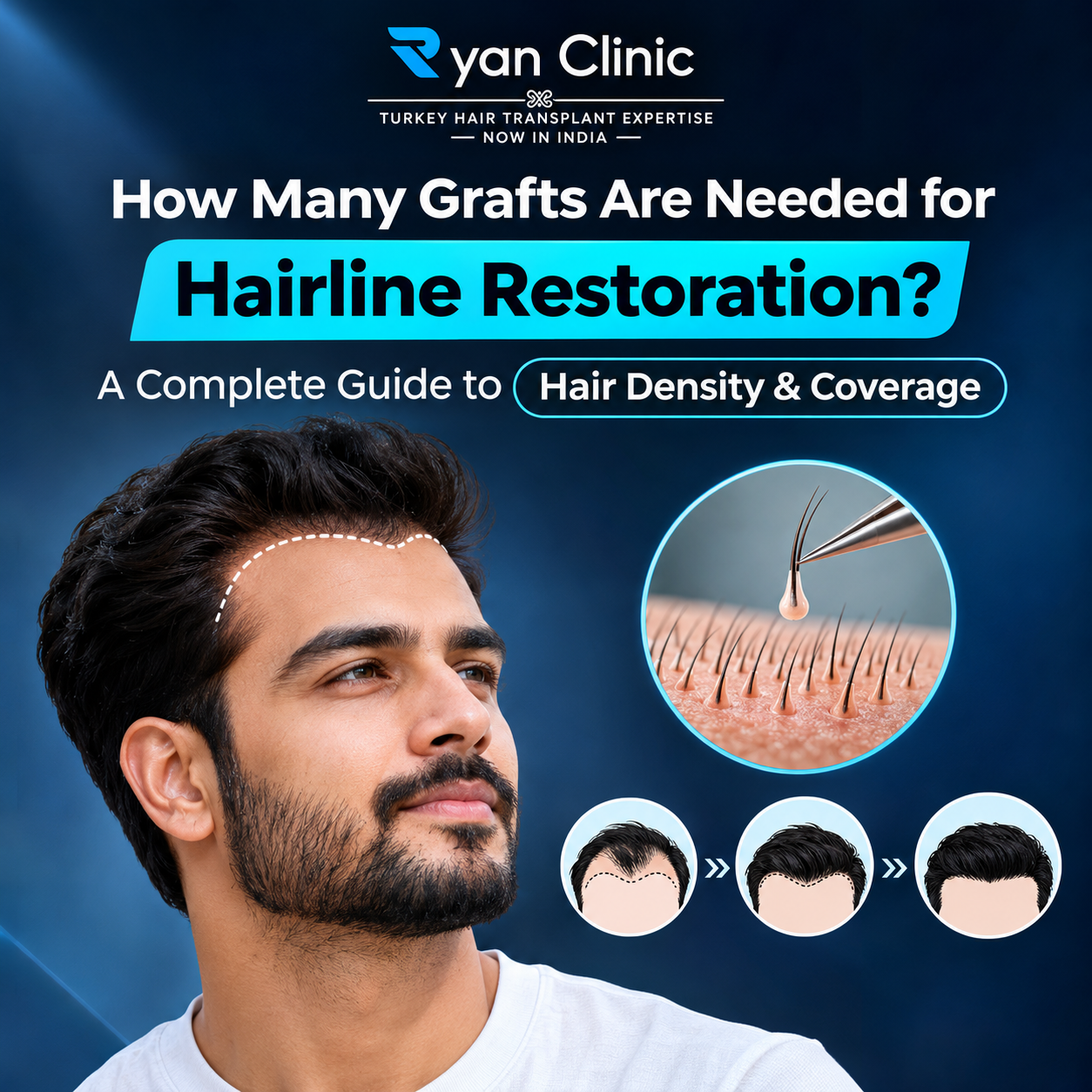
Discover how hair graft requirements are calculated based on hair loss, scalp density, donor hair availability, and coverage goals. Learn about FUE hair transplant techniques, natural hairline design, and personalised treatment planning for fuller-looking hair.
Discover how hair graft requirements are calculated based on hair loss, scalp density, donor hair availability, and coverage goals. Learn about FUE hair transplant techniques, natural hairline design, and personalised treatment planning for fuller-looking hair.
Hair loss is a common concern affecting both men and women. One of the most noticeable changes caused by hair thinning is a receding hairline, which can make the forehead appear wider and change the overall facial appearance. For individuals considering hairline restoration, one of the first questions is: How many hair grafts are needed to restore a natural-looking hairline?
The answer depends on several factors, including the extent of hair loss, existing hair density, scalp characteristics, donor hair availability, and desired coverage.
Modern hair transplant techniques, particularly Follicular Unit Extraction (FUE), allow doctors to plan hairline reconstruction according to individual needs.
This guide explains how graft requirements are calculated, what influences hair density, how different transplant techniques work, and what patients should consider before choosing a Hairline Transplant Clinic.
Hairline restoration is a hair transplantation procedure designed to improve the appearance of a receding, thinning, or uneven frontal hairline.
During the procedure, healthy hair follicles are generally extracted from the donor area, usually the back or sides of the scalp, and transplanted into areas experiencing hair loss.
The objective is to create a hairline that complements the patient's facial proportions, age, existing hair growth pattern, and future hair loss expectations.
Hairline restoration may be considered for:
Men experiencing male pattern baldness.
Women with a widening forehead or thinning frontal hairline.
Individuals with naturally high or uneven hairlines.
Patients experiencing hair loss due to certain injuries or scars.
Individuals seeking correction of a previous hair transplant.
Not every patient with hairline thinning requires surgery. A medical assessment is important to identify the cause of hair loss and determine whether transplantation is appropriate.
A hair graft is a small unit of tissue containing one or more hair follicles.
In hair transplantation, these naturally occurring follicular units are extracted from the donor area and implanted into the recipient area.
A single graft may contain one, two, three, or occasionally four hairs.
For example, 2,000 grafts do not necessarily mean 2,000 individual hairs. Depending on the follicular units, they may contain approximately 3,500–4,500 hairs or a different number.
Different graft types are useful for different purposes.
Single-hair grafts are commonly used along the front edge of the hairline to create a softer appearance. Multiple-hair grafts may be placed behind the frontal hairline to improve visual density.
The distribution of grafts is therefore just as important as the total graft count.
The number of grafts required depends on the size of the area being treated and the density that can safely be achieved.
The following table provides broad illustrative estimates :
Hair Loss Condition | Approximate Grafts |
Minor hairline recession | 500–1,000 |
Mild frontal hairline thinning | 1,000–1,500 |
Moderate hairline recession | 1,500–2,500 |
Significant frontal hair loss | 2,500–3,500 |
Extensive frontal and mid-scalp coverage | 3,500–4,500+ |
These figures are not fixed clinical recommendations. Actual graft requirements may be lower or higher depending on the patient's scalp characteristics, donor capacity, and treatment goals.
For example, a person with mild recession around the temples may need fewer grafts than someone requiring restoration across the entire frontal scalp.
A qualified surgeon should determine the final graft count after examining the scalp and evaluating the donor area.
Several important factors influence how many grafts are needed for successful hairline planning.
The size of the bald or thinning area is one of the main factors affecting graft requirements.
A small receding hairline generally requires fewer grafts than extensive frontal baldness.
Patients who still have healthy hair in the recipient area may require fewer transplanted grafts to improve the appearance of coverage.
However, surgeons must consider the risk of damaging existing follicles during implantation.
Hair characteristics influence the visual appearance of density.
Thicker hair shafts may provide greater visual coverage than very fine hair. Curly or wavy hair can also create a fuller appearance in some patients.
The donor area provides the follicles used for transplantation.
A patient with limited donor hair may not be able to achieve the same graft count or density as someone with a stronger donor supply.
A lower hairline usually requires more grafts because it increases the area that needs coverage.
An age-appropriate hairline design helps balance aesthetic goals with long-term donor hair preservation.
Hair density refers to the number of follicular units or individual hairs present within a specific area of the scalp.
In hair transplantation, density is commonly discussed in follicular units per square centimetre.
For illustrative planning, a surgeon might consider approximately 30–45 grafts per square centimetre in certain recipient areas. However, appropriate density varies substantially according to scalp condition, blood supply, hair characteristics, and surgical judgement.
A simple estimate can be calculated using:
Required grafts = Treatment area (cm²) × Planned graft density (grafts/cm²)
For example, if a patient needs coverage across 40 cm² and the planned density is 35 grafts per cm²:
40 × 35 = 1,400 grafts.
This is only a mathematical illustration. Real treatment planning also accounts for existing hair, irregular hairline contours, graft survival considerations, and donor limitations.
Achieving natural-looking coverage does not always require placing the maximum possible number of grafts.
Follicular Unit Extraction, commonly called FUE, is a widely used hair transplantation technique.
At an FUE Hair Transplant Clinic, the procedure generally involves several stages.
Step 1: Hair and Scalp Assessment
The doctor evaluates the hair loss pattern, donor hair density, scalp health, and medical history.
Step 2: Hairline Design
The proposed hairline is marked according to the patient's facial structure and treatment goals.
Step 3: Donor Graft Extraction
Individual follicular units are removed using specialised extraction instruments, usually under local anaesthesia.
Step 4: Recipient Site Preparation
Small recipient sites are created, or another appropriate implantation method is used, to guide graft placement.
Step 5: Graft Implantation
The extracted grafts are carefully positioned according to the planned hair direction, angle, and distribution.
FUE avoids the long linear donor incision associated with strip harvesting, although it still produces small extraction scars.
Recovery and final outcomes depend on individual healing, surgical technique, and postoperative care.
A common misconception is that a higher graft count automatically produces a better hair transplant.
In reality, successful hairline restoration depends on several factors beyond graft quantity.
The shape of the hairline should complement the patient's facial structure and age.
Hair direction is also important because transplanted hair should blend with the surrounding natural hair.
Surgeons often use single-hair follicular units at the leading edge of the hairline and larger units behind it to create a gradual transition.
An excessively straight or unusually low Hairline Transplant may appear unnatural, particularly as the patient ages.
Careful graft distribution, donor preservation, and realistic expectations are therefore essential elements of long-term treatment planning.
Hairline concerns are not limited to men. Women may experience frontal hair thinning, traction-related hair loss, or a naturally high hairline.
A Female Hair Transplant may be considered in selected cases where the cause of hair loss has been identified and the donor area is suitable.
Some women seeking frontal hairline restoration may require approximately 800–2,000 grafts, although requirements vary widely.
Female hair transplant planning often considers forehead proportions, existing hair density, hairstyle preferences, and the underlying cause of thinning.
Women experiencing diffuse hair loss may require additional medical evaluation because not all forms of female hair loss are suitable for transplantation.
A personalised consultation helps determine whether surgery or a non-surgical approach is more appropriate.
Platelet-Rich Plasma, commonly known as PRP treatment, is a procedure in which a concentrated portion of the patient's own blood is prepared and injected into selected scalp areas.
PRP has been studied as a treatment for certain types of hair loss and as an additional procedure alongside hair transplantation.
Some studies suggest potential improvements in hair density or thickness for selected patients, but evidence remains variable and treatment protocols are not standardised.
PRP does not replace transplanted follicles or reliably restore completely bald areas.
Patients considering PRP should discuss its potential benefits, limitations, risks, and costs with a qualified medical professional.
It should not be considered a guaranteed method of improving hair transplant outcomes.
A Beard Transplant and scalp hairline restoration share several surgical principles.
Both procedures may involve extracting follicular units from a suitable donor area and implanting them into areas requiring additional hair coverage.
However, beard transplantation requires careful attention to facial hair direction, angle, texture, and density.
The number of grafts depends on whether the patient wants to improve a small patch, enhance the moustache, or reconstruct a larger beard area.
In some scalp restoration cases, suitable beard hair may also be considered as an additional donor source. However, beard hair differs from scalp hair in texture and growth characteristics, making it unsuitable for certain areas, particularly the delicate leading edge of a natural hairline.
Hair transplantation results develop gradually because transplanted follicles pass through normal hair growth cycles.
A typical recovery and growth timeline may include:
Timeline | Expected Changes |
First 7–14 days | Early healing, scab formation and shedding |
2–8 weeks | Some transplanted hair shafts may shed |
3–4 months | Early new hair growth may begin |
5–6 months | Gradual improvement in visible coverage |
9–12 months | More noticeable density and maturation |
12–18 months | Further growth and final maturation in some patients |
The timeline varies among individuals.
Temporary shedding after transplantation does not necessarily mean the follicles have failed.
Patients should follow their surgeon's instructions for washing, medication, physical activity, and follow-up appointments.
Existing non-transplanted hair may continue thinning, so long-term hair loss management can remain important.
Choosing a suitable Hairline Transplant Clinic involves more than comparing prices or advertised graft counts.
Patients should evaluate the qualifications and experience of the treating medical professionals, the clinic's hygiene practices, and the transparency of its treatment planning.
An appropriate consultation should include a scalp examination, discussion of donor limitations, explanation of the proposed technique, and realistic expectations about results.
Patients should also ask who will perform each stage of the procedure and what postoperative support is available.
A reputable clinic should explain possible complications, including infection, scarring, poor graft growth, unnatural appearance, and the potential need for further treatment.
Written informed consent and clear follow-up instructions are important parts of responsible medical care.
Some patients may require around 1,000–2,500 grafts for frontal hairline restoration, while others need fewer or more. The exact requirement depends on the treatment area, planned density, and donor hair availability.
For certain patients, 2,000 grafts may provide meaningful frontal coverage. However, this depends on the extent of recession, hair thickness, existing density, and planned hairline position.
Transplanted follicles taken from suitable donor areas often retain their resistance to pattern hair loss. However, graft survival is not guaranteed, and existing non-transplanted hair may continue thinning.
All surgical hair transplantation can produce some scarring. FUE generally creates small, scattered extraction scars rather than one long linear donor scar.
Yes. Female Hair Transplant may be suitable for selected women with stable hair loss patterns and adequate donor hair. A medical diagnosis is essential before treatment.
PRP may offer benefits in certain circumstances, but current evidence does not establish that it consistently increases transplanted hair density. Results vary, and it should not replace appropriate surgical planning.
The number depends on donor capacity, scalp condition, patient safety, and the surgical team's assessment. Larger sessions are not automatically better or safer.
Both matter, but appropriate hairline design, graft distribution, and donor preservation are essential for achieving balanced, natural-looking results.
Hairline restoration is not simply about transplanting the highest possible number of grafts. The right approach involves understanding the patient's hair loss pattern, facial structure, donor hair availability, and long-term restoration goals.
Whether a patient needs 1,000, 2,000, or more grafts, careful planning plays an important role in achieving natural-looking coverage. Techniques such as FUE Hair Transplant can provide surgical options for suitable candidates, while treatments such as PRP may be considered in selected cases following medical evaluation.
Ryan Turkey Hair Transplant Expertise Now In India, located in New Delhi, offers consultations for individuals exploring hairline restoration and hair transplant treatment options.
The clinic has branches in Delhi, Mumbai, Hyderabad, Noida, and Gurgaon, providing access to hair restoration consultations across these locations.
Patients considering a procedure should undergo an individual assessment to understand their graft requirements, treatment options, expected recovery, and possible risks.
Medical Disclaimer: This article is intended for general educational purposes only and does not replace professional medical advice. Hair transplant suitability, graft requirements, recovery, and results vary between individuals. Consult a qualified medical professional before undergoing treatment.
Book Your Free Consult Now!