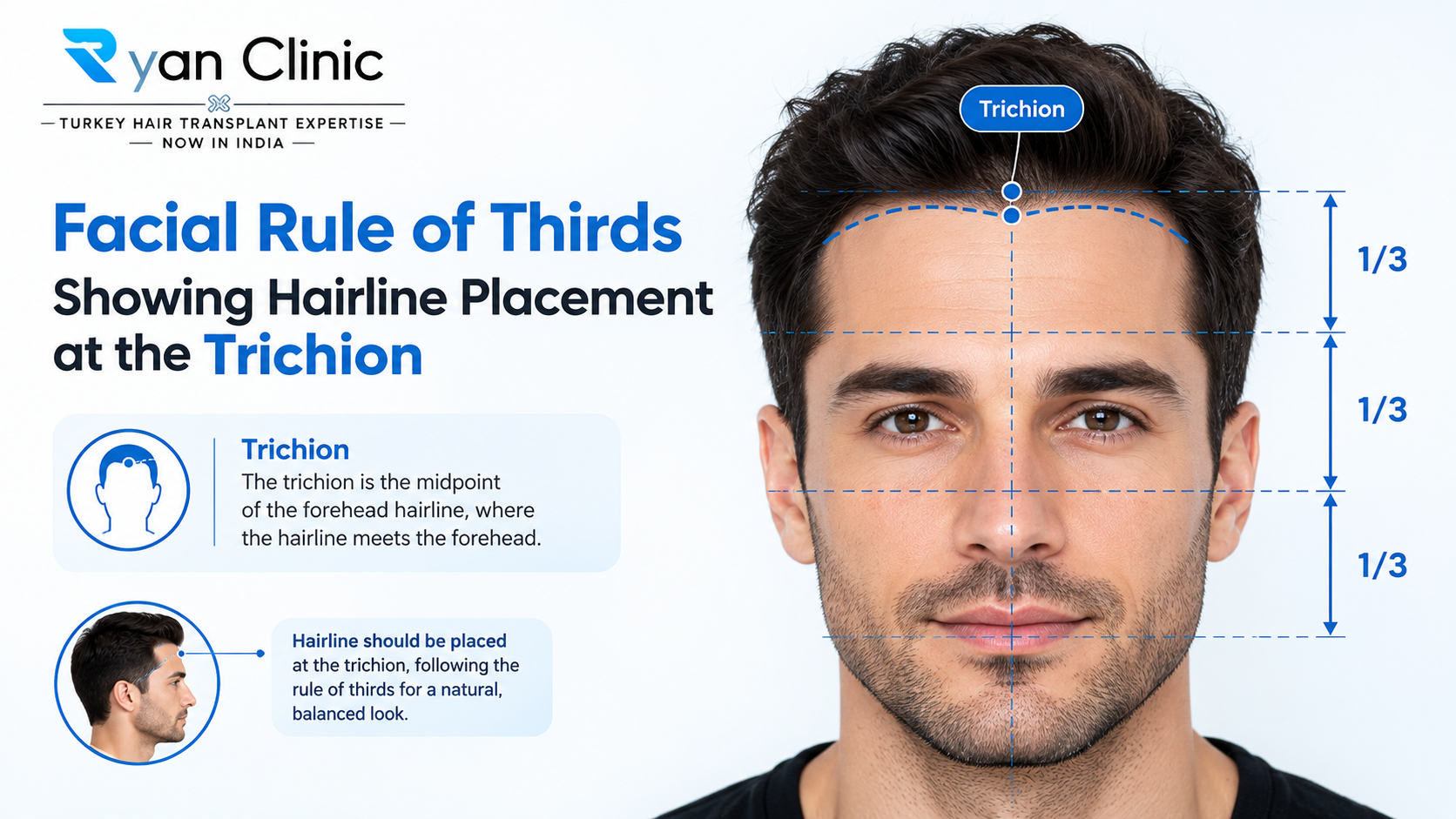
The exact measurements surgeons use to place a natural hairline — and the mirror test you can run yourself to check if a proposed design is too low.
The exact measurements surgeons use to place a natural hairline — and the mirror test you can run yourself to check if a proposed design is too low.
A transplanted hairline's mid-frontal point sits 7 to 9 cm above the glabella, positioned so the upper third of the face roughly matches the middle and lower thirds. The corners must sit on or lateral to a vertical line from the outer corner of the eye. Placing a hairline 1 cm too low costs around 500 extra grafts and looks progressively wrong as you age.
Key points
The rule of thirds sets height: forehead, mid-face and lower face should read as roughly equal
Mid-frontal point at 7–9 cm above the glabella; below 7 cm is almost always a mistake
The frontotemporal angle must not sit medial to the lateral canthus — that produces a juvenile, rounded hairline
A mature male hairline is slightly M-shaped and asymmetric, never a smooth curve
Every centimetre lower costs roughly 500 grafts from a finite donor supply
You should see and approve the drawn hairline before surgery begins
Most disappointing hair transplant results are not surgical failures. The grafts grew. The problem is where they were put.
A hairline is the most scrutinised 2 cm of skin on the human body. People read faces constantly and unconsciously, and they detect an unnatural hairline long before they can explain why. Technique determines whether hair grows; design determines whether anyone notices it was transplanted.
Design is also permanent in a way technique is not. A poorly executed extraction can be worked around at a second session. A hairline placed 2 cm too low, in the wrong shape, has consumed donor grafts to build something that will look worse each decade — and correcting it means removing grafts, not adding them.
Facial aesthetics has used the same proportional framework since the Renaissance: a face reads as balanced when it divides into three roughly equal horizontal sections.
Section | From | To |
Upper third | Trichion (hairline) | Glabella (ridge between the brows) |
Middle third | Glabella | Subnasale (base of the nose) |
Lower third | Subnasale | Menton (bottom of the chin) |
In adult men the upper third typically measures 5.5 to 7.5 cm. A hairline placed to make that section grossly shorter than the other two reads as unnatural even to someone who has never thought about facial proportion — it produces the low, heavy-browed look that immediately signals a transplant.
Thirds are a guide, not a formula. A man with a long mid-face can carry a slightly higher hairline comfortably. A short face suits a marginally lower one. A skilled surgeon measures your specific proportions rather than applying a fixed number, which is why hairline design cannot be done from a photograph or over WhatsApp.
The mid-frontal point (MFP) is the centre of the hairline, and it is placed first — everything else is built outward from it.
Standard placement: 7 to 9 cm above the glabella, measured along the curve of the forehead rather than in a straight line.
Below 7 cm: almost always too low. Looks unnaturally youthful on an adult male face and consumes donor supply for the least defensible centimetres.
7–8 cm: the common range for most adult men.
8–9 cm: appropriate for taller foreheads, longer faces, or patients with advanced loss and limited donor.
The four-finger check. Place four fingers horizontally above your brow. The top of your index finger lands at roughly 7 to 8 cm. It is not a substitute for measurement, but it gives you a sense of whether a proposed hairline is in a sane range before you walk into a consultation.
The frontotemporal angle (FTA) is where the frontal hairline meets the temporal hairline — the corner of the hairline. Getting this wrong is the single most common design error, and it is easy to check.
The lateral canthus test. Draw an imaginary vertical line upward from the outer corner of your eye. The FTA should sit on that line or lateral to it (further out). It should never sit medial — closer to the centre of the face.
An FTA placed too far in produces a rounded, closed-off hairline with no temple recession at all. That is a juvenile or feminine hairline shape, and on an adult male face it reads as obviously constructed. It also costs grafts to build something that works against you.
Working outward from the FTA, the temporal hairline rises in an arc — the "lateral hump" — before descending toward the sideburn. Preserving or rebuilding that arc is what makes a hairline look like it belongs to the head it's on.
Temple points deserve their own note. They sit forward of the temporal hairline, use single-hair grafts only, and are implanted at a very acute angle — roughly 10 to 20 degrees to the scalp, far flatter than anywhere else. They carry disproportionate weight in how young a face reads, and skipping them to save grafts undermines an otherwise good frontal restoration.
The hairline you had at 15 is not the hairline you should be given at 35.
A juvenile hairline is low, flat and rounded, with no temporal recession. Almost every man has one before puberty, and almost no man keeps it past his late twenties.
A mature hairline sits 1 to 2 cm higher, with defined frontotemporal recession producing a gentle M shape. This is the normal adult male pattern, and it is what a transplant should recreate.
Three shape rules:
Slight M, never a smooth curve. A rounded arc across the front is the most recognisable signature of a badly designed transplant.
Deliberate asymmetry. Real hairlines are not symmetrical. A hairline matched to the millimetre on both sides looks manufactured. Good design builds in small, natural irregularities.
A broken transition, not a line. The front 0.5 to 1 cm is a soft zone of single-hair grafts placed irregularly, with a few "sentinel" hairs sitting slightly forward of the main line, and density building up behind. A hard edge of multi-hair grafts is the pluggy look that is visible from across a room.
Hairline design is a prediction about a face you have not seen yet.
Hair loss is progressive. The hair behind your new hairline is native, DHT-sensitive, and will continue thinning unless treated. A dense low hairline placed at 28 can sit in front of a receded mid-scalp by 40 — a transplanted strip stranded at the front of a balding head, which looks considerably worse than the original recession did.
Faces change too. Skin descends, the forehead lengthens slightly, features soften. A hairline calibrated to a 28-year-old face reads increasingly incongruous on the same man at 55.
So design conservatively at every age, and more so when young.
Age at surgery | Design approach |
Under 25 | Most surgeons decline elective hairline work. Pattern is unpredictable; medication first. |
25–35 | Conservative placement. Assume progression to at least two Norwood stages beyond current. |
35–50 | Standard placement based on measured proportion and family history. |
Over 50 | Pattern is usually established. Placement can follow current proportion more closely. |
The test a good surgeon applies is not "will this look good next year" but "will this look right when he is 60, with whatever hair he has left then.
Hairline height is not just aesthetic. It is expensive.
An adult male hairline runs roughly 13 cm wide across the front. Lowering it by 1 cm therefore adds about 13 cm² of area. At a frontal density of 40 follicular units per cm², that is:
13 cm² × 40 FU/cm² = roughly 520 additional grafts
At Sapphire FUE rates of ₹60–₹110 per graft, one centimetre costs ₹31,000 to ₹57,000 — and, more importantly, permanently spends 520 grafts from a lifetime supply of only 4,000 to 7,000. See our donor capacity guide for why that matters.
Those 520 grafts placed 1 cm further back would instead reinforce the mid-scalp, where they would still be doing useful work in twenty years. This is the practical reason surgeons resist low hairlines, quite apart from how they look.
Design in women
Female hairline design follows different rules and should not be assessed against this article's measurements.
Women's hairlines are naturally lower, rounder and without frontotemporal recession — the juvenile shape that reads as wrong on a man is correct on a woman. Female pattern loss also typically preserves the frontal hairline while thinning the central parting, so the procedure is often hairline lowering or density restoration rather than hairline reconstruction. See our female hair transplant guide.
How to audit a proposed hairline
Design should be a conversation before surgery, not a decision made while you are on the table.
Before you agree:
Ask them to draw it on your scalp with a surgical marker, and to photograph it from the front, both 45° angles and above.
Measure the mid-frontal point from your glabella. Under 7 cm, ask why.
Run the lateral canthus test. Look straight ahead in a mirror and check that the drawn corners sit on or outside a vertical line from your outer eye corners.
Check the shape. A smooth rounded arc is a warning sign. You want a gentle M with visible recession at the corners.
Ask what happens at 60 — specifically, what the design assumes about future loss behind it.
Ask whether temple points are included, and how many grafts they've been allocated.
Sleep on it. A drawn hairline photographed today can be reviewed calmly tomorrow. Any clinic unwilling to let you do that is rushing you.
Red flags in a design:
Mid-frontal point below 7 cm
Frontotemporal angle medial to the lateral canthus
A perfectly symmetrical, smooth, rounded line
Multi-hair grafts planned in the front row
No temple points in the plan
A design produced from photographs without an in-person measurement
No written record of the agreed hairline before surgery day
At Ryan Clinic, the hairline is drawn, measured, photographed and approved by the patient before any extraction begins, at our Delhi, Mumbai and Hyderabad branches.
The mid-frontal point should sit 7 to 9 cm above the glabella, positioned so the upper third of the face roughly matches the middle and lower thirds. Below 7 cm is almost always too low for an adult male face.
It divides the face into three sections — hairline to brow ridge, brow ridge to nose base, nose base to chin — which should read as roughly equal. The hairline is placed to keep the upper third proportionate, typically 5.5 to 7.5 cm in adult men.
The frontotemporal angle should sit on or lateral to a vertical line drawn upward from the outer corner of the eye. Placing it medial to that line creates a rounded, juvenile hairline shape that looks constructed on an adult male face.
Three reasons: it looks incongruous as you age, it consumes roughly 500 grafts per additional centimetre from a finite donor supply, and hair loss behind it continues — leaving a low transplanted strip in front of a receded mid-scalp.
No. A natural hairline is a soft, irregular transition, not a line. The front 0.5 to 1 cm uses single-hair grafts placed irregularly, with some sitting slightly forward of the main line. A straight, even edge is the classic signature of poor design.
You should approve it, but the placement limits are clinical rather than cosmetic. A good surgeon will draw a design, explain the measurements, and decline to go lower than is defensible. Willingness to place any hairline a patient asks for is a warning sign, not good service.
In most cases, yes. A restored frontal hairline without matching temple points reads as obviously surgical. Temple points use single-hair grafts at a very acute angle and typically account for 400 to 800 grafts across both sides.
Before surgery day, ideally at consultation, so you can photograph it and review it without pressure. It should be measured, agreed and recorded before any extraction begins.
Sources
Shapiro R. Principles and techniques used to create a natural hairline in surgical hair restoration. Facial Plastic Surgery Clinics of North America.
Unger W., Shapiro R. Hair Transplantation, 5th edition — hairline design, frontotemporal angle and transition zone construction.
Nusbaum B.P., Fuentefria S. Naturally occurring female hairline patterns. Dermatologic Surgery.
Farkas L.G. Anthropometry of the Head and Face — facial proportion and thirds.
International Society of Hair Restoration Surgery (ISHRS) — Practice Census and hairline design guidance.
Indian Association of Dermatologists, Venereologists and Leprologists (IADVL) — androgenetic alopecia treatment guidelines.
About the author Dr. Pranendra Singh is a hair restoration surgeon at Ryan Clinic, Delhi, specialising in Sapphire FUE. Read full profile →
Medical disclaimer: This article is for general information and does not replace a personal medical consultation. Hairline placement is individual and must be assessed in person. Please consult a qualified hair transplant surgeon.
Book Your Free Consult Now!