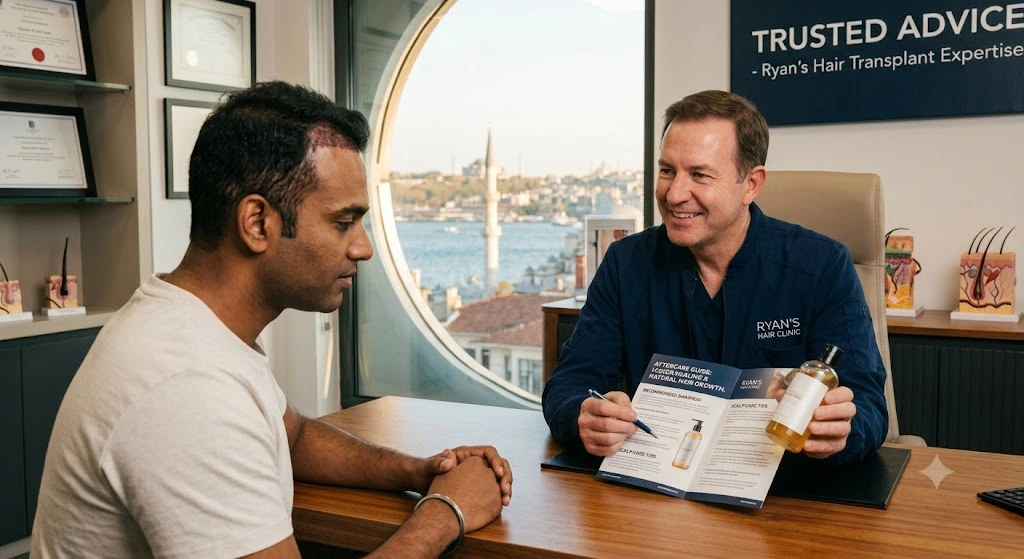
Get expert guidance on the best shampoo and aftercare tips for faster healing and natural hair growth — trusted advice from Ryan Turkey Hair Transplant Expertise.
Get expert guidance on the best shampoo and aftercare tips for faster healing and natural hair growth — trusted advice from Ryan Turkey Hair Transplant Expertise.
Deciding to undergo a hair transplant is a weighty matter. There is a lengthy process even after the surgery has been performed. Each day for the weeks and actual months after the transplant, you will have to perform specific care in order to let the grafts settle and begin their growth. The questions that will most likely surface will be concerning the use of shampoo after the hair transplant - what you will be allowed to use or even what is the most appropriate.
This post will cover everything regarding the use of shampoo and what the hair transplant care entails after the procedure. Furthermore, we will answer the most popular questions you will be asked. Together, we will examine the most appropriate ingredients to use in the post-surgical phase, what must be avoided, the most optimal schedule for washing your hair, and a lot more!
Right after getting a hair transplant, no matter the type of hair transplant a Female Hair Transplant in Delhi, Eyebrow Transplant, or Beard Transplant in Delhi -- the area where the grafts were transplanted is very sensitive and in the beginning stages of healing. The skin around the grafts is inflamed and is ready to be infected.
Using the wrong type of shampoo which is very strong, very processed, or full of sulfates can...
- Irritate recently implanted grafts.
- Remove grafts before they are completely set.
- Delay healing for the tiny openings.
- Delaying healing for the tiny openings may be prolonged.
When the tiny openings of the skin are healing, itching and/or dandruff can occur. This prompts scratching and increases the chances of infection.
The right type of shampoo can help the healing process for the skin openings and lessen the scabbing while keeping the scalp clean and not affecting the grafts. It can also help promote a healing environment to the grafts and encourage growth of the hair in the right direction.
Aftercare protocols differ from clinic to clinic. Variations are to be expected. However, procedures and recovery from (Follicular Unit Extraction) FUE transplants Clinic in Delhi are likely to be the same across the board.
Day 1 and 2: Complete rest/bear no interference. Immediate post operative care is crucial for the grafts to settle.
Day 3 and 4: Only a very gentle rinse is allowed; this rinse must be eithevery light pressure, lukewarm water, or an approved, diluted solution.
Day 5 to 10: Gentle application of a mild, sulfate-free shampoo is deemed necessary. The grafts must be protected from any stress during this process which is to be done by finger tips and then cast dry by a gentle pat.
Day 10 to 14: The grafts will begin to shed scabs. By this time normal shampooing is permitted, though gentle application and a sulfate-free shampoo is still required.
This is a standard time-line whether you have undergone a Hair Restoration Treatment in India, an Eyebrow Transplant, or Beard Restoration.
Sodium Lauryl Sulfate and other sulfates act as surfactants. They create a rich lather and help strip oil from a surface. This can be potentially irritating on skin that is in the process of healing and shampoo that is sulfate free can help cleanse your hair and skin without harming the skin grafts.
Human scalp skin is a pH mild acid. During the healing process, to assist in the maintenance of a protective barrier on the healing skin of the scalp, the shampoos should be pH balanced.
Shampoo with strong and heavy fragrances can be irritating to healing, sensitive, and skin of a lower pH barrier, because they may contain harsh synthetic chemicals.
Shampoos containing Panthenol and in small and diluted forms, tea tree oil, chamomile, and aloe vera can help promote healing and reduce skin inflammation.
Some clinics provide a specific post-op shampoo in the aftercare kits. If a specific post-op shampoo has been provided to you, please use it as directed.
- Shampoos with sulfate are an irritant and dry the scalp.
- Dyes/fragrances are usually a large factor in allergies and skin irritation
- Strong medicated Anti-dandruff shampoos (coal tar, heavy salicylic acid) need to be approved by the surgeon first to be used
- Always use lukewarm water, no hot water for the first few weeks post-op
- High pressure shower water
- No harsh scrubbing, even if the scalp is itchy
- Hair styling products (gels, waxes, sprays) have to be approved by the surgeon before use
- Shampoos with sulfate are an irritant and dry the scalp.
- Dyes/fragrances are usually a large factor in allergies and skin irritation
- Strong medicated Anti-dandruff shampoos (coal tar, heavy salicylic acid) need to be approved by the surgeon first to be used
- Always use lukewarm water, no hot water for the first few weeks post-op
- High pressure shower water
- No harsh scrubbing, even if the scalp is itchy
- Hair styling products (gels, waxes, sprays) have to be approved by the surgeon before use
Female Hair Transplant in Delhi: Longer hair requires added detangling care to prevent tangling near graft sites. Detangling should always be done from the ends first to the top of the strands—not touching the scalp. This should be done with fingers instead of a brush.
Eyebrow Transplant / Eyebrow Transplant Near Me: The skin near the eyebrows is a lot thinner than the scalp. Wash the area around the eyebrows with a cotton pad instead of using direct shampoo.
Beard Transplant in Delhi: The skin on the face is especially sensitive to certain shaving products. Usually patients are advised to avoid all shaving products near the grafted area until the area is healed.
FUE Hair Transplant in Delhi: The main concern with FUE is that many tiny extractions are done. One area of concern is the donor area, and the other is the recipient area. Washing both areas gently is key.
PRP Treatment in Delhi: If PRP treatment in Delhi (Platelet-Rich Plasma)is done to boost healing and make hair growth faster with the transplant, special care instructions are given. PRP makes the scalp sensitive so instructions may change slightly.
- Your typical hair care routine can resume about a month post-operation, but you should keep these habits for good:
- Use a gentle shampoo that is sulfate-free
- Use less heat when styling hair
- Don’t expose your scalp to the sun too much and for long periods
- PRP sessions and any additional post-operation treatments should still be done
- Follow-up appointments for graft growth should still be done
Using the appropriate shampoo following your hair transplant is vital to enhance the healing of the grafts and the final appearance of the transplant. After the hair transplant, you can use a gentle, sulfate-free hair transplant shampoo combined wi th a pH balanced wash technique to give your new hair the best start.
If you are planning for hair restoration or are already in recovery and want expert tips for your specific treatment, Ryan Turkey Hair Transplant Expertise Now In India, based in New Delhi, India, is a great option. This clinic brings world-renowned Turkish hair transplant techniques to Indian clients. If you are considering a Female Hair Transplant in Delhi, FUE Hair Transplant in Delhi, a Hairline Transplant Clinic in Delhi, an Eyebrow Transplant, a Beard Transplant in Delhi, or PRP Treatment in Delhi, you can expect to receive personalized aftercare support from this clinic, including advice on what products you can use for your specific treatment to help you achieve optimal results that look natural and are effective.
For the initial weeks a conditioner should not be used as it is can make the washing process more disruptive to the grafts. Your surgeon will say when it is okay to use aga
Most of the concepts and principles are the same, but women with longer hair require additional procedures to reduce the risk of pulling on graft areas when detangling.
Yes, the skin in these areas is delicate and so cleansing is gentler and may involve alternative products or techniques to those used in scalp aftercare.
If PRP Treatment in Delhi is done in conjunction with your Transplant, then your scalp may be sensitive for a short period and in that case, your surgeon may recommend you use a particular mild Shampoo.
Using a harsh or unsuitable shampoo can cause irritation to the sensitive scalp and dislodge the healing grafts, extend the post-operative recovery period, and may increase the risk of infection. For these reasons, it is very important to follow the guidelines provided by your clinic.
Ryan Turkey Hair Transplant Expertise Now In India, based in New Delhi, offers detailed guidance for all pre- and post-procedure care, including advice on washing and a tailored Shampoo for each type of transplant.
No. Your usual shampoo should not be used in the early post-operative period. Shampoo varieties that are fragrant and that contain sulfates should be avoided. The instructions given by your surgeon should indicate the use of a very mild, sulfate-free shampoo.
Book Your Free Consult Now!