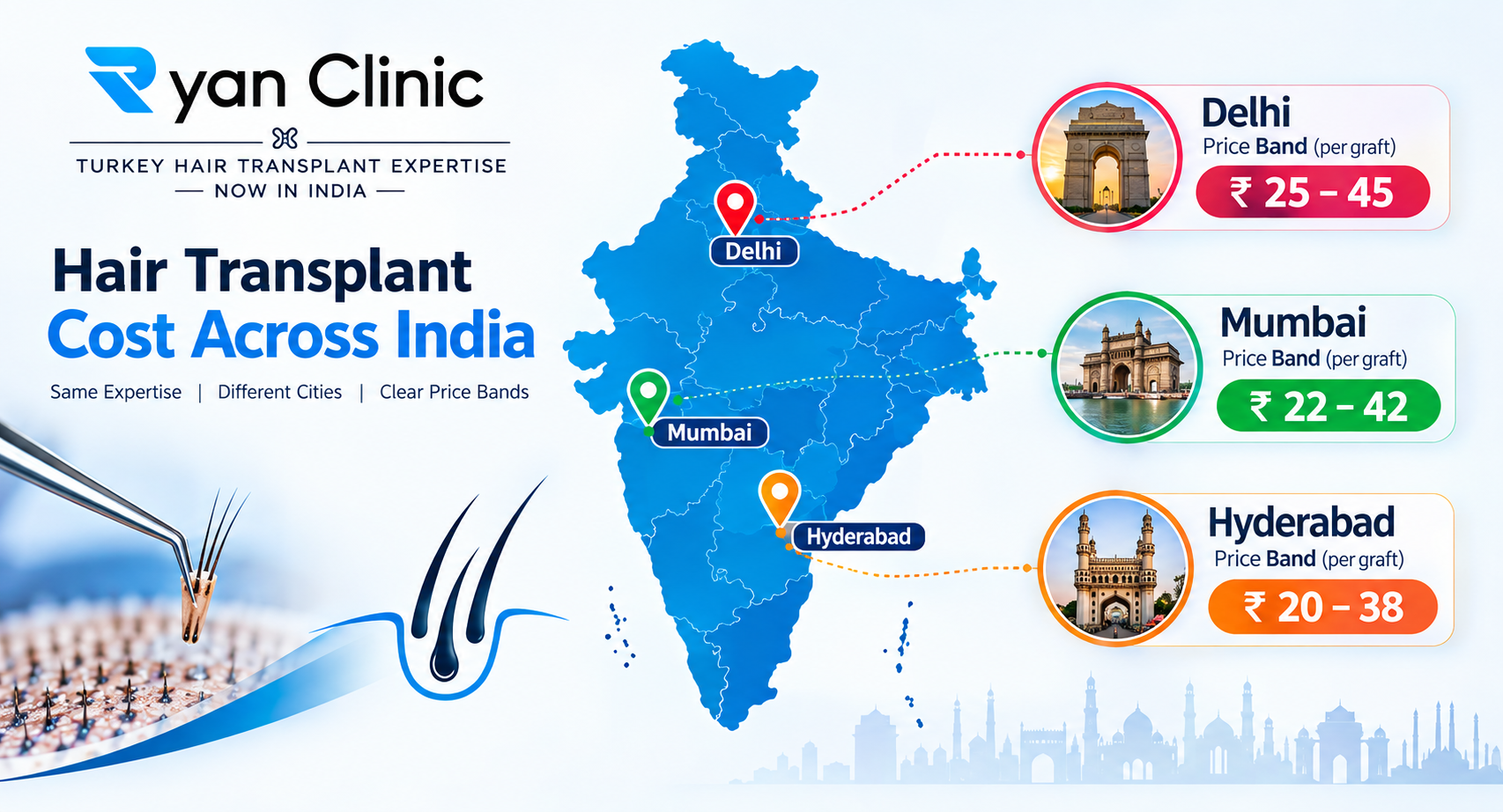
Real 2026 per-graft rates across all three cities — plus the travel and follow-up costs most comparisons leave out, and the graft count where switching cities actually pays off.
Real 2026 per-graft rates across all three cities — plus the travel and follow-up costs most comparisons leave out, and the graft count where switching cities actually pays off.
For doctor-led surgery, Hyderabad is cheapest at ₹45–₹70 per graft, Delhi sits at ₹55–₹80, and Mumbai is dearest at ₹60–₹90. On 2,500 grafts that is a gap of roughly ₹30,000–₹50,000 between the cheapest and dearest city — but flights, hotel and follow-up visits typically cost ₹25,000–₹55,000, so travelling rarely pays.
Key points
Hyderabad runs about 15–20% below Delhi; Mumbai about 10% above it
The gap tracks rent, salaries and local competition — not surgical quality
Travelling for surgery costs ₹25,000–₹55,000 once follow-up trips are counted
A Delhi patient needs roughly 3,000 grafts before flying to Hyderabad breaks even
18% GST, your graft requirement and your lifetime donor capacity are identical in all three cities
Follow-up matters more than most people plan for: day-1, day-10 and month-1 checks are hard to do remotely
Which Indian city is cheapest for a hair transplant?
Hyderabad. But the gap is smaller than most people expect.
Here are 2026 doctor-led rates — meaning a surgeon performs the extraction and the implantation, not a technician:
City | Doctor-led rate per graft | 2000 grafts with 18% GST | 2500 grafts with GST | 3000 grafts with GST |
|---|---|---|---|---|
Hyderabad | ₹45–₹70 | ₹1,06,200–₹1,65,200 | ₹1,32,750–₹2,06,500 | ₹1,59,300–₹2,47,800 |
Delhi NCR | ₹55–₹80 | ₹1,29,800–₹1,88,800 | ₹1,62,250–₹2,36,000 | ₹1,94,700–₹2,83,200 |
Mumbai | ₹60–₹90 | ₹1,41,600–₹2,12,400 | ₹1,77,000–₹2,65,500 | ₹2,12,400–₹3,18,600 |
Using a representative mid-point from each city — ₹55 in Hyderabad, ₹65 in Delhi, ₹72 in Mumbai — a 2,500-graft surgery works out to:
City | Ex-GST | With 18% GST | Difference vs Hyderabad |
|---|---|---|---|
Hyderabad at ₹55 | ₹1,37,500 | ₹1,62,250 | — |
Delhi at ₹65 | ₹1,62,500 | ₹1,91,750 | +₹29,500 |
Mumbai at ₹72 | ₹1,80,000 | ₹2,12,400 | +₹50,150 |
So: a real gap, but one that a single round of travel can wipe out.
Three reasons, none of them clinical.
Rent and salaries. A theatre in Bandra or Andheri West costs multiples of one in Banjara Hills. Staff salaries follow the same curve. That cost sits inside every graft.
Competition density. Hyderabad has an unusually high concentration of hair restoration clinics in a small area, which keeps prices compressed. Mumbai’s premium tier faces less direct price pressure.
Market character. Delhi NCR is the largest and most crowded market in India, which is why it has the widest spread — you can find ₹20 a graft and ₹150 a graft within the same ten kilometres.
What does not explain the difference: surgeon skill, technique, equipment or graft survival. Those vary far more within a city than between cities. The most expensive clinic in Hyderabad charges more than the cheapest in Mumbai.
What does it actually cost to travel for a hair transplant?
This is the line item people leave out, and it is usually the one that decides the answer.
Item | Realistic cost |
|---|---|
Return domestic flight | ₹6,000–₹14,000 |
Hotel, 3 nights near the clinic | ₹6,000–₹15,000 |
Local transport | ₹2,000–₹4,000 |
Meals | ₹2,000–₹4,000 |
One return trip for follow-up | ₹8,000–₹18,000 |
Total | ₹24,000–₹55,000 |
Plus | 3–4 working days off, twice if you return |
A companion adds most of these again. And this assumes one follow-up trip — most protocols want you seen on day 1, around day 10 for the first proper wash and scab check, and again at months 1, 6 and 12. Remote follow-up by video works for some of those and not for others.
At what graft count does travelling actually pay off?
Straight arithmetic, using ₹35,000 as a mid-range travel cost:
Route | Saving per graft (with GST) | Grafts needed to break even |
|---|---|---|
Delhi → Hyderabad | about ₹11.80 | ≈ 3,000 grafts |
Mumbai → Hyderabad | about ₹20.10 | ≈ 1,750 grafts |
Mumbai → Delhi | about ₹8.30 | ≈ 4,200 grafts |
Read that carefully. A Delhi patient needing 2000 grafts does not save money by flying to Hyderabad — they lose money. A Mumbai patient needing 3000 grafts genuinely does save, on the order of ₹25,000, if they only travel once.
And break-even is not the same as worthwhile. Breaking even means you spent the same money, took four days off work, recovered in a hotel room, and made your day-10 check harder to attend. Below roughly 3,000 grafts, travelling for price alone is not a good trade.
Not sure how many grafts you need? Our free graft calculator gives an estimate in about a minute.
What is identical in all three cities?
18% GST. It is a central tax. Nobody in India can legally quote you a cosmetic hair transplant without it.
Your graft requirement. A Norwood 4 head needs the same 2,500–3,500 grafts in Mumbai as in Hyderabad.
Your donor capacity. Roughly 5,000–7,000 grafts across a lifetime, wherever you spend them.
The technique. Sapphire FUE is the same procedure in every city; only the hands differ.
The questions that matter. Who operates, at what density, with what instruments, on how many cases that day.
Which is the real point of this article: city is a weak variable, surgeon is a strong one. Moving from a technician-led clinic to a doctor-led one changes your result far more than moving between metros changes your bill.
City-by-city: what to watch for
The largest market in India and the widest price spread — ₹20 to ₹150 per graft within the same city. That range is the opportunity and the hazard: the best value in the country is available here, and so is the highest concentration of volume clinics. Delhi also sees the most repair cases, which is a direct consequence of the same spread. Ask harder questions here than anywhere else. Our Delhi centre is in Pitampura.
The most expensive of the three, almost entirely because of rent and salaries. Fewer ultra-budget operators than Delhi, and a visible premium tier built around named surgeons and celebrity association. Paying Mumbai prices is reasonable; paying a celebrity premium on top of it is a separate decision. Our Mumbai centre is in Andheri West.
The cheapest of the three and a genuine medical-tourism destination, drawing patients from across Telangana, Andhra Pradesh and increasingly from Mumbai and the Gulf. High clinic density around Banjara Hills and Jubilee Hills keeps rates competitive. The low prices here are mostly structural rather than a warning sign — but the ₹20-a-graft tier exists in Hyderabad too, and the same arithmetic applies to it. Our Hyderabad centre is in Banjara Hills.
Turkish packages typically land at ₹2,10,000–₹3,50,000 all-in for high graft counts, which looks competitive against Mumbai until you add flights, a week’s hotel, and the fact that most packages are technician-performed with the surgeon in a supervisory role. Many also advertise “unlimited grafts”, which is the opposite of donor-area discipline.
The harder problem is follow-up. If something needs attention at week three — an infected follicle, unusual shedding, a reaction — you are in a different country from the person who operated on you. Indian patients travelling abroad for cost reasons are, in effect, paying to make aftercare difficult. Dubai is more expensive than any Indian metro. Thailand is comparable to Mumbai with the same aftercare problem.
Budget four days. Arrive the day before, surgery day, day-after check, travel on day three or four.
Do not book a same-day return. You will be bandaged, tired and told not to lift anything.
Ask about flying. Most surgeons clear domestic flights after about 3–5 days; take an aisle seat and let someone else handle your bag.
Fix the follow-up schedule before you book the surgery, in writing — which checks must be in person, which can be by video, and what happens if something goes wrong at home.
Confirm the surgeon operates in that city on your date. Multi-city groups sometimes rotate surgeons. Ask who will be in the room, by name.
Travelling from another city and want to know what it involves? Ask our team — we will tell you honestly whether it is worth the trip for your graft count.
Ryan Clinic operates in Delhi, Mumbai and Hyderabad on one protocol: every surgery planned and performed by a surgeon, the same technique, the same instruments, the same follow-up schedule.
[CONFIRM AND ADD: whether your per-graft rate is identical across all three cities or varies by centre; if it varies, state the rate per city; which surgeons operate at which centre and on what schedule; your policy on follow-up for out-of-city patients, including which checks can be done by video; whether you assist with accommodation.]
Every quote is issued in writing after a free scalp analysis — never from a photograph. Full pricing is on our hair transplant cost page, and no-cost EMI is available through HDFC, ICICI and Axis Bank on 6- and 12-month plans.
Hyderabad. Doctor-led rates there run ₹45–₹70 per graft against ₹55–₹80 in Delhi and ₹60–₹90 in Mumbai. On 2,500 grafts, Hyderabad is roughly ₹30,000 cheaper than Delhi and ₹50,000 cheaper than Mumbai before travel costs.
Delhi, by roughly 10%. A 2,500-graft doctor-led surgery costs about ₹1,91,750 in Delhi against ₹2,12,400 in Mumbai, including 18% GST. The gap reflects rent and salaries, not surgical standards.
Usually not below about 3,000 grafts. Flights, hotel, local transport and one follow-up trip cost ₹24,000–₹55,000, which cancels the saving on smaller cases. A Mumbai patient needing 3000 grafts is the clearest case where it does pay.
Lower commercial rent, lower salaries, and an unusually high concentration of clinics competing in a small area. None of those factors relates to surgical quality, which varies far more between clinics in one city than between cities.
No. GST is a central tax, charged at 18% on cosmetic hair transplants anywhere in India. If a quote in one city looks tax-free, it is almost certainly quoted exclusive of GST rather than exempt from it.
Four is comfortable: arrive the day before, surgery day, a day-after check, then travel. Most surgeons clear domestic flights after about 3–5 days. You will also need follow-up checks at roughly day 10 and month 1.
Not usually, once travel is included. Turkish packages run ₹2,10,000–₹3,50,000 plus flights and a week’s stay, which is at or above Indian doctor-led pricing, and most are technician-performed with aftercare in another country.
No. Results depend on the surgeon’s skill, implantation density, graft handling and your own donor supply. Those vary far more between clinics inside one city than between Delhi, Mumbai and Hyderabad.
For more on planning and paying for a hair transplant, browse our more cost guides.
Sources
CBIC. GST rate schedule for services — cosmetic and plastic surgery taxable at 18% nationwide.
International Society of Hair Restoration Surgery (ISHRS). Practice Census — session sizes, graft counts and implantation density norms.
Published literature on safe donor area and lifetime harvestable graft estimates in androgenetic alopecia.
Per-graft rates observed across published clinic price pages in Delhi NCR, Mumbai and Hyderabad, and Ryan Clinic quotations, 2026. Recheck quarterly.
Travel cost ranges based on published domestic airfare and hotel rates on the Delhi–Hyderabad, Mumbai–Hyderabad and Mumbai–Delhi routes, 2026.
About the author Dr. Pranendra Singh is a hair restoration surgeon at Ryan Clinic, specialising in Sapphire FUE. Read full profile →
Disclaimer: This article is general information, not medical or financial advice. Prices, airfares and tax rates change; confirm current figures before deciding. Your graft requirement and suitability for surgery can only be determined by a qualified surgeon after an in-person examination.
Book Your Free Consult Now!