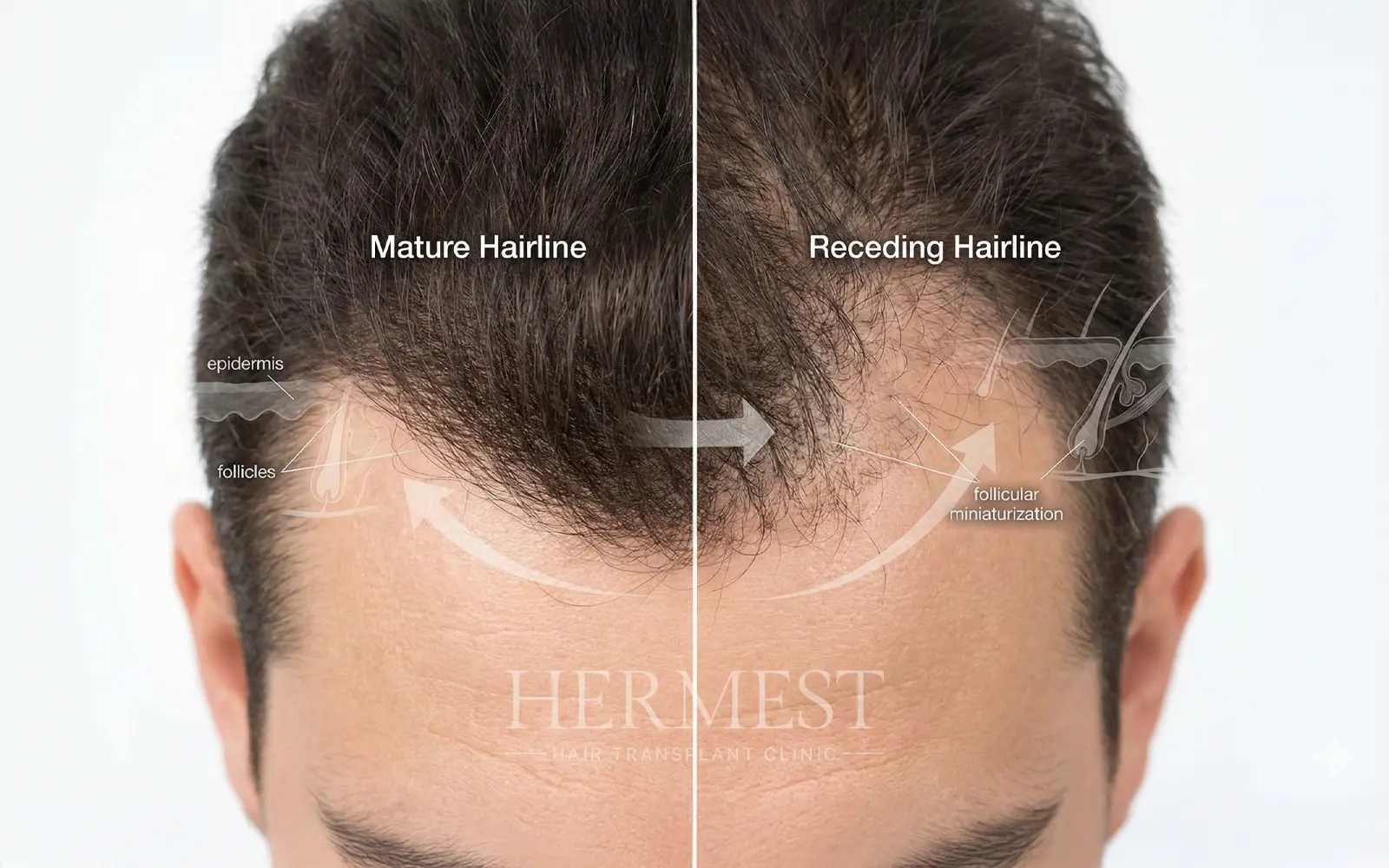
Description: There is no upper age limit. Fitness for surgery and donor supply decide — and a settled pattern often makes older patients better candidates.
Description: There is no upper age limit. Fitness for surgery and donor supply decide — and a settled pattern often makes older patients better candidates.
There is no upper age limit for a hair transplant. Fitness for surgery decides, not birth year, and patients in their sixties and seventies are operated on routinely. Older patients are often better candidates than young ones, because the pattern has finished declaring itself. The real constraints after 50 are donor supply, general health and realistic goals — not age.
Key points :
No age cut-off exists in India or in surgical guidance; health and donor quality decide
Your pattern is stable, so the surgeon can plan a result that will still be right in fifteen years
Donor density declines with age, and some of the donor zone may itself be thinning
Grey and white hair transplants perfectly well — the graft grows the colour it was always going to
With limited donor hair, the frontal third comes first. The crown can consume 2,500+ grafts alone
If you take finasteride, tell your doctor before a PSA test — it roughly halves the reading
No. There is no legal age limit in India, and no surgical guideline sets one. What replaces it is a straightforward question: are you fit for an 8–10 hour procedure under local anaesthesia, and is there enough donor hair to achieve something worth doing?
Patients in their fifties and sixties are common in hair restoration. Patients in their seventies are operated on where health and donor supply allow. A fit 62-year-old with good donor density and controlled blood pressure is a considerably better candidate than an unwell 45-year-old — or, for that matter, than a 22-year-old whose hair loss is still moving.
This runs against what most people assume, so it is worth stating plainly.
Your pattern has declared itself. The single biggest problem in younger patients is that nobody knows where the loss will stop. At 55, the surgeon can see the finished pattern and design for it. The result will not be undermined by recession five years later.
No moving target behind the hairline. A hairline placed at 55 does not get stranded the way one placed at 22 does.
Expectations are usually realistic. Older patients tend to want to look like a well-maintained version of themselves, which is exactly what this surgery delivers. Younger patients frequently want to look like someone else.
A higher, softer hairline is appropriate — and cheaper. An age-appropriate hairline sits higher and is less dense at the leading edge. That is both the natural-looking choice and one that uses fewer grafts.
Medication decisions are simpler. The long-term commitment question that dominates planning for a 25-year-old is much less pressing at 60.
Lifetime donor capacity is roughly 5,000–7,000 grafts in Indian patients, but at 55 or 65 two things have usually happened. First, hairs in the donor zone thin gradually with age — senile alopecia affects the back and sides too, not only the top. Second, if you have had previous surgery, that supply is already partly spent.
The practical effect is that usable donor hair at 60 can be meaningfully lower than it would have been at 30. It does not stop surgery. It changes the plan, which is why donor assessment under magnification matters more at this age than at any other.
Most patients over 50 have at least one condition that affects surgical planning. The three that matter most have their own detailed guides:
Diabetes — HbA1c under 7% and physician clearance, with slower healing and higher infection risk if control is poor
High blood pressure — under 140/90 on the day, and a cardiology discussion if you take any blood thinner
Cardiac disease and anticoagulants — never stop aspirin, clopidogrel or any anticoagulant for cosmetic surgery without your cardiologist’s instruction
If you have any of these, read those guides before your consultation and bring your reports. They are the difference between a date being confirmed and a consultation being wasted.
Skin turnover slows with age. Scabs may take a few days longer to clear and donor sites a little longer to settle, particularly if you are also diabetic. This is a matter of days, not months, and it does not affect the final result.
Eight to ten hours in a chair is harder at 65 than at 35. Back pain, stiffness, and — commonly in men over 60 — a prostate that requires more frequent breaks are all real considerations that nobody mentions in a consultation unless you raise them.
Ask about splitting the session across two days. For a large graft count in an older patient, two shorter sittings are frequently the better plan, and a good clinic will offer it rather than wait to be asked.
Yes. A transplanted follicle produces the hair it was always going to produce, including its colour. Grey hair grows exactly as reliably as pigmented hair.
There is one practical wrinkle. White hair is hard to see against pale scalp during extraction, which slows the surgeon and can increase transection. The standard solution is to dye the donor area a day or two before surgery — a temporary colour that makes the follicles visible. If you have white or mostly grey hair, ask whether your clinic wants you to do this and what they recommend. It is a small thing that meaningfully affects graft quality.
A second point in your favour: grey hair against pale scalp has lower visual contrast, which means a given density looks fuller than the same density in black hair. Older patients with grey hair often need fewer grafts for the same apparent coverage.
This is the conversation that decides whether you are happy at twelve months.
With a Norwood 5 or 6 pattern and a donor area that has thinned with age, there may be 3,500–4,500 usable grafts against a bald area that would ideally take 6,000 or more. That gap does not mean the surgery is not worth doing. It means choices have to be made deliberately rather than discovered later.
The frontal third comes first, always. It frames the face, it is what people see when they look at you, and it delivers by far the largest perceived change per graft. A restored front with a thin crown reads as a full head of hair in almost every situation. A restored crown with a bald front reads as nothing at all.
The crown is expensive. Its whorl pattern needs higher density to look right, and at Norwood 6 the crown alone can absorb 2,500 grafts and still look modest. For most patients over 50 with limited donor hair, the honest advice is to leave it — or to accept light coverage there rather than full density.
Other levers worth discussing:
A higher hairline costs fewer grafts and looks more natural at your age
Scalp micropigmentation behind a transplanted front creates the impression of density without spending grafts
Two planned sessions a year apart, rather than one that overreaches
Accepting a softer, less dense result — which at 60 looks entirely right and at 25 would not
Full pricing by graft count is on our hair transplant cost page.
This is the most important practical detail on this page, and it has nothing to do with your scalp.
Finasteride — prescribed to slow hair loss — lowers PSA (prostate-specific antigen) by roughly half in men taking it. PSA is the blood test used in prostate cancer screening. A man on finasteride can therefore return a PSA result that looks reassuringly normal while the true value is twice as high.
What to do:
Tell any doctor ordering a PSA test that you take finasteride. Every time, including at a routine health check-up.
Your doctor will interpret the result accordingly — commonly by doubling it, or by tracking changes over time rather than the absolute number.
Do not interpret your own PSA result. And do not stop finasteride before a test without medical advice.
This is not a reason to avoid finasteride. It is a reason to make sure the right people know you are on it. It is also a conversation worth having with your doctor before starting the drug at this age, alongside the usual discussion of benefits and side effects.
More than a younger patient, and that is appropriate:
ECG — standard over 40
Blood pressure, ideally a home log for the week before
HbA1c and fasting glucose
Complete blood count, clotting profile
Kidney and liver function
Cardiology clearance in writing if you have ischaemic heart disease, a stent, a previous heart attack, arrhythmia, heart failure, or take any anticoagulant
HIV, HBsAg, HCV screening — required of every patient
A complete medication and supplement list, including fish oil, vitamin E and ginkgo, which increase bleeding.
The same as any other patient: shedding of the transplanted hair in weeks 2–6, the quiet phase to month 3, first growth at months 3–5, meaningful density by months 8–10, and the final result at 12–18 months.
Healing may run a few days longer. Growth does not. The timeline is set by the hair cycle, and the hair cycle does not care how old you are.
Uncontrolled diabetes, hypertension or cardiac disease, until managed
Anticoagulant therapy without written cardiology guidance
A recent cardiac event or stroke — generally within the last 6–12 months
Donor density too low to achieve a result worth the surgery
Significant donor-area thinning, where harvesting would leave visible damage
Expectations that cannot be met with the donor hair available
Note what is not on that list: being 65. Every surgery at Ryan Clinic is planned and performed by the doctors, and the assessment is of you, not of your age.
Ryan Clinic does not apply an upper age limit. Patients over 50 are assessed on surgical fitness, donor quality measured under magnification, and what can realistically be achieved with the hair available — set out in writing before anything is booked.
[CONFIRM AND ADD: whether you apply any upper age limit; your oldest patient treated, if you are willing to publish it; whether you routinely offer split sessions for older patients and above what graft count; whether you advise donor dyeing for white-haired patients and what you recommend; whether you offer SMP alongside surgery for limited-donor cases; your cardiology clearance requirements.]
Free scalp analyses are available at our Delhi, Mumbai and Hyderabad centres.
Book a free scalp analysis — bring your current medication list and any recent cardiac or diabetes reports.
No. There is no legal or surgical upper age limit. Suitability depends on fitness for a long procedure under local anaesthesia, controlled medical conditions, and sufficient donor hair. Patients in their sixties and seventies are treated routinely.
Yes, if you are medically fit and have adequate donor density. At 60 the pattern is stable, which makes planning more reliable than in a younger patient. The main constraints are donor supply and whether goals can be met with the hair available.
Yes. A transplanted follicle grows the colour it was always going to grow, and grey hair takes as reliably as pigmented hair. Surgeons often ask white-haired patients to dye the donor area a day or two before surgery so follicles are visible during extraction.
Generally yes, when both are controlled — HbA1c under 7% and blood pressure under 140/90, with written clearance where indicated. Uncontrolled diabetes raises infection risk and slows healing; uncontrolled hypertension increases bleeding during surgery.
It depends on donor density rather than age. Donor hair thins gradually with age, so usable grafts at 60 may be fewer than at 30. Where donor supply is limited, the frontal third is prioritised because it gives the largest visible change per graft.
Slightly. Scabs and donor sites may take a few days longer to settle, more so if you are also diabetic. The growth timeline is unchanged — first growth at 3–5 months and the final result at 12–18 months, the same as for any patient.
Yes. Finasteride roughly halves PSA levels, which can mask a raised reading used in prostate cancer screening. Always tell the doctor ordering a PSA test that you take it, so the result can be interpreted correctly. Do not interpret your own result.
The front, in almost every case. The frontal third frames the face and produces the largest perceived improvement per graft. The crown needs high density to look right and can absorb 2,500 grafts or more at advanced stages of loss.
For more on planning a hair transplant, browse our more guides.
Sources :
International Society of Hair Restoration Surgery (ISHRS) — candidacy assessment, donor evaluation and patient selection guidance.
American College of Cardiology / American Heart Association — perioperative cardiovascular evaluation for non-cardiac surgery.
Indian Journal of Dermatology / International Journal of Trichology — senile alopecia, donor area characteristics and hair restoration in older patients.
Published literature on finasteride and its effect on serum prostate-specific antigen.
Published literature on safe donor area and lifetime harvestable graft estimates.
About the author Dr. Pranendra Singh is a hair restoration surgeon at Ryan Clinic, Delhi, specialising in Sapphire FUE. Read full profile →
Medical disclaimer: This article is general information and does not replace medical advice. Surgical fitness, medication decisions and cardiology clearance must be determined by your treating doctors. Never stop or change any prescribed medication — particularly antiplatelet or anticoagulant therapy — on the basis of this article, and discuss PSA testing with your own physician.
Book Your Free Consult Now!