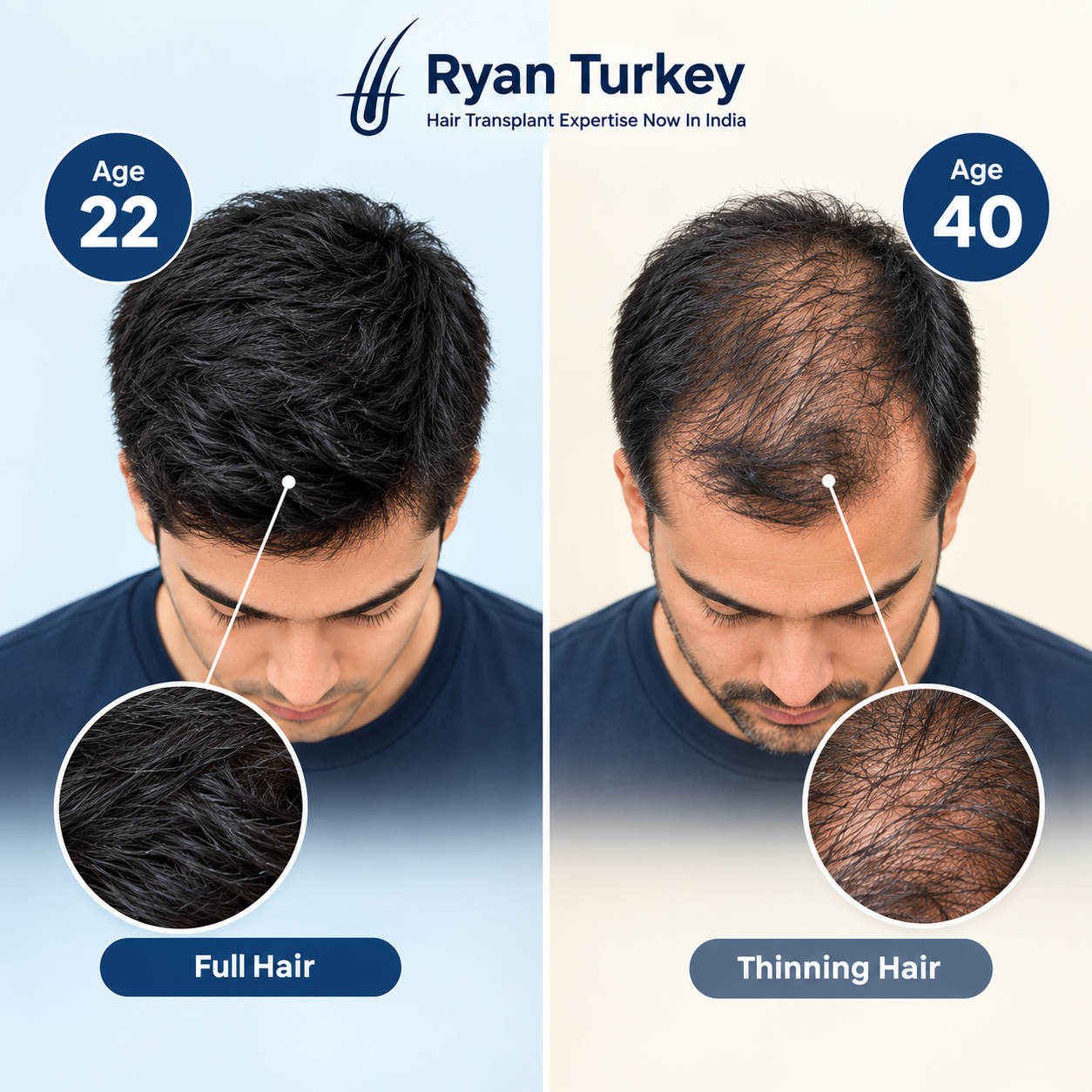
At 22, your hair loss pattern hasn't finished declaring itself — and a transplant is permanent even when the hair around it isn't. Learn why surgeons decline surgery this young, what a stranded hairline really looks like a decade later, and what you should be doing right now instead.
At 22, your hair loss pattern hasn't finished declaring itself — and a transplant is permanent even when the hair around it isn't. Learn why surgeons decline surgery this young, what a stranded hairline really looks like a decade later, and what you should be doing right now instead.
Most surgeons decline elective hair transplants under 25, because at 21–25 the pattern has not finished declaring itself. Transplanted hair is permanent; the native hair behind it is not. Operating early risks a transplanted hairline left stranded above a bald scalp, and spends grafts from a lifetime supply of roughly 5,000–7,000. The usual advice is medication and monitoring for 12–24 months first.
Key points :
Age is not the real criterion — stability is. A surgeon needs to see where your loss is heading
Transplanted hair stays; the hair behind it keeps receding. That gap is what makes early results look wrong later
A 22-year-old at Norwood 3 may need two or three surgeries by 45 if operated on now
Dropping a hairline 1 cm lower across the front can cost 500–800 extra grafts — permanently
Diffuse unpatterned alopecia (DUPA) can present in the early twenties and makes anyone a poor surgical candidate. It must be excluded by examining the donor area
Medication genuinely works best in this age group. Twelve months is the minimum meaningful trial
Not because of the number on your ID. Because of what a surgeon cannot yet see.
Male pattern baldness is progressive. At 22, you are somewhere on a curve, and nobody — not you, not the surgeon — knows where it flattens. It may stop at Norwood 3. It may reach Norwood 6 by 35. The rate of loss in the early twenties is also, on average, faster than loss that begins at 35, which means early onset often signals a more extensive final pattern.
A transplant does not change that curve. It moves permanent hair from the back of your head to the front. The hair it sits among continues to behave exactly as it was going to.
So the surgeon is not refusing to operate on a 22-year-old. The surgeon is refusing to operate on a pattern that has not finished happening.
This is the classic outcome, and you have seen it without knowing what you were looking at: a dense, well-defined hairline at the front, and behind it, bare scalp.
What happened is simple. A new hairline was built at 22. The native hair immediately behind it continued to recede over the next decade. The transplanted hairline stayed exactly where it was — because it is permanent — and the scalp behind it emptied. The result is a strip of hair floating on a bald head, which looks more obviously surgical than baldness ever did.
Fixing it means transplanting the gap behind. Which requires more grafts. Which you may no longer have.
Young men almost always want the hairline they had at 17: low, straight across, with the temple corners filled in. Surgeons design a mature hairline instead — typically sitting about 1 to 1.5 cm above the highest crease of your forehead when you raise your eyebrows, with the temples set slightly back.
That is not the surgeon being stingy. A juvenile hairline on a 40-year-old face reads as obviously transplanted, and it is one of the most common reasons people seek repair surgery.
It is also expensive in a way nobody explains: dropping the hairline 1 cm lower across the front costs roughly 500–800 additional grafts, and it commits you to defending that lower line for the rest of your life, because the hair behind it will keep thinning.
Your donor area — the permanent zone at the back and sides — holds a finite lifetime supply, usually 5,000 to 7,000 grafts in Indian patients.
Consider a 22-year-old at Norwood 3 who has 2,500 grafts placed at the hairline:
Age | What has happened | Grafts spent |
|---|---|---|
22 | Hairline restored | 2,500 |
30 | Loss progresses behind the transplant; mid-scalp thins | 2,500 + 2,000 = 4,500 |
40 | Crown opens up. Donor is now thin | Little or nothing left |
45 | Wants coverage. Cannot have it | — |
The same man, medicated from 22 and operated on at 30 once the pattern was clear, spends 3,000 grafts on a single well-planned surgery and keeps a reserve.
Early surgery does not just risk a bad result. It removes your options later. Full pricing across graft counts is on our hair transplant cost page — but the graft budget matters more than the rupee budget at your age.
Diffuse unpatterned alopecia is thinning that includes the donor area itself. It can present in the early twenties, and from the front it can look like ordinary pattern loss.
Transplanting a DUPA patient is close to the worst thing that can happen in this field. The grafts are harvested from hair that is itself going to be lost, so the transplant fails — and the donor area, now visibly damaged, cannot be repaired.
It is detected by examining the donor zone under magnification for miniaturisation — thinner, shorter, variable-calibre hairs where there should be uniform ones. Any surgeon who does not look at your donor area under trichoscopy before quoting you a graft count is not in a position to rule this out. At your age, that examination matters more than the consultation itself.
Something. The answer is not “nothing until you are 25”.
Get an actual diagnosis. Pattern baldness, telogen effluvium, thyroid disease, iron deficiency and alopecia areata all look like “my hair is falling”. They have different treatments and only one of them is surgical.
Start medication, if prescribed. Finasteride and minoxidil are the two treatments with real evidence behind them, and they work best in younger men with early loss — this is the window where they can stabilise a head of hair for years. Finasteride is prescription-only; the benefits and the possible side effects are a conversation with a doctor, not a decision to make from a blog post or a forum thread.
Give it at least 12 months. Hair grows about a centimetre a month. Nothing is assessable before a year, and shedding often increases in the first few months of minoxidil before it improves.
Photograph your scalp every six months. Same room, same light, same angles — front, top, crown, and the back of your head. In two years, these photographs are the most useful clinical document you own, and they are the thing that tells a surgeon whether you are stable.
Consider PRP or GFC as an adjunct if your doctor recommends it. It supports existing hair; it does not regrow a bald scalp.
Look at scalp micropigmentation if you want a visible change now. It is not permanent in the way surgery is, it costs no grafts, and it can be undone or built on later.
Treat the scalp you have. Sleep, iron levels, vitamin D, stress and crash dieting all move the needle more at 22 than most people expect.
Yes — occasionally, and never casually. The threshold a good surgeon applies:
Pattern stable for at least two years on medication, documented in photographs rather than remembered
Committed to continuing medication indefinitely — surgery does not stop loss, and stopping the medication afterwards undoes the plan
Strong donor density, confirmed under magnification, with DUPA excluded
Limited, localised loss — a conservative hairline or temple points, not a full frontal rebuild
A mature hairline accepted, designed for the face at 45 rather than the face in the mirror today
Realistic expectations, including the explicit understanding that a second surgery may be needed later
And a separate category where age is much less relevant: hair loss that is not androgenetic at all. Scarring from an accident or burn, a surgical scar, traction alopecia, a congenital hairline defect, or eyebrow and beard work. Those are stable targets. They do not progress, so the “wait for the pattern” argument does not apply.
If all six conditions hold, Sapphire FUE at 23 or 24 can be entirely appropriate. What is not appropriate is a 22-year-old at Norwood 3, never medicated, asking for a low hairline — and being booked for next Tuesday.
It is worth being blunt about this, because you will be told yes somewhere.
The clinics most willing to operate on a 22-year-old are usually the ones running on volume — technician-performed surgery, high case counts, fast booking cycles. A young patient with savings, urgency and no medical gatekeeping is the easiest sale in the market. Turkish packages aimed at this age group are built on the same economics.
The consequence arrives ten years later, and by then the clinic is not involved. You are, with a stranded hairline and a spent donor area.
A surgeon willing to lose your booking is giving you information. A surgeon delighted to take it at 22 is giving you a sales pitch.
Losing hair in your early twenties is genuinely hard, and it is not vanity to find it difficult. It arrives at the age when appearance feels most consequential, and the sense that it is happening faster than you can respond is real.
Two things worth saying. First, medication at your age is genuinely more effective than it will ever be again — this is the best window you will get, and using it is doing something, not waiting passively. Second, if hair loss is affecting your mood, your sleep, how you feel about going out, or how you see yourself, that is worth talking to someone about alongside the hair. Good clinics ask about it. Surgery is a poor treatment for distress, and a much better one for a stable, well-defined pattern of hair loss.
You are under 25 with progressive loss and no period of documented stability
You have never tried medication, or have been on it for less than 12 months
Donor examination shows miniaturisation suggestive of DUPA
The hairline you are asking for is juvenile rather than age-appropriate
Family history and current rate of loss point to Norwood 5 or above
You are unwilling to continue medication after surgery
“Decline” here almost always means “not yet, and here is the plan”. Most men turned away at 22 are good candidates at 28, with a better result and grafts still in reserve. Every surgery at Ryan Clinic is planned and performed by the doctors — which includes saying this when it is true.
Ryan Clinic does not operate on the basis of age alone, in either direction. Patients in their early twenties are assessed with donor trichoscopy, given a diagnosis, and started on a monitoring plan — not booked for surgery on the day they walk in.
[CONFIRM AND ADD: your minimum age policy, if any, and whether it is absolute; whether you require a documented medication trial before operating on under-25s, and for how long; whether you perform donor trichoscopy to exclude DUPA in every young patient; whether you offer a monitoring or photography programme for young patients; whether you prescribe medically or refer; whether you screen for body dysmorphic disorder and how.]
Free scalp analyses are available at our Delhi, Mumbai and Hyderabad centres.
Book a free scalp analysis — at your age, the point of the visit is a diagnosis and a plan, not a quote.
There is no legal minimum, but most surgeons decline elective surgery under 25. The reason is that pattern hair loss is still progressing in the early twenties, so a surgeon cannot yet see where it will stop or plan a hairline that will still look right decades later.
Occasionally, but only with two years of documented stability on medication, a strong donor area with DUPA excluded, limited localised loss and an age-appropriate hairline. Most 22-year-olds are better served by medication and monitoring for 12–24 months first.
The transplanted hair is permanent but the native hair behind it keeps receding, leaving a dense hairline above bald scalp. Correcting that needs more grafts, from a lifetime supply of roughly 5,000–7,000 that has already been partly spent.
It is a guideline, not a rule. The real criterion is stability — whether the pattern has stopped moving. A 24-year-old stable for three years on medication can be a better candidate than a 30-year-old losing hair rapidly.
It stabilises loss in many young men and is most effective at this stage, though results vary and it must be continued to keep the benefit. It is prescription medication: the benefits and possible side effects should be discussed with a doctor before starting.
Yes, unless it is treated. A transplant only redistributes hair; it does not stop androgenetic alopecia in the hair around it. This is why surgeons want medication continued after surgery, particularly in younger patients.
Dropping the hairline about 1 cm lower across the front typically needs 500–800 additional grafts. It also commits you to maintaining that line as the hair behind it thins, which usually means further surgery later.
Diffuse unpatterned alopecia is thinning that includes the donor area itself. Because donor hair is also being lost, transplanted grafts eventually fail and the donor area is left visibly damaged. It is excluded by examining the donor zone under magnification.
For more on planning a hair transplant, browse our more guides.
Sources :
International Society of Hair Restoration Surgery (ISHRS) — candidacy assessment, patient age and hairline design guidance.
Indian Association of Dermatologists, Venereologists and Leprologists (IADVL) — treatment guidelines for androgenetic alopecia.
Indian Journal of Dermatology / International Journal of Trichology — early-onset androgenetic alopecia, diffuse unpatterned alopecia and donor area assessment.
Published literature on finasteride and topical minoxidil in male androgenetic alopecia.
Published literature on safe donor area and lifetime harvestable graft estimates.
About the author Dr. Pranendra Singh is a hair restoration surgeon at Ryan Clinic, Delhi, specialising in Sapphire FUE. Read full profile →
Medical disclaimer: This article is general information and does not replace medical advice. Finasteride and minoxidil are medications whose suitability, benefits and risks must be assessed by a qualified doctor. Surgical candidacy can only be determined by a surgeon after an in-person examination including assessment of the donor area.
Book Your Free Consult Now!