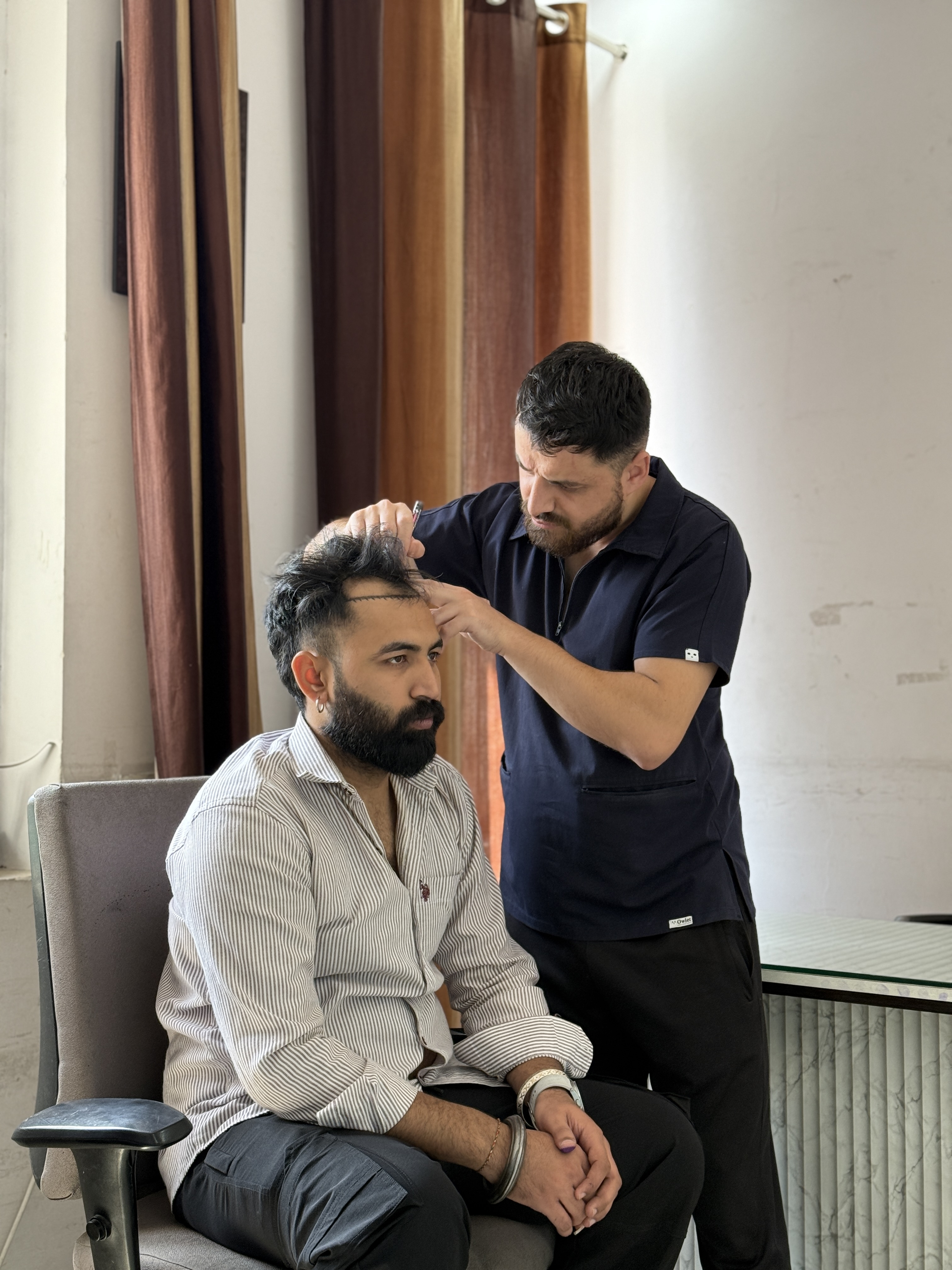
Learn about the causes and early signs of genetic hair loss and explore modern treatment options, including PRP, FUE hair transplant, and hairline restoration.
Learn about the causes and early signs of genetic hair loss and explore modern treatment options, including PRP, FUE hair transplant, and hairline restoration.
Millions of individuals worldwide experience issues linked to loss of hair, where most of these individuals testify that their main issues are not to do with their food plan and stress, but are rather linked to heredity. Genetic loss of hair is usually referred to by this term - androgenetic alopecia, which makes it the leading cause of hair loss among both men and women. Unlike temporary hair loss caused by the disease or hormonal change, genetic loss of hair is a progressive, measurable and inevitable issue if not treated on time.
Now, in 2026 the science of hair restoration has achieved a lot of progress, providing individuals with efficient solutions offered by clinics offering FUE Hair Transplant services or PRP Treatment in Delhi, just to name a few.
The technical term for genetic hair loss is androgenetic alopecia that refers to the inherited disposition to this condition that occurs in people having a genetic predisposition whereby the hair follicles start being more sensitive to the male hormone dihydrotestosterone (DHT). As it becomes more sensitive to DHT, the hair follicles begin shrinking or undergo miniaturization that results in the complete stopping of visible hair production.
This condition is also known as “male pattern baldness” or “female pattern baldness” depending on its manifestation. Though the entire biological mechanism of hair loss is the same in men and women, the patterns of hair loss are different.
Genetic hair loss is not contagious and does not have any connection to negligence on the part of the affected person. Therefore, it is not a disease that could be treated just by changing one’s lifestyle.
Androgenetic alopecia is referred to as a very common occurrence. Researches revealed that more than half of men aged over 50 will experience baldness. Besides, females may also suffer from a significant degree of hair loss by the age of 50. Some people can even start to lose their hair at the age of 18 and 20 if they have a family history of baldness.
Androgenetic alopecia is mainly caused by genetics. If someone in your family is bald, it is likely that you will lose your hair too. Many researchers have managed to identify certain genes that are responsible for baldness and inherited from mother or father or both.
The body converts hormone testosterone to hormone DHT using an enzyme called 5-alpha reductase. People who genetically lose their hair have hair follicles that are sensitive to DHT. As a result of this process, DHT binds to some receptors in hair follicles and causes them to shrink over time. This process reduces the thickness and length of hair and results in eventual hair loss.
The chances of hair loss and severity of hair loss often increase with age. Gene play significant role in determining if one has inherited the predisposition towards baldness, but it is age which dictates the timing of the experience.
In women, fluctuations of hormone levels such as those found in pregnancy, menopause, or PCOS (polycystic ovary syndrome) can contribute to accelerating hereditary hair loss due to shifting estrogen/androgen balance.
Genetics is the main driver of hair loss, but the progression of hair loss can be influenced by additional factors including long-lasting stress, poor scalp condition, cigarette smoking and various illness.
Identifying the signs of genetic alopecia in its early stages can result in effective management of the problem. The symptoms can vary in men and women.
Symptoms in Men:
- Receding hairline which usually appears first at the temples area
- Porky thinning at the back of the head with a circled bald area forming
- Gradual formation of "M" "U" or horseshoe shapes
- Shedding of hair in larger proportions during hair wash and combing
- Lack of proper hair growth with scalp being visible underneath thin hair
Symptoms in Women:
- Widespread thinning of hair in the front instead of a receding hairline
- The widening of the middle part of the hair
- Overall hair losing its thickness and density
- Hair feeling thinner and weaker than previously
If you have been suffering from hair loss for several months now, are losing above 100-150 hair strands daily, or have begun to notice that your hair has started to part wider than usual, you may want to consult with a doctor. In general, the earlier you seek help with your baldness, the more effective the treatment you may expect to undergo in the future.
A trichologist or a dermatologist typically diagnose the problem by:
- Examining the scalp visually to check for the pattern of hair loss
- Conducting a pull test to assess how much shedding is happening.
- Performing trichoscopy to see the follicles.
- Conducting blood tests to rule out any nutritional problems or hormonal issues.
- Studying the genetic background of the patient.
It is important to get a clear diagnosis before determining the kind of treatment since it varies based on the pattern and degree of the loss.
The positive development is that 2026 is providing us with a greater number of great and minimally invasive hair loss treatments than we've ever had before. Overall, the treatments can be divided into three major groups: medical treatments; non-surgical restorative procedures, and surgical hair restoration treatments.
The well-known Minoxidil topical solution is basically the first treatment that should be suggested. It provides blood to the hair roots, and prolongs the stage of hair development. The product can be bought without a doctor's prescription, and can be used by both women and men. Nevertheless, one may have to wait for a few months to see the results.
The oral and topical Finasteride works by prohibiting the conversion of testosterone into DHT; thus, it can treat the hormonal cause of hair loss. Generally, it is used in the very beginning of hair loss.
Platelet-Rich Plasma therapy (aka PRP therapy) is one of the most popular non-surgical methods of treating genetic hair loss. It involves the taking of a small sample of a patient's blood, the processing of blood in order to get concentrated platelets, and injection of the obtained plasma
FUE technique (Follicular Unit Extraction) is known for being the best surgical treatment for hair restoration. It involves taking single hair follicles one by one from the donor area that is usually found at the back or side of the scalp which does not respond to DHT and planting it in the areas that lack hair.
The advantages of FUE Hair Transplant include:
- No linear scarring like previous strip harvesting techniques
- Short recuperation time
- Natural results matching with the natural direction of hair growth
- Can be used for scalp, beard, and eyebrow recovery
Hairline Transplant is considered one of the popular areas of the surgery that is aimed exactly at treating receding hairline. This technique requires high artistic sensibility as the surgeon must create the hairline that should look natural from every angle and be compatible with the patient’s features, age, and hair type. An improperly designed hairline is considered to be the most frequent reason of patients applying for correction which makes the professional selection really important in this case.
Researching hair transplants in Delhi means finding the right clinic. But the effectiveness of your chosen clinic depends on many factors, including the surgeon's skills, the technology used, and sanitation measures of the clinic. Generally, Delhi has become one of the main centers for hair restoration in India, attracting patients from all over the country and the world.
But before selecting the clinic, let's look at the main factors that should be considered when evaluating the clinic in question:
- The experience of the surgeon
- The success rate of the procedures in question
- The technology applied
- The aftercare services provided by the clinic
- The pricing policies
No matter which treatment method you chose, aftercare is very important in determining the results:
- Stay away from the sun for the first few weeks after the treatment.
- You should follow the medication and shampoo instructions without making any changes.
- You should not exercise heavily for approximately 7-10 days after the procedure.
- You should attend follow-up consultations in the following days.
- Be sure to wait as the hair takes around 2-4 months to start growing after the surgery and 1 year for the full effect to be achieved.
Despite the fact that genetics cannot be changed, you can still make use of the following tips in order to slow down the process of hair loss:
- Starting the treatment from early signs of hair loss.
- Using products that have proven effectiveness, such as minoxidil and finasteride, under the guidance of a physician.
- Eating a healthy diet, containing protein, biotin, and iron in abundance.
- Reducing the amount of stress in life. Stress can worsen the process of hair loss.
- Minimizing the use of chemicals and heat styling techniques.
Conclusion
Genetic hair loss marks its place as one of the widespread yet commonly misinterpreted conditions that both men and women suffer from today. Although genetic hair loss cannot be completely avoided, combining different approaches, starting with early diagnosis and followed by medical actions as well as surgical interventions, can lead to enormous positive outcomes.
For those who wish to know more about their possibilities, Ryan Turkey Hair Transplant brings its internationally renowned Turkish hair restoration skills to the Indian market. Known for its precision techniques in performing FUE Hair Transplant, Hairline Restorations, Beard Transplants, and Female Hair Restoration procedures, as well as carrying out innovative PRP Treatment, Ryan Turkey Hair Transplant has its central office in New Delhi as it expands its expertise in the country.
Offices: Delhi | Mumbai | Hyderabad
If you have just started experiencing the signs of hair thinning or realize that you need a hair transplant in Delhi, Mumbai, or Hyderabad, you can be sure that the team at Ryan Turkey Hair Transplant has everything you need for restoring your hair and confidence.
Genetic hair loss cannot be completely reversed once Genetic hair loss cannot be totally reverted after follicles completely miniaturize but, nonetheless, it can be significantly slowed down through timely intervention and density lost can be cosmetically regained by means of FUE Hair Transplant procedures.
It can actually start as early as the late teens, though the most common period when it becomes obvious is the late twenties and thirties. The early onset is characteristic of individuals with a strong familial predisposition.
Yes. Female Hair Transplant is an established procedure aimed at the diffuse thinning phenomenon typical of women, which is achieved through different techniques than those used in male pattern baldness.
PRP Treatment helps current follicles by using the platelet-rich plasma of a patient and is most effective at the early stages of density loss, while hair transplant moves healthy follicles to bald areas and is more suitable for cases where baldness is pronounced.
The procedure is conducted under local anesthesia, which gives patients minimum discomfort during the process, while mild side effects such as discomfort or tightness within the next few days are expected and treated with medications received from doctors. .
Yes. Beard Transplant uses donor hair from the head to cover missing parts of the
Book Your Free Consult Now!