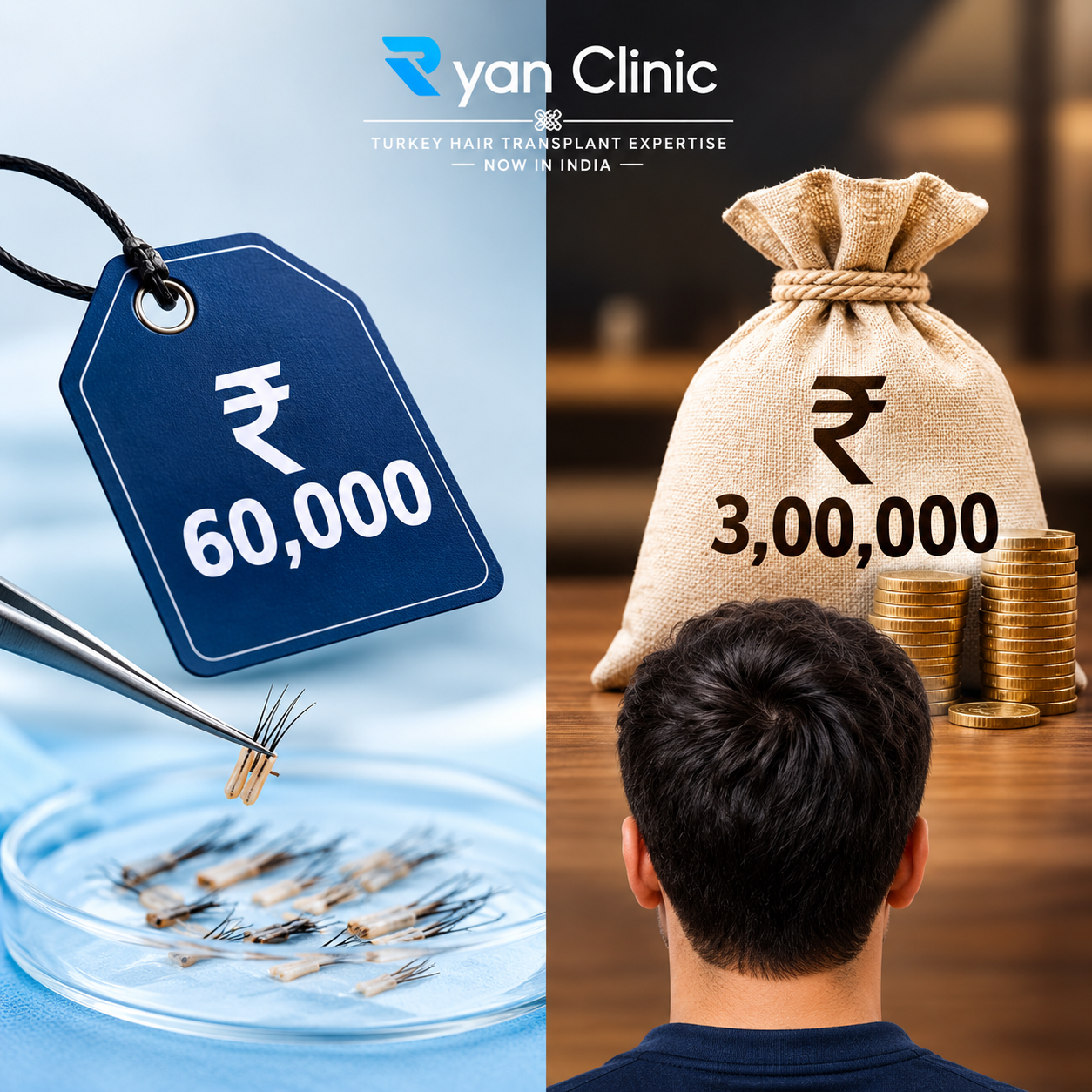
₹20 per graft looks like ₹60,000. It often ends up costing ₹3 lakh. See the real unit economics, what gets cut to hit that price, and the honest 5-year comparison against doing it once, properly.
₹20 per graft looks like ₹60,000. It often ends up costing ₹3 lakh. See the real unit economics, what gets cut to hit that price, and the honest 5-year comparison against doing it once, properly.
At ₹20 per graft, 3000 grafts is ₹60,000 — about a quarter of a doctor-led price. That rate cannot cover a surgeon’s time, so the surgery is performed by technicians at volume. When the result needs repair, the typical five-year total reaches ₹2.9–₹3.2 lakh, against ₹2.35 lakh for doing it once properly — and half your donor area is gone.
Key points
₹60,000 minus 18% GST leaves about ₹50,800 to cover 8–10 hours of theatre, a team of four to five, and consumables
The only large enough lever is labour: replacing the surgeon with technicians and running several cases a day
Graft survival depends on extraction skill and time out of the body — both are what gets compressed at volume
Repairing a poor result typically costs 1.5–2× the original surgery, and donor-area damage often cannot be repaired at all
A cheap surgery does not just waste money; it permanently spends grafts from a lifetime supply of roughly 5,000–7,000
A low price is not automatically a bad clinic — but it must have an explanation you can verify
Start with the arithmetic, because it answers the question better than any opinion.
A 3000-graft surgery at ₹20 per graft bills ₹60,000. Of that, 18% is GST, which goes to the government — so the clinic keeps about ₹50,800. That ₹50,800 has to cover:
Start with the arithmetic, because it answers the question better than any opinion.
A 3000-graft surgery at ₹20 per graft bills ₹60,000. Of that, 18% is GST, which goes to the government — so the clinic keeps about ₹50,800. That ₹50,800 has to cover:
What the surgery needs | Realistic cost |
|---|---|
Operating theatre, 8–10 hours | Rent, power, sterilisation, housekeeping |
Surgical team of 4–5 people for a full day | Salaries |
Sapphire blades or punches, implanters, cannulae | ₹8,000–₹20,000 in single-use consumables |
Local anaesthesia, saline, holding solution, dressings | ₹3,000–₹6,000 |
Pre-op assessment, follow-ups, admin, marketing | Overhead |
Surgeon’s time for 8–10 hours | The largest single cost |
Add those honestly and ₹50,800 does not reach the bottom row. Something has to give, and there are only three levers big enough to matter:
Remove the surgeon from the operating theatre. A technician costs a fraction of a surgeon’s day.
Run several surgeries at once. One doctor nominally “supervising” four rooms is four bills for one salary.
Cut consumables. Cheaper punches, reused instruments, fewer implanters.
This is not an accusation. It is the only arithmetic that makes ₹20 a graft work. When you see that price, you are not being offered the same surgery cheaper — you are being offered a different surgery.
Graft survival is decided in two places: how cleanly follicles come out, and how carefully they go in. Both are manual skills. A blunt or oversized punch, or a punch angled wrongly against the follicle, severs the hair below the skin — transection. Transected follicles are destroyed permanently, and they still get counted in your graft total, because counting happens before anyone knows whether they grew.
Experienced surgeons keep transection low. High-volume, low-skill extraction is where the rate climbs — and a 20% loss on 3000 grafts is 600 follicles gone from a supply you cannot replace.
Once extracted, follicles sit in holding solution until they are implanted. Survival falls as that time extends and as they dry, warm, or get crushed by forceps. A careful team keeps grafts chilled, moist and moving. A rushed team, working to finish before the next case starts, does not.
This is invisible to you on the day. You find out at month nine, when the density that arrives is not the density that was promised.
The cheapest way to make 3000 grafts look like full coverage in a photograph is to spread them over 110 cm² instead of 75 cm². It photographs well under flat light. In daylight, at eye level, it reads as thinning — and the grafts are spent.
Single-use punches, blades and implanters exist because they stay sharp and stay sterile. Both properties are the first thing a squeezed consumables budget loses.
A ₹20 rate depends on volume, and volume depends on booking quickly. Hairline design, donor density measurement, age-appropriate planning and a candid “you are too young for this” conversation all slow the funnel down. They are the least visible thing to cut and the most expensive to fix, because a badly placed hairline is permanent in a way that a thin one is not.
Low headline rates are frequently recovered on the day, once you are committed. The pattern is consistent:
Graft count rises. The “3000 grafts” becomes 3,600 during surgery, billed at the same rate. That is ₹12,000 plus GST you did not plan for.
GST appears at the end. The quote was ₹60,000; the bill is ₹70,800.
“Advanced” upgrades are offered mid-consult. Sapphire blades, DHI implanters, “premium” holding solution — each a surcharge.
PRP or GFC becomes non-optional. Two sessions at ₹8,000 is ₹18,880 with tax.
Medication and tests are billed separately. ₹4,000–₹6,000.
A ₹60,000 quote that becomes ₹1,00,000 on the day is still cheaper than ₹2,35,000. The problem was never that it was cheap. The problem is what happens at month twelve.
What goes wrong, in order of how expensive it is to fix
Problem | What you see | Repairable? |
|---|---|---|
Low graft survival | Thin result at 9–12 months, far below promised density | Yes — with more grafts, from your own finite supply |
Wrong hairline height or shape | Looks “off” in every photo; too low, too straight, too young | Partly — lowering is easier than raising |
Wrong angle and direction | Hair grows outward or sideways; will not sit | Difficult — usually needs excision and re-implantation |
Pluggy or doll-hair hairline | Visible tufts, doll-like row | Yes, but costly — and repair spends more grafts |
Overharvested donor area | Moth-eaten patches at the back and sides | Often not fully — SMP or beard grafts camouflage, they do not restore |
Necrosis or infection | Scarring in the recipient area | Poorly — scar tissue does not hold grafts well |
Notice the pattern. The cheap problems to fix are the ones that only cost money. The expensive ones cost donor hair, and donor hair is the one thing you cannot buy back at any price.
Here is the honest version of both routes, using the same doctor-led rate of ₹65 per graft used throughout our cost guides.
Route A — ₹20 a graft, then repair
Stage | Cost |
|---|---|
3000 grafts at ₹20, with GST | ₹70,800 |
Add-ons and graft overrun on the day | ₹15,000 |
PRP sessions pushed post-op | ₹18,880 |
Month 12: density poor, hairline too low | — |
Second opinion and planning | ₹2,000 |
Repair: 2000 grafts doctor-led, with GST | ₹1,53,400 |
Donor camouflage (SMP) for over-harvesting | ₹40,000–₹60,000 |
Five-year total | ₹3,00,080–₹3,20,080 |
Grafts spent from your lifetime supply | 5,000 of roughly 5,000–7,000 |
Result | Acceptable, not ideal. No reserve left |
Route B — done once, doctor-led
Stage | Cost |
|---|---|
3000 grafts at ₹65, with GST | ₹2,30,100 |
Tests and medication | ₹4,800 |
Five-year total | ₹2,34,900 |
Grafts spent | 3,000 of roughly 5,000–7,000 |
Result | As planned. Reserve intact for future loss |
Route A costs about ₹70,000 more, delivers a worse result, and leaves you with nothing in reserve when hair loss continues in your forties. The money is the smaller of the two losses.
(Medication to protect native hair costs the same on both routes, so it is excluded from each. Not sure how many grafts you need? Our free graft calculator gives an estimate in about a minute.)
No, and this matters — the argument here is about arithmetic, not about a price being low in itself.
There are legitimate reasons a clinic charges less:
Lower city costs. Rent and salaries in a tier-2 city are genuinely lower. Hyderabad is cheaper than Mumbai for real reasons.
A slab rate at high graft counts. ₹60 per graft at 3000 when the headline is ₹70 is normal pricing, not a red flag.
A newer surgeon building a practice. Fewer years, real qualifications, lower price. Verify the qualification, not the fee.
No showroom overhead. Not every clinic spends on marble and celebrity endorsements.
What is not legitimate is a price that cannot pay a surgeon to be in the room. The test is not “is it cheap” — it is “does this price have an explanation that survives being asked about?”
Ask these at the consultation and listen to how directly they are answered. Evasion is the answer.
Who will perform my extraction and implantation — name and NMC registration number? Not “our team”. A name.
How many surgeries are scheduled in this clinic on my day?
What is my measured donor density, in hairs per cm²? If nobody measured it, no graft count is real.
What implantation density are you planning, in grafts per cm², and over what area?
Is the quoted price inclusive of 18% GST?
What is the maximum graft count you can add on the day without asking me first? Get the answer in writing.
Are punches, blades and implanters single-use?
What happens if growth is poor at twelve months — what is your policy, in writing?
A clinic that answers all eight plainly may still be expensive. A clinic that deflects on more than two is telling you where the ₹20 came from. Not sure what to make of a quote you have been given? Ask our team — we will read it with you whether or not you book with us.
Cheap and expensive are the wrong axis. The right question is: what is the total cost of arriving at the result I want, once?
On that measure, the doctor-led route is not the premium option. It is the one that does not have to be paid for twice.
Ryan Clinic prices Sapphire FUE at a rate that pays for a surgeon to perform the extraction and the implantation, not to supervise them.
[CONFIRM AND ADD: your per-graft rate and what it includes; how many surgeries you schedule per day per surgeon; confirmation that punches, blades and implanters are single-use; your written graft-overrun policy; your growth policy at 12 months if any; whether the quoted price includes 18% GST.]
Every quote is issued in writing after a free scalp analysis that measures donor density and maps the recipient area — never from a photograph. Full pricing is on our hair transplant cost page, and every surgery is planned and performed by the doctors in Delhi, Mumbai and Hyderabad.
It can be, but a rate of ₹20–₹25 per graft cannot fund a surgeon’s presence for an 8–10 hour procedure. At that price the surgery is usually performed by technicians at volume, which is where transection, poor graft survival and donor over-harvesting occur.
Because the graft count is the same but the surgery is not. The rate reflects who performs extraction and implantation, how many cases run per day, whether instruments are single-use, and how much time each graft is given. It is a labour price, not a materials price.
Budget clinics quote ₹20–₹30 per graft, so 3000 grafts is ₹60,000–₹90,000 before 18% GST. Confirm what that includes, who operates, and the maximum grafts that can be added on the day before treating it as the final price.
Typically 1.5 to 2 times the original surgery. A 2000-graft repair at a doctor-led rate is around ₹1,53,400 with GST, and donor camouflage adds ₹40,000–₹60,000. Some damage — particularly an over-harvested donor area — cannot be fully corrected.
Often partly. Density, hairline shape and pluggy grafts can usually be improved. Wrong angles need excision and re-implantation. Over-harvested donor areas and scarred recipient zones are the hardest, and sometimes only camouflage is possible.
Yes, in two ways: transected follicles are destroyed but still counted, and any repair spends more grafts. A lifetime donor supply is roughly 5,000–7,000 grafts, so one cheap surgery plus one repair can consume most of it.
Ask for the operating surgeon’s name and NMC registration number, verify it on the NMC register, ask how many surgeries run that day, ask for your measured donor density in hairs per cm², and get the graft-overrun policy in writing before paying.
No. Price alone guarantees nothing — some expensive clinics also delegate to technicians. What matters is verifiable: who operates, at what density, with what instruments, on how many cases that day. Ask, and judge the answers rather than the number.
For more on planning and paying for a hair transplant, browse our more cost guides.
Sources :
International Society of Hair Restoration Surgery (ISHRS) — statements on unlicensed practice and the role of non-physician personnel in hair restoration surgery.
Journal of Cutaneous and Aesthetic Surgery / Indian Journal of Dermatology — published work on follicular transection rates, graft handling, out-of-body time and graft survival.
Published literature on safe donor area and lifetime harvestable graft estimates in androgenetic alopecia.
National Medical Commission — online register for verifying a practitioner’s registration.
CBIC. GST rate schedule for services — cosmetic and plastic surgery taxable at 18%.
Cost models calculated by Ryan Clinic using Delhi NCR market rates observed in 2026. Recheck quarterly.
About the author Dr. Pranendra Singh is a hair restoration surgeon at Ryan Clinic, Delhi, specialising in Sapphire FUE. Read full profile →
Disclaimer: This article discusses pricing tiers and surgical economics in general terms. It does not describe or assess any named clinic, and a low price is not by itself evidence of poor care. It is general information, not medical or financial advice. Suitability for surgery and safe graft counts can only be determined by a qualified surgeon after an in-person examination.
Book Your Free Consult Now!