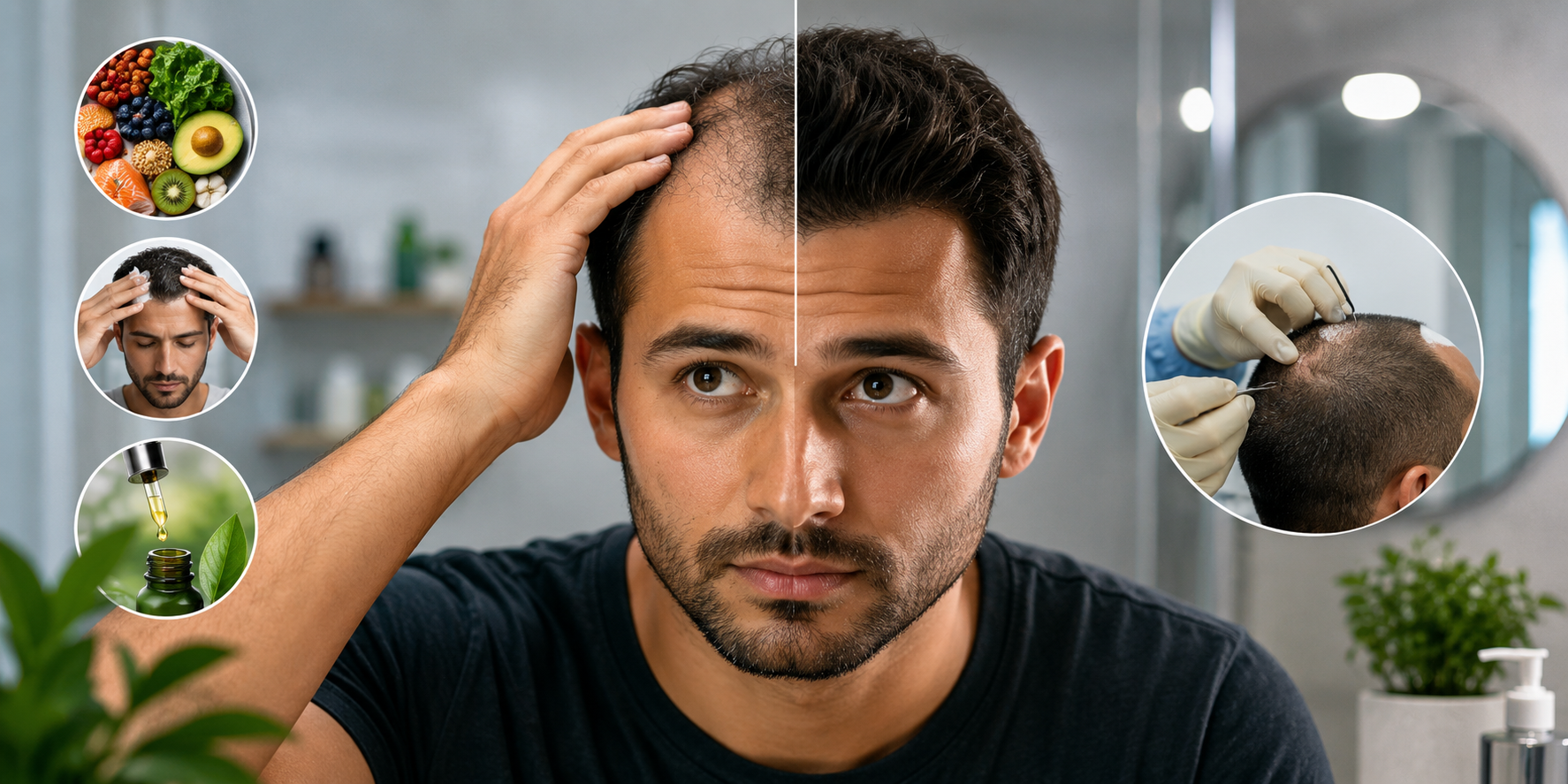
Learn when hair loss can regrow naturally, how PRP and FUE work, and when hair, beard, eyebrow, or female hair transplantation may be considered for you today.
Learn when hair loss can regrow naturally, how PRP and FUE work, and when hair, beard, eyebrow, or female hair transplantation may be considered for you today.
Losing hair is one of the most frequent issues that trouble both males and females. Discovering more hair on your pillows, in your bathrooms, or in your brushes may be a cause of concern, especially when one’s hairline has started receding or bald spots have appeared. Perhaps the most widely asked question is “Is it true that my hair may grow back naturally without having to have any type of surgery?
It can sometimes be true. In case temporary hair loss is solely due to nutrition, hormones, inflammation or lifestyle, hair may regenerate by itself or can be treated. However, if the hair follicle is destroyed or lost, the non-invasive treatment will not help.
It is in this case when a hair transplant may become a good option. Modern technologies and methods, such as FUE, allow people to move healthy follicles from the donor site to places with permanent hair loss.
The regrowth of hair is determined by the cause of hair loss as well as whether or not hair roots are still able. When the hair follicles perform well and eject their purpose into the bald areas, it is possible that hair can be restored after solving the problem of hair loss. In case when temporary hair loss is caused by depression, illness, poor nutrition, or hormonal changes, regrowth will happen without delays.
On the contrary, long-duration baldness in a male or female case may lead to gradual death of hair roots. Over some time certain roots will lose their ability to grow61. Simply changing food consumption of using hair products would not solve the issue. Therefore the very first step is defining the reason for hair loss.
There are various causes of hair loss, some of which include the following:
- Genetic hair loss
- Male baldness
- Female baldness
- Lack of proper nutrients
- Hormonal changes
- Thyroid disorder
- Psychological stress
- Drugs
- Disease on the scalp
- Drastic weight loss
- Poor diet
- Hair abuse
- Thinning of hair due to aging
Consultation with an expert can determine if the hair follicles can still create new healthy hair.
Not all individuals who have experienced hair loss require transplants. If the follicles are still active, there are medical and non-surgical methods available to promote hair growth and prevent hair loss.
1. Improved nutrition
There are many essential nutrients necessary for healthier hair growth, including protein, iron, vitamin D, and zinc.
Keep in mind that dietary supplements should only be taken under the recommendation of your doctor who may want you to undergo tests to rule out nutrient deficiency.
Extreme psychological or physical stress causes stress. One can overcome the effects of stress with the help of improvements in quality of sleep, regular exercise, creating a proper routine, and managing stress.
Particular medical conditions may result in hair loss. The treatment of the underlying problem will restore the functioning of the follicles.
For instance, in case of hair loss due to nutritional deficiency or hormonal imbalance, correcting the deficiency is a good idea.
A doctor may suggest different options of treatment according to a given diagnosis in order to slow down the process
One more non-invasive method is accessible for the selected patients in Delhi as PRP therapy.
PRP means Platelet Rich Plasma. PRP involves taking a small blood sample from the patient which is separated to extract both platelet and growth factors having concentrated amounts. This plasma is then injected into the area of the scalp needing treatment.
PRP is mainly used to maintain existing but not fully functioning hair follicles rather than to replace the follicles that were already lost completely. Results of the treatment may vary from person to person, and PRP is more suitable when hair follicles still remain capable of producing thinner or weak hair.
A consultation with a doctor is necessary to check whether the PRP procedure is appropriate for your type of hair loss.
In the case of irreversible loss of hair and availability of donor hair enough to perform the procedure, hair transplant can be carried out. Moreover, it is worth noting that hair transplantation does not stimulate the production of new hair follicles. Instead, it takes healthy hair follicles from donor areas, like the side or back of the head, and places them in the affected area, suffering baldness.
If the patient suffers from baldness, receding hairline, etc., they can benefit from hair transplant because it usually restores the hair better than non-surgical treatments.
FUE Hair Transplant In Delhi is a trending modern hair restoration method. FUE means Follicular Unit Extraction. In this technique, follicular units are extracted and implanted into the area where hair loss occurs.
The process entails 3 important steps:
The doctor evaluates the pattern of hair loss, donor density, scalp condition, existing hair, and expected future hair loss.
The hairline is then planned according to facial proportions and the patient's goals.
Specialized tools are employed to extract individual follicular units from the donor site.
It is crucial to create an extraction pattern that enables a natural look in the donor's area.
At this point, the follicles are prepared and implanted in the recipient area.
The way the grafts are distributed, along with their direction and angle, is essential in achieving a natural look.
As different patients' hair characteristics differ, the number of grafts needed varies from person to person.
Hair transplantation is viewed as a hair recovery method that is effective in the long term because the follicles for the transplant are harvested from the areas that are usually more resistant to miniaturization due to androgens.
This, however, does not imply that the natural hair of the scalp will remain intact for good.
A person may continue to lose hair in the parts of their head that have not been treated.
That is why diagnosis, proper planning, and hair loss treatment are of utmost importance.
A doctor may recommend that the patient combines the transplant with medical or non-surgical procedures, depending on the condition of the person in question.
There are several reasons why women can suffer from hair loss, and the treatment will be based on the cause.
Some of them will shed their hair temporarily and revert back to normal once the trigger for the condition is dealt with. While some women may face female pattern hair loss that is progressive.
Women with permanent hair loss and donor hair follicles may benefit from a female hair transplant in Delhi.
The process of female hair restoration is complicated as there is a possibility of seeing diffuse thinning instead of a bald area. The doctor must check your donor density, miniaturization of hair strands, the state of scalp, and the reason for hair loss before suggesting surgery.
Every woman will not undergo a transplant right after diagnosis.
A receding hairline might improve if the hair follicles are still working and can be treated.
If the hair follicles were previously very small or are dead now, natural hair regrowth might not be possible.
That’s why it is wise for people looking for Hairline Transplant Clinic in Delhi to make their choice of treatment after a thorough professional evaluation instead of relying only on advertising.
The planning process has to be very careful when it comes to hairline transplantation. The frontal hairline is one of the most prominent areas, hence, the implantation has to take into account:
- The facial shape
- The patient’s age
- The position of the existing hairline
- The availability of donor hair
- The density of the hair
- The natural hair growth direction
- The possible pattern of hair loss in the future
When defining what natural hairline looks like, it is important to strike a balance between the hair line and the model/s face aesthetics.
Can Beard Hair Grow Back Without a Beard Transplant?
The process of growing a beard is dependent on each individual genetics as well as factors such as age, hormones and more. This also applies to uneven beard growth, where the cause may not allow for the growth of new beard hair in areas without the hair follicles present. For individuals who qualify for the procedure, hair transplant surgeons in Delhi are known for their ability to remedy this problem through hair follicle transplanting to the areas of the beard where hair is sparse.
In addition to being hair transplant specialists, the surgeons involved in beard hair transplants need to be skilled in this area. Since facial hair growth is different from the growth of hair on the head, the angling and movements of the hairs have to be in accordance with the normal pattern of facial hair.
What About Eyebrow Hair Loss?
Eyebrows are essential, and that’s why thinning out your brows is considered a disaster. People endure over-plucking, accidents, diseases, and heredity, which result in thinning eyebrows.
If your eyebrow follicles remain alive and functional, then in some cases, it is possible to treat the underlying cause of eyebrow thinning.Yet, if the hair roots are dead, you will be left no choice but to perform an eyebrow transplant.
In case you want to have eyebrow transplant done, you should consult an experienced hair restoration specialist who will advise you whether this procedure is suitable for you.
Both approaches have a role in hair restoration, but they work differently.
Hair Restoration Approach | Main Purpose |
Nutrition | Supports normal hair growth |
Medical treatment | May slow hair loss or support existing follicles |
PRP | May support weakened existing follicles |
Hair transplant | Repositions healthy follicles into areas of permanent hair loss |
Beard transplant | Restores missing or sparse beard areas |
Eyebrow transplant | Restores selected areas of eyebrow loss |
The right choice depends on the diagnosis.
For some patients, non-surgical treatment may be enough. For others, a transplant may provide a more effective way to restore lost density.
PRP and hair transplantation are not direct substitutes.
PRP works to nourish existing follicles, while hair transplantation actually moves the follicles to areas of the head where permanent hair loss has occurred.
For instance, if someone has mild thinning of the hair with many miniaturized follicles, PRP may still be one of the options for treatment.
If the person has an area of baldness where the follicles do not produce hair anymore, PRP cannot provide a new supply of follicles. The transplant will be considered if the patient meets the requirements.
In some treatment plans, PRP and hair transplant may be used together.
Talking to a professional is the proper course of action to help you decide if you should go through with a transplant or not.
When assessing the level of baldness, hair restoration services evaluate:
- Characteristics and extent of balding
- Status of scalp
- Density of hair available for donation
- Thickness of hair follicles
- Presence of miniaturized hair
- Family history
- Treatments taken in the past
- Expected degree of baldness in future
- Goals of treatment
As a next step, the doctor may suggest a non-invasive treatment option, hair transplant, or a mix of both.
Recovery times may differ among patients, but in general, patients should follow specific aftercare guidelines.
Initially, a hair transplant patient’s follicles need time to heal and adjust. It is also commonplace for the hair strands to shed after the transplant, a phenomenon that is known as “shock loss.”
The return of hair does not occur immediately. Since hair follicles undergo particular phases in order to grow, a patient does not typically see results right away.
However, the timing for the results may vary.
Non-surgical treatment or hair transplant is not enough for hair restoration if you are not taking care of your scalp and hair as a whole. Some good habits may include the following:
- Follow the treatment that your doctor has recommended.
- Make sure that you eat good and nutritious food.
- Do not use chemicals on your hair unless absolutely necessary.
- Protect your scalp from direct sunlight.
- Observe the instructions given after the hair transplant.
- Never miss any follow up appointments.
- Never self-prescribe medications.
- Do not ignore hair loss!
Yes, certain forms of hair loss can have resolution if the reason is temporary or treatable. Nevertheless, permanent loss of hair follicles cannot be resolved through diet or regular hair products. .
No. Medical procedure, lifestyle changes, PRP and other procedure is often considered regarding the cause and degree of hair loss. Hair restoration procedure is mainly for parts of the head with permanent losses of hair.
No. Fitness is checked on the basis of factors, such as hair donor possibilities, hair loss type, scalp, and overall condition of a patient. You need to consult a health professional.
Yes. Women, having appropriate donor hairs and having certain types of permanent hair loss problems, can be candidates. A Female Hair Transplant in Delhi has to be discussed with the cause of the problem identified first.
PRP is aimed at supporting already existing or weakened hair follicles. It is not a method of generating new hair follicles in bald areas.
This depends on whether hair follicles can still operate. Sometimes, processes of the early stage of thinning can be treated quietly through appropriate treatment, while the case of obvious and severe loss of hair follicles might require hair transplantation.
The grafted hair follicles usually serve in the purpose of providing hair growth for a longer time; however, it may not be the same for everyone. In order to achieve optimum results, proper patient selection and placement are required. .
The hair grows instantaneously; however, it may shed earlier than its new growth starts. Hence, gradual progress will be noticed during the period until the desired result is achieved.
Modern surgeries are usually done under local anesthesia; however, there can be some discomfort and irritation after the procedure has been performed.
Not always. The sequence will depend on the type of hair loss and why it has started. A doctor has to be consulted about the hair loss to know whether medical treatment, PRP, hair implants, or a combination of method
Is it possible for hair to regrow naturally without hair transplantation? The answer is sometimes, but it depends on the issue leading to hair loss.
If hair loss is due to reasons like stress, diet changes, illness, etc., temporary shedding may be treated by addressing it. Medications like PRP may also aid patients who still have hair follicles.
However, in cases when hair loss leads to baldness and the hair follicles are completely gone, natural treatments won’t help. In that case, transplant surgery is a viable option.
Regardless of whether you are interested in Female Hair Transplantation in Delhi, FUE Hair Transplant in Delhi, Beard Transplant in Delhi, Eyebrow Transplant, or Hair Transplant Clinic, obtain an accurate diagnosis first.
If you are looking for professional consultations and treatment for hair loss, Ryan Turkey Hair Transplant Expertise now has its representative offices in India, including Mumbai, Delhi, Hyderabad, and Noida.
Book Your Free Consult Now!