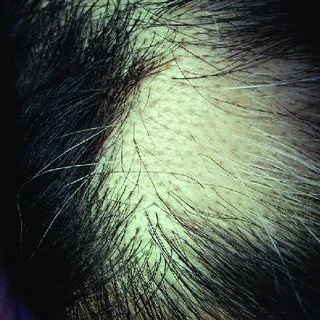
This is autoimmune, not permanent. Around half of limited patches regrow within a year — here's how to tell it apart from pattern baldness, and what actually helps.
This is autoimmune, not permanent. Around half of limited patches regrow within a year — here's how to tell it apart from pattern baldness, and what actually helps.
Alopecia areata is an autoimmune condition, not permanent baldness. The follicle is usually alive and can regrow — around half of people with limited patchy disease regrow within a year, sometimes without treatment. A transplant does not address the immune attack, and transplanted follicles can be attacked in exactly the same way. The right first step is a dermatologist, not a surgeon.
Key points :
Alopecia areata causes sharply defined round or oval patches, often appearing over days or weeks
The follicle survives — this is why regrowth is possible and why the condition is not “permanent”
Transplanted hair carries the same target the immune system is attacking, so grafts can be lost
The donor area is not automatically safe; some patterns affect the back of the scalp specifically
Treatments exist and work for many people: steroid injections, topical immunotherapy, and newer prescription drugs
If you have round bald patches rather than a receding hairline, you need a dermatologist first.
Alopecia areata is an autoimmune condition. The immune system mistakenly targets hair follicles in their growth phase, and those follicles shut down and shed. It affects roughly 2% of people at some point in life, often beginning in childhood or early adulthood, and it affects men and women about equally.
The crucial detail — the one that changes everything about treatment — is that the follicle is not destroyed. Alopecia areata is a non-scarring alopecia. The structure remains under the skin, dormant rather than dead. That is why hair can return months or years later, and why the first goal is always to calm the immune attack rather than to replace the hair.
Contrast this with androgenetic alopecia, where follicles progressively miniaturise until they no longer produce visible hair, and with scarring alopecias, where the follicle is genuinely destroyed and replaced by fibrous tissue. Three different diseases, three completely different answers.
Alopecia areata | Pattern baldness | Diffuse shedding (telogen effluvium) | |
|---|---|---|---|
Shape | Sharply defined round or oval patches | Receding temples, thinning crown | Thinner all over |
Edges | Distinct, smooth, clearly bordered | Gradual, no border | No border |
Onset | Days to weeks | Years | Weeks, usually after an illness or stress |
Skin in the patch | Smooth and normal, no scaling or scarring | Normal | Normal |
Where | Anywhere — scalp, beard, eyebrows, lashes, body | Top and front of scalp only | Whole scalp |
Classic clue | Short broken hairs at the patch edge, tapering near the scalp | Progressive miniaturisation | Heavy shedding on the pillow and in the shower |
Nails | Pitting or ridging in some patients | Normal | Normal |
Right first step | Dermatologist | Surgeon or dermatologist | Find the trigger, treat the cause |
The simplest version: a clear round patch with normal-looking skin is not male pattern baldness. Pattern loss does not create sharp edges. If you can trace the border of the bald area with a finger, that is the shape of an autoimmune process, not an inherited one.
Diagnosis is confirmed by a dermatologist using dermoscopy, which shows characteristic features within the patch, and occasionally a small biopsy where the picture is unclear.
Five reasons, in order of importance.
1. The follicle is alive, so you would be replacing hair that may return by itself. Around half of people with limited patchy disease see regrowth within twelve months. Transplanting into that patch spends permanent, finite grafts on an area that had a genuine chance of recovering without surgery.
2. Transplanted follicles carry the same target. The immune system is attacking a structure, not a location. Move hair from the back of your head into an affected area and it presents the immune system with exactly what it has been reacting to. Grafts can be lost in the same way the original hair was.
3. The disease is unpredictable. Alopecia areata relapses. Someone stable for three years can develop new patches, and there is no test that reliably predicts who. Surgery makes a permanent commitment against an unpredictable disease.
4. Your donor area may not be safe. Alopecia areata can occur anywhere hair grows, including the back and sides of the scalp. One pattern, called ophiasis, specifically affects a band around the lower back and sides of the head — precisely the zone a surgeon harvests from. Taking grafts from an area the disease favours is not a stable foundation.
5. Trauma is not always neutral. In some patients, skin injury appears to provoke new activity. Surgery is thousands of small injuries.
None of this means a person with alopecia areata can never have surgery for anything. It means that for the active disease itself, surgery is the wrong tool.
This is a dermatological condition with real treatments, and treatment decisions belong with a dermatologist who can see your scalp. In broad terms:
Watchful waiting. Reasonable for limited, recent patches, given the rate of spontaneous regrowth. Not a fobbing-off; a legitimate option.
Intralesional corticosteroid injections. The usual first-line approach for a small number of patches, given directly into the affected area at intervals over some months.
Topical corticosteroids and topical minoxidil. Often used alongside other treatment. Minoxidil alone does not treat the immune process — it supports regrowth once the attack settles, which is why months of self-treatment with it frequently disappoints.
Topical immunotherapy (contact sensitisers such as DPCP), used in specialist centres for extensive disease.
Short courses of systemic steroids, in selected cases, with the limitations and side effects that implies.
JAK inhibitors. A newer class of prescription medicines used for severe alopecia areata. They are specialist-supervised, require monitoring and are not suitable for everyone. If your disease is extensive, this is a conversation worth having with a dermatologist rather than reading about online.
Intralesional steroid injections work well for limited disease, and they are the treatment most Indian patients will be offered first. What is less often explained is that repeated injections into the same area can cause a visible dent — localised thinning of the skin and fat underneath. It usually recovers over months once injections stop, but it can be alarming if nobody warned you.
This is not a reason to refuse the treatment. It is a reason to ask your dermatologist how many sessions are planned, at what interval, and to mention it promptly if you notice a depression forming. Spaced, measured dosing is how it is avoided.
Alopecia areata keeps company with other autoimmune conditions, and a reasonable workup usually includes:
Thyroid function and anti-TPO antibodies — autoimmune thyroid disease is the most common association
Ferritin, vitamin D and vitamin B12 — deficiency does not cause alopecia areata but can worsen shedding alongside it
Blood sugar, particularly with a family history of type 1 diabetes
A look at the nails — pitting or ridging supports the diagnosis and can indicate more active disease
Screening questions for vitiligo, coeliac disease and atopic conditions such as eczema and asthma
If your thyroid is also involved, the hair picture can be mixed — an autoimmune patch alongside diffuse thyroid-related shedding. Both need treating, and neither needs surgery.
Rarely, and it remains debated among surgeons. Some decline it outright. Where it is considered at all, the bar is high:
Disease burnt out and completely stable for several years — five is the figure commonly used — with no new patches
A single, fixed, long-standing area rather than shifting or multiple patches
A dermatologist’s written agreement that the disease is quiescent
A donor area free of any history of involvement
Explicit acceptance by the patient that grafts may still be lost if the disease reactivates, and that the grafts cannot be recovered
Even then it is a considered risk rather than a routine procedure. A clinic that offers you Sapphire FUE for active or recent alopecia areata without any of the above is not managing the condition — it is selling a surgery.
A separate point worth knowing: eyebrow loss from alopecia areata is sometimes addressed with microblading or semi-permanent pigmentation rather than grafting. It costs no donor hair, it is reversible, and it can be redone if the disease changes.
Alopecia areata is harder than its medical description suggests. It arrives suddenly, it is visible, it is unpredictable, and it often affects people young. Losing eyebrows or eyelashes changes a face in a way that is difficult to explain to people who have not experienced it. None of that is vanity.
A few things worth saying:
The uncertainty is often worse than the hair loss. Not knowing whether it will spread, or return, is the part most people find hardest. A dermatologist who explains your particular pattern and prognosis helps more than any amount of searching.
Cosmetic options are legitimate. Wigs and hair systems, eyebrow microblading, scalp micropigmentation, and simply changing a haircut are all reasonable responses and cost you nothing permanent.
Patient groups exist, and many people find them more useful than clinical information — practical advice, and the ordinary relief of talking to someone who has the same thing.
If this is affecting your mood, sleep, work or how you feel about going out, that is worth raising with a doctor alongside the hair. It is a common and reasonable response to a visible condition, and support for it exists.
If you arrive with round, sharply defined patches, we will tell you that you need a dermatologist and not a surgeon, and we will say so at the first appointment rather than after a deposit. Every assessment at Ryan Clinic is carried out by the doctors, and distinguishing autoimmune from androgenetic hair loss is the first thing that examination is for.
[CONFIRM AND ADD: whether you have a dermatologist on the team or a named referral pathway for alopecia areata — and who; whether you perform dermoscopy at the first consultation; your policy on patients presenting with patchy loss; whether you offer eyebrow microblading or SMP as non-surgical options; your stability requirement if you consider surgery for burnt-out disease at all, or whether you decline it outright.]
Consultations are available at our Delhi, Mumbai and Hyderabad centres.
Book a free scalp analysis — if what you have is not surgical, we will tell you, and point you to who can help.
Sources :
Indian Association of Dermatologists, Venereologists and Leprologists (IADVL) — treatment guidelines for alopecia areata.
Indian Journal of Dermatology / International Journal of Trichology — epidemiology, dermoscopic features, prognosis and associations of alopecia areata in Indian patients.
British Association of Dermatologists — guidelines for the management of alopecia areata.
National Alopecia Areata Foundation — patient information on disease course, variants and treatment options.
Published literature on intralesional corticosteroid therapy and localised cutaneous atrophy.
International Society of Hair Restoration Surgery (ISHRS) — contraindications to hair restoration surgery.
About the author Dr. Pranendra Singh is a hair restoration surgeon at Ryan Clinic, Delhi, specialising in Sapphire FUE. Read full profile →
Medical disclaimer: This article is general information and does not replace medical advice. Alopecia areata requires diagnosis and treatment by a qualified dermatologist, and treatment choices — including prescription medicines — must be made with a doctor who has examined you. Do not start, stop or change any treatment on the basis of this article.
Book Your Free Consult Now!