Real 2026 pricing, explained — per-graft rates by clinic tier, exact coverage area, GST, donor limits and EMI options, so you know what you're actually paying for.
Real 2026 pricing, explained — per-graft rates by clinic tier, exact coverage area, GST, donor limits and EMI options, so you know what you're actually paying for.
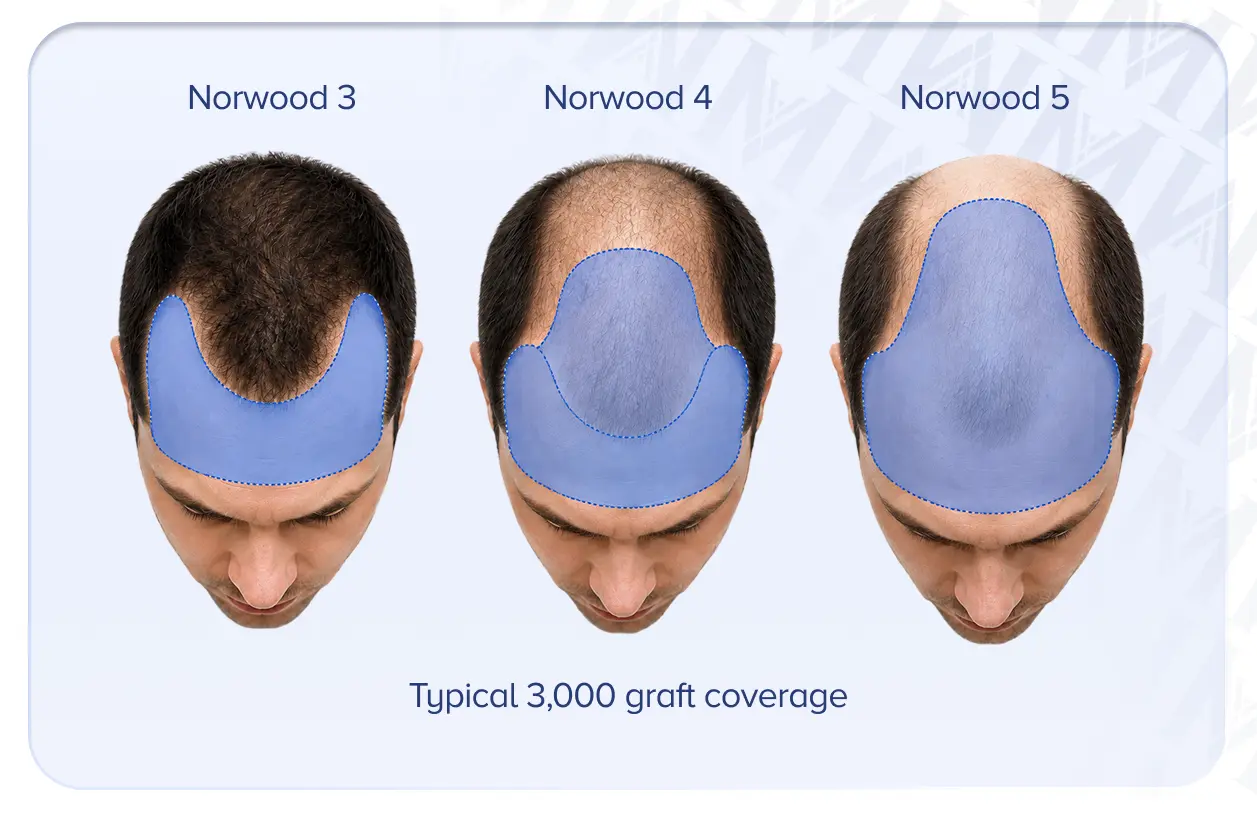
A 3000 graft hair transplant in Delhi costs ₹60,000 to ₹4,50,000 before tax, because per-graft rates run from ₹20 to ₹150. A doctor-led Sapphire FUE at ₹55–₹80 per graft works out to ₹1,65,000–₹2,40,000 before 18% GST, or roughly ₹1.95–₹2.85 lakh all in. 3000 grafts covers about 75 cm² — front and partial crown.
Key points :
At ₹65 per graft, 3000 grafts is ₹1,95,000 plus ₹35,100 GST — a real bill of about ₹2,34,900
Many Delhi clinics use slab rates above 2,500 grafts, so ask for the per-graft price at 3000, not the headline rate
3000 grafts implanted at 40 per cm² covers roughly 75 cm² — frontal zone plus mid-scalp, or front plus a partial crown
In Indian hair, 3000 grafts is about 6,000–6,600 hairs
3000 grafts suits Norwood 4 and Norwood 3 Vertex; Norwood 5 and above usually needs 3,500–4,500
It is a single long session of 8–10 hours, and it spends roughly half a typical lifetime donor supply
Between ₹60,000 and ₹4,50,000 before GST. The spread is not vagueness — it is the real Delhi market, and it exists because per-graft rates differ by a factor of seven depending on who performs the surgery.
Clinic tier | Per-graft rate | 3000 grafts (ex-GST) | With 18% GST | Who actually operates |
|---|---|---|---|---|
Budget / high-volume chain | ₹20–₹30 | ₹60,000–₹90,000 | ₹70,800–₹1,06,200 | Technicians, surgeon supervises or visits |
Mid-market clinic | ₹35–₹50 | ₹1,05,000–₹1,50,000 | ₹1,23,900–₹1,77,000 | Mixed: doctor plans, technicians extract and implant |
Doctor-led Sapphire FUE | ₹55–₹80 | ₹1,65,000–₹2,40,000 | ₹1,94,700–₹2,83,200 | Surgeon performs extraction and implantation |
Premium / named surgeon | ₹90–₹150 | ₹2,70,000–₹4,50,000 | ₹3,18,600–₹5,31,000 | Senior surgeon, smaller daily case load |
These are the same rates as our 2000-graft guide, because the rate does not change with the count — the bill does. What changes at 3000 is that the gap between tiers becomes enormous in rupee terms: the difference between ₹30 and ₹65 per graft is ₹1,05,000 on this surgery, against ₹70,000 at 2000 grafts. At this size, the choice of clinic tier is the single largest number in your decision.
Most Delhi clinics reduce the per-graft rate once you cross about 2,500 grafts — often by ₹5–₹15. A clinic advertising ₹70 per graft may charge ₹60 at 3000. That is a genuine ₹30,000 saving, and it is also why you should never compare two clinics on their advertised headline rate. Ask both: “What is your per-graft price at exactly 3000 grafts, including GST?”
A worked example at a doctor-led Delhi clinic charging ₹65 per graft for Sapphire FUE:
Line item | Amount |
|---|---|
3000 grafts at ₹65 | ₹1,95,000 |
18% GST on the procedure | ₹35,100 |
Pre-surgery blood tests | ₹1,800 |
Medication, 3–4 weeks | ₹3,000 |
Follow-up consultations (usually included) | ₹0 |
Realistic total | ₹2,34,900 |
Optional: 2 PRP sessions at ₹8,000 | +₹18,880 with GST |
Round figure: about ₹2.3 to ₹2.4 lakh, all in, at a doctor-led Delhi clinic.
What the per-graft rate does not include, at any clinic: GST, blood tests, take-home medication, PRP or GFC sessions, a no-shave surcharge if you need one, and any grafts extracted beyond the planned count. That last item is worth ₹65 each plus tax — at 3000 grafts, a 400-graft overrun is ₹30,680. Fix the maximum in writing before surgery day.
About 75 cm² — roughly the area of a large smartphone screen, laid flat on the scalp.
Indian surgeons typically implant at 35–45 grafts per cm². At 40 grafts per cm², 3000 grafts covers 75 cm². That is enough for the frontal zone plus the mid-scalp behind it, or the frontal zone plus a partial crown at reduced density.
In hairs rather than grafts: Indian follicular units average about 2.0–2.2 hairs each, so 3000 grafts delivers roughly 6,000 to 6,600 hairs. A clinic advertising “6,000 hairs” is describing this surgery, not a 6,000-graft one.
Goal | Realistic with 3000 grafts? |
|---|---|
Hairline, temples and frontal third at strong density | Yes, with grafts to spare |
Frontal zone plus full mid-scalp | Yes |
Frontal zone plus partial crown coverage | Yes, at moderate density |
Front and a fully dense crown together | Usually not in one session |
Full coverage from Norwood 5 | Partial only — expect a second session |
Full coverage from Norwood 6–7 | No |
It depends on your Norwood stage and your donor supply, not your budget.
Norwood stage | Typical grafts needed | Is 3000 enough? |
|---|---|---|
Norwood 2 | 800–1,500 | Far more than needed |
Norwood 3 | 1,500–2,200 | More than needed |
Norwood 3 Vertex | 2,000–2,800 | Yes, comfortably |
Norwood 4 | 2,500–3,500 | Usually yes — this is the classic 3000-graft case |
Norwood 5 | 3,500–4,500 | Partial. Front first, crown later |
Norwood 6–7 | 4,500–7,000+ | No — plan two sessions |
3000 is the most commonly quoted number in Delhi for Norwood 4, which is also the stage at which most men finally book. If a clinic quotes you 3000 grafts without measuring donor density in hairs per cm², the number came from a price list, not an examination.
Want a figure to plan around before you visit? Our free graft calculator gives an estimate in about a minute.
This is the question almost no price page answers, and at 3000 grafts it matters more than the money.
Your donor area — the permanent zone at the back and sides — holds a finite lifetime supply. For most Indian patients that is 5,000 to 7,000 grafts safely harvestable across an entire lifetime, and less if donor density is below about 65 hairs per cm². Harvesting beyond that leaves the donor visibly thin, and it cannot be reversed.
So a 3000-graft session spends roughly half your lifetime budget in one day.
That is not an argument against it. It is an argument for three things:
Know the number before you spend it. Ask for your measured donor density and your estimated lifetime capacity in writing.
Plan for the hair you have not lost yet. Hair loss continues after surgery. If you are 32 at Norwood 4, you may be Norwood 5 at 45 and want grafts then. Spending everything now means no reserve.
Take medication seriously. Finasteride and minoxidil protect native hair. Every hair they save is a graft you do not have to spend.
A surgeon who books 3000 grafts without discussing your remaining donor capacity is selling a procedure, not planning a head of hair. Every surgery at Ryan Clinic is planned and performed by the doctors, and that conversation happens before any quote is issued.
At a doctor-led ₹65 per graft, including 18% GST:
Grafts | Ex-GST | With GST | Coverage | Typical use |
|---|---|---|---|---|
2000 | ₹1,30,000 | ₹1,53,400 | ~50 cm² | Hairline and frontal third, Norwood 3 |
2500 | ₹1,62,500 | ₹1,91,750 | ~62 cm² | Frontal zone with mid-scalp blending |
3000 | ₹1,95,000 | ₹2,30,100 | ~75 cm² | Norwood 4, front plus partial crown |
3500 | ₹2,27,500 | ₹2,68,450 | ~87 cm² | Norwood 4–5, front and mid-scalp fully |
4000 | ₹2,60,000 | ₹3,06,800 | ~100 cm² | Norwood 5, usually with a slab discount |
Applied at a slab rate of ₹60 above 2,500 grafts, the 3000-graft figure drops to ₹1,80,000 ex-GST, or ₹2,12,400 with tax. Ask which applies to you.
Somewhat — and at this bill size the gap is real money, though rarely enough to justify travelling for it alone.
City | Doctor-led rate per graft | 3000 grafts with GST |
|---|---|---|
Delhi NCR | ₹55–₹80 | ₹1,94,700–₹2,83,200 |
Mumbai | ₹60–₹90 | ₹2,12,400–₹3,18,600 |
Hyderabad | ₹45–₹70 | ₹1,59,300–₹2,47,800 |
Turkey (package) | — | ₹2,10,000–₹3,50,000 plus flights and hotel |
Hyderabad is typically the cheapest of the three Indian metros, Mumbai the most expensive, tracking rent and salary costs rather than surgical quality. Turkish packages often advertise “unlimited grafts”, which sounds generous at 3000 and is the opposite of donor-area discipline — and almost all of them are technician-performed. Ryan Clinic operates in Delhi, Mumbai and Hyderabad at the same protocol in each city.
On a ₹2,30,000 bill under a genuine no-cost EMI:
Tenure | Monthly instalment | Extra you actually pay |
|---|---|---|
6 months | ₹38,350 | about ₹2,340 |
12 months | ₹19,200 | about ₹3,770 |
The “extra” is 18% GST on the bank’s interest plus a processing fee. No-cost EMI is not free — it is a loan whose interest is offset by a clinic discount, and on a credit card the GST on that interest is still yours to pay. At this bill size, check one more thing: your credit limit. The full ₹2,30,000 is blocked against your card from day one and released only as you repay, so a ₹2,00,000 limit will not take it.
And always ask: is the price the same if I pay upfront? A 5% cash discount on ₹2,30,000 is ₹11,500 — three times what the EMI costs you.
Yes, usually — as a single day of roughly 8 to 10 hours under local anaesthesia, with breaks for food and rest.
It is a long day. Extraction runs for the first half, graft sorting and implantation the second. Some clinics split counts above 3,500 across two consecutive days; at 3000 that is uncommon but not unreasonable if you tire easily or have a medical reason to avoid a long sitting.
Ask how many surgeries the clinic schedules that day. If yours is one of five running simultaneously, the surgeon is not performing all of them.
At ₹20 per graft, 3000 grafts is ₹60,000. It is the most tempting number in the market and the most common route into a repair case.
Volume clinics run on technicians. Extraction and implantation decide graft survival; handing both to a non-surgeon is where transection rates climb — and at 3000 grafts, a 20% transection loss is 600 follicles destroyed permanently.
Donor damage scales with count. Over-harvesting at 3000 grafts does far more visible, permanent damage than at 1,500.
Density is quietly reduced. Spreading 3000 grafts over 110 cm² instead of 75 cm² looks like coverage in a photograph and like thinning in daylight.
Repair costs more than the original. Correcting a pluggy hairline or a moth-eaten donor area typically costs 1.5 to 2 times the first surgery — and donor damage often cannot be undone at all.
A ₹60,000 surgery that burns 3,000 irreplaceable grafts was never the cheap option.
You are under 25 with actively progressing loss. At Norwood 4 by 24, the pattern is not finished. Spending 3000 grafts now can strand a transplanted island in ten years.
You have not tried medication for at least 6–12 months. Surgery moves hair; it does not stop hair loss elsewhere on the scalp.
Your donor density is low. Below about 60 hairs per cm², a 3000-graft harvest risks a visibly thin donor zone.
Your loss is diffuse rather than patterned. Diffuse unpatterned alopecia, alopecia areata and telogen effluvium need diagnosis, not grafts.
A clinic willing to tell you to wait is worth more than one willing to book you tomorrow.
3000 graft cost at Ryan Clinic
Ryan Clinic performs 3000-graft Sapphire FUE as a doctor-performed procedure in Delhi, Mumbai and Hyderabad.
[CONFIRM AND ADD: your per-graft rate at 3000 grafts and whether a slab rate applies above 2,500; whether the quoted price is inclusive or exclusive of 18% GST; what is included (tests, medication, follow-ups, PRP); your policy on graft overrun and the maximum added without written consent; whether 3000 is performed in one day or two; no-shave surcharge if any.]
Every quote is issued in writing after a free scalp analysis that measures donor density, estimates lifetime donor capacity and maps the recipient area — never from a photograph. Full pricing is on our hair transplant cost page, and no-cost EMI is available through HDFC, ICICI and Axis Bank on 6- and 12-month plans.
Book a free scalp analysis to get your actual graft count and a written all-inclusive figure.
Between ₹60,000 and ₹4,50,000 before GST, because per-graft rates in Delhi run from ₹20 to ₹150. A doctor-led Sapphire FUE at ₹55–₹80 per graft costs ₹1,65,000–₹2,40,000 before tax, or roughly ₹1.95–₹2.85 lakh with 18% GST.
For Norwood 3 Vertex and most Norwood 4 patients, yes. 3000 grafts covers about 75 cm² — the frontal zone plus mid-scalp, or front plus a partial crown. Norwood 5 and above usually needs 3,500 to 4,500 grafts.
About 75 cm², at a standard implantation density of 40 grafts per cm². Spreading the same 3000 grafts over 110 cm² to claim wider coverage produces visible thinness once the hair grows in.
Roughly 6,000 to 6,600. Indian follicular units usually contain two hairs, sometimes three. A clinic advertising “6,000 hairs” is describing about 3000 grafts, not 6,000 grafts.
Yes, normally — a single day of about 8 to 10 hours under local anaesthesia. Counts above roughly 3,500 grafts are the ones more often split across two consecutive days.
On a ₹2,30,000 bill, no-cost EMI works out to about ₹38,350 a month over 6 months or ₹19,200 a month over 12 months, plus roughly ₹2,300–₹3,800 in GST on interest and processing fees. Your credit limit must exceed the full amount.
It uses roughly half of it. Most Indian patients can safely give 5,000 to 7,000 grafts across a lifetime. A 3000-graft session leaves a reserve for future loss, but not a large one — which is why medication to protect native hair matters after surgery.
Per graft, often yes, because many Delhi clinics apply a lower slab rate above 2,500 grafts. But grafts are not a bulk purchase — taking more than your recipient area needs permanently spends donor hair you may want in ten years.
For more on planning and paying for a hair transplant, browse our more cost guides.
Sources :
International Society of Hair Restoration Surgery (ISHRS). Practice Census — session sizes, implantation density and graft-count norms.
Indian Journal of Dermatology / Journal of Cutaneous and Aesthetic Surgery — follicular unit hair counts and donor density in Indian patients.
Published literature on safe donor area and lifetime harvestable graft estimates in androgenetic alopecia.
CBIC. GST rate schedule for services — cosmetic and plastic surgery taxable at 18%; exemption applies only to reconstructive surgery for congenital defects, trauma or disease.
Reserve Bank of India. Circular RBI/2013-14/292, 17 September 2013 — zero-percent EMI schemes.
Delhi NCR market rates observed across published clinic price pages and Ryan Clinic quotations, 2026. Recheck quarterly.
About the author Dr. Pranendra Singh is a hair restoration surgeon at Ryan Clinic, Delhi, specialising in Sapphire FUE. Read full profile →
Disclaimer: This article is general information, not medical or financial advice. Prices, tax rates and EMI terms change; confirm current figures with the clinic and your bank. Your graft requirement and safe donor capacity can only be determined by a qualified surgeon after an in-person scalp examination.
Book Your Free Consult Now!